
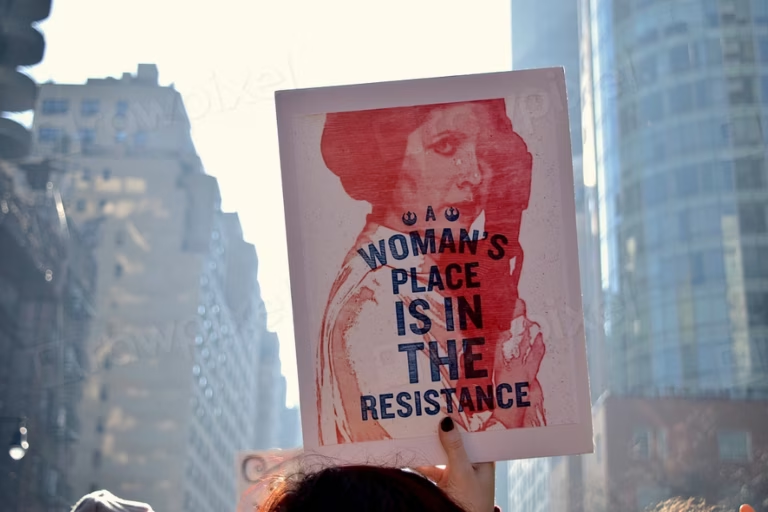
Women's Strikes
Explore the history of women's strikes and their impact on gender equality. Discover how iconic events like Iceland's 1975 strike inspire global social change.
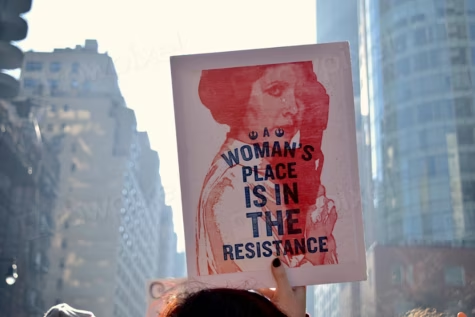
➡️ HISTORY OF WOMEN'S STRIKES – Fighting Against Gender Inequality & For Social Change
The iconic women's strike in Iceland in 1975 paved the way for other women's strikes around the world in the fight for gender equality. Unlike traditional Women's Day protests or marches, strikes entail a deliberate stoppage of work as a form of political protest.
Strikes highlight the role that women play in society and in the workplace and demonstrate what the world would look like if women simply gathered in the streets instead. Strikes usually demand fairer pay, greater economic rights, a fairer distribution of domestic work and childcare, and even bodily autonomy.
Historically and in today's modern world, women are victims of inequality, but they are also the driving forces of social change. Strikes show how feminist politics are negotiated not only in Parliament, but also on the streets, in workplaces, in homes, and online.
Women's strikes are a symbol of hope that a different type of society is possible.
The 1975 strike in Iceland was one of the biggest and most influential women's strikes in history. It helped to bring about real change and serves as an inspiration for feminist movements today.
"We will show up until we no longer must show up." - Marta Ólöf Jónsdóttir, chair of the Kópavogur Municipal Workers' Union in Iceland
*****
Jump straight to our resources on the ➡️ Women's Strikes
Explore our comprehensive guides on -
-
Women's Suffrage & The Right to Vote
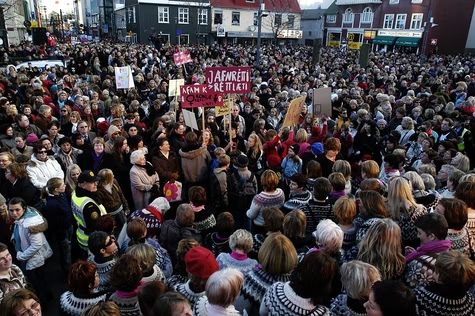
Icelandic Women's Strike 1975 - The Day The Country Stood Still
Known as the 'Women's Day Off', October 24, 1975, saw 90% of women in Iceland refuse to go to work, do household chores, care for their children, or cook for their families. Instead, more than 25,000 gathered in Reykjavík and thousands more in towns all over the country to demand policy change for a more equal Iceland.
The strike caused widespread disruption, leading to the closure of schools, factories, shops, offices, and public services. Even flights were cancelled, and the phone lines were cut off.
The day was a global awakening to the value that women bring to society and the stark inequalities that exist. The impact of women's labour became very apparent in its absence.
Icelandic women were frustrated with low wages, poor employment opportunities, and the stark imbalance of unpaid domestic work. At this point, only a handful of women had ever served in Parliament, and so women had very little influence on national policies.
The strike was organised by the women's movement Kvinnafrídagurinn. It was union-related and highly political. With the country paralysed, men had to bring their children to work with them, and were forced to manage their own households.
The day marked a massive shift in Iceland's fight for gender equality, one which five years later led to the world's first democratically elected female president, single mother Vigdís Finnbogadóttir. In 1976, a law was passed to ban wage discrimination based on gender.
In the aftermath, women also won the right to join the Farmers Association after 140 years, and the first women's shelter opened its doors. For almost 2 decades now, Iceland has taken top place as the world's most gender-equal nation by the World Economic Forum. They have managed to close the gaps in healthcare, education, economic participation, and political empowerment by 90%.
Iceland regularly commemorates this strike with annual celebrations. It was a huge nationwide collective effort which showed how political pressure can bring about real-life change. It is still considered one of the most iconic moments in the struggle for gender equality.
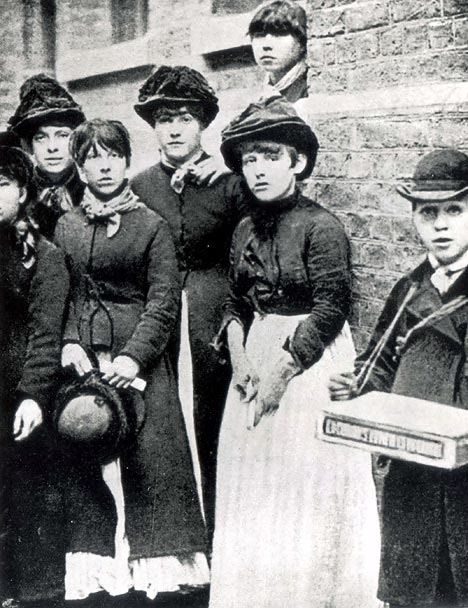
London Matchgirls' Strike 1888
An earlier example of a successful strike by women, though on a local scale, occurred at the Bryant & May factory in Bow, London. The factory employed around 2,000 predominantly female match-dippers, makers, and packers.
The work here was dangerous, owing to the handling of white phosphorous, the pay was meagre, and the staff were subjected to regular unfair fines for trivial offences such as talking.
Socialist activist Annie Besant published an exposé entitled "White Slavery in London" on June 23, 1888, which documented the realities of daily life in the factory. It detailed the horrors of 'phossy jaw', an industrial disease which caused severe jaw necrosis, rotting of the jawbone, tooth loss, and disfiguring infections. This disease proved fatal in 20% of cases.
In an attempt to quash the damning report, management pressured workers to sign a document which denied the claims. Workers refused to sign, triggering the landmark industrial dispute in which roughly 1,400 women walked out of the factory.
The strike ultimately lasted 3 weeks and was a major victory for the largely unskilled and majority female workers. The resulting deal led to improved pay, the abolishment of fines, and the creation of a matchmakers' union. The matchgirls' strike sparked the New Unionism movement in Britain that transformed the trade union movement.
Women's Strikes In The DACH Region – Germany, Austria, Switzerland (1990's - Ongoing)
Over the last 3 decades within Europe, the DACH region has become synonymous with women's strikes, which are a recurring, active movement. The strikes often coincide with International Women's Day on March 8.
Switzerland historically has hosted the largest and most prominent mobilisations, which centre on issues such as wage inequality, underappreciation of care work, sexual harassment, and broader patriarchal structures.
While the country is a wealthy nation with strong legal frameworks and a tradition of proactive peacebuilding and neutrality, it lags significantly behind many other European nations in terms of gender equality. It was one of the last countries in Europe to give women the vote, which was only introduced in 1971.
In 1991, a strike supported by over 500,000 women took place and established June 14th as a day for gender equality in Switzerland. The 2019 strike renewed the focus on equal pay and care work. In 2023 and again in 2025, more than 300,000 people took to the streets, demanding "No Step Back."
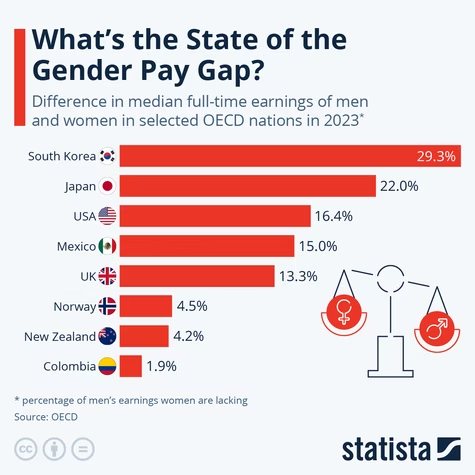
Today, women still earn almost €1,500 less than men on average.
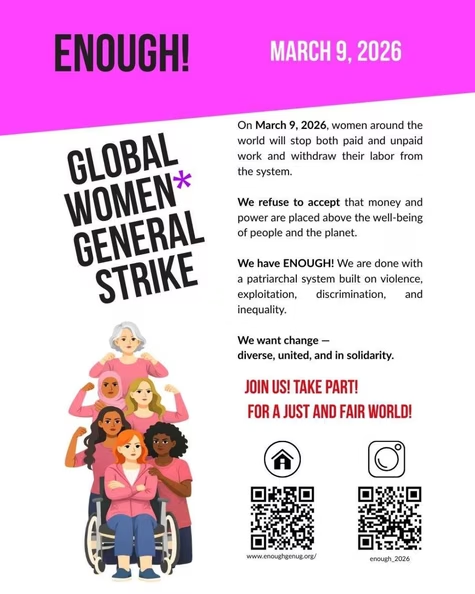
In October 2025 in Austria, a care and women's strike took place in Vienna under the motto "#Stillgelegt" (shut down), which was directly inspired by the Icelandic strike of 1975. The campaign focused on unpaid care work, violence against women, and the devaluation of both women's work and care work.
This was repeated on March 8, 2026, at an international women's strike in Vienna under the motto "Enough!". Women demanded an end to femicides and racist hate speech, a fairer distribution of public funds, and the fight against social insecurity. The term strike was used not only to refer to a work stoppage but also to a refusal to perform care work in everyday life without pay.
The women's strike discourse in Germany has gained importance in recent years, particularly in the context of the racist debate surrounding "German daughters" and social division. Initiatives such as "Enough!" and "Töchterkollektiv" emphasise that the strike is not only about wage or job inequality, but about a broad alliance of concerns, including violence against women, racist and sexual discrimination, care infrastructure, refugees, and social security.
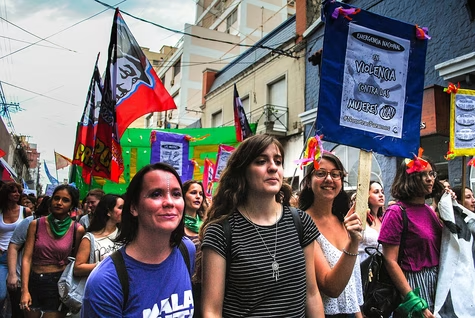
International Women's Strike/Paro Internacional de Mujeres - March 8, 2018
The idea of an international women's strike came from the 2016 Polish "Black Monday" protest against a proposed abortion ban and the #NiUnaMenos movement against femicide in Argentina. The strikes are held on International Women's Day and coordinate strikes across more than 50 countries.
Major actions take place in Spain, the U.S., Argentina, and Ireland. During the 2018 strikes in Spain, approximately 5 million people participated in a 24-hour strike in support of feminism. The strikes demonstrate perfectly the concept that when women stop working, the world stops.
This global grassroots movement was established in 2017 and highlights the invisibility of women's labour and the impact of systemic inequality. It also stands to protest against gender-based violence, economic inequality, and patriarchal neoliberal policies.
*****
Gender inequality in the global labour market remains a significant, persistent issue. Closing the gender gap in labour force participation would significantly boost global GDP, with potential increases of up to 35% in some cases.
Despite this, women are repeatedly held back by harmful laws, traditions, societal norms, discrimination, and uneven caregiving responsibilities. We have seen gender equality gaps close in developing countries, proving it is possible.
Devestatingly, this is what women are up against:
-
The global labour force participation rate for women is just under 47%, compared to 72% for men.
-
Women capture less than one-third of total global labour income.
-
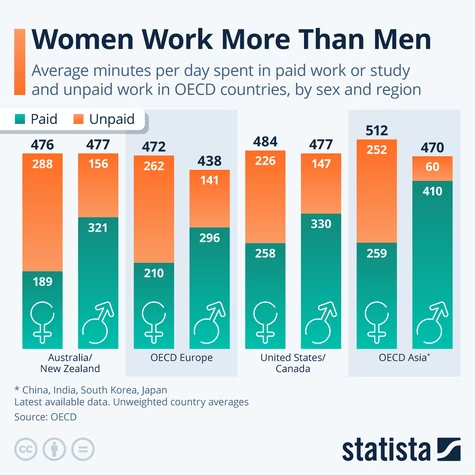
Women perform at least 2.5 times more unpaid household and care work than men.
-
Women with children under six experience an employment gap of 43% compared to women without young children at 29%.
-
Over 2.7 billion women are legally restricted from having the same choice of jobs as men.
-
There are 69 nations that have laws which restrict women's decision to work.
-
Women are significantly overrepresented in low-paying, service-oriented roles.
-
The COVID-19 pandemic disproportionately affected women, with one in every 10 women globally now living in extreme poverty.
These figures clearly show us that there is still much work to be done. Women must continue to organise, unite, strike, protest, and demand change.
We can clearly see how much society depends on the work of women. It is time we started valuing it.
"Let's build a new world with the hands of strong women in all countries!" - From the Icelandic feminist anthem "Áfram Stelpur".
Author: Rachael Mellor 30.03.26 licensed under CC BY-SA 4.0
For further reading on Women's Strikes see below ⬇️
More Resources
Curated Directory & Deep-Dive Resources on Women's Strikes
- Novara Media 511796
- Women's Strike - Wikipedia 511447
- International Women's Strike - Wikipedia 511791
- Global Women's Strike - Wikipedia 511449
- 1975 Icelandic women's strike - Wikipedia 511448
- BBC Wales history - Women: Strikes and protests 511808
- Decades after Iceland’s ‘day off’, our women’s strike is stronger than ever - Guardian 08.03.26 511807
- This is what happened when thousands of women refused to work in Iceland 50 years ago - Metro 19.10.25 511813
- Iceland PM joins crowd of 100,000 for full-day women’s strike - Guardian 10/23 511446
- Sex strikes and birth strikes as tactics in the women's suffrage movements of Britain and the United States, 1890-1920 - University of Manchester 27.06.22 511803
- Strikes are taking place across the UK for International Women’s Day - here’s why - Big Issue 07.03.22 511802
- A gender for strikes? - EHNE 02.03.22 511793
- The Power of Women Strike for Peace - Arms Control Association 11/21 511798
- How can women get equality? Strike! - Guardian 14.03.21 511811
- How a harsh Polish abortion bill sparked women’s strikes around the world - Open Democracy 15.04.20 511799
- 'Wages. Time. Respect': Swiss Women Go On Strike - NPR 14.06.19 511810
- The Women’s Strike in Britain: A Continuous Practice of Feminist Solidarity - Viewpoint Magazine 13.05.19 511797
- The Women’s Strike, Reconsidered - Organizing Work 03/19 511814
- Women’s Strikes Are a Reminder That Women Produce Most of the Wealth in Society - Truthout 09.02.18 511805
- With "A Day Without a Woman," success isn't the question - Stanford 20.03.17 511812
- 11 photographs of historic women's strikes around the world - Elle 08.03.17 511794
- A Look at Women’s Strikes Around the World - Pacific Standard 08.03.17 511804
- Why Women Are on Strike - NY Times 08.03.17 511806
- ‘Don’t Iron While the Strike is Hot’: These Are the Precursors to ‘A Day Without a Woman’ - Time 07.03.17 511800
- What the Women’s Strike Means - International Viewpoint 04.03.17 511801
- The Day Women Went on Strike - Time 26.08.15 511809
- The day the women went on strike - Guardian 18.10.05 511795
- Four women's strikes that made history - BBC Bitesize 511790
- How Ford’s striking women drove the Equal Pay Act - TUC 511792
- Our GERMAN Links on the Topic 511815