
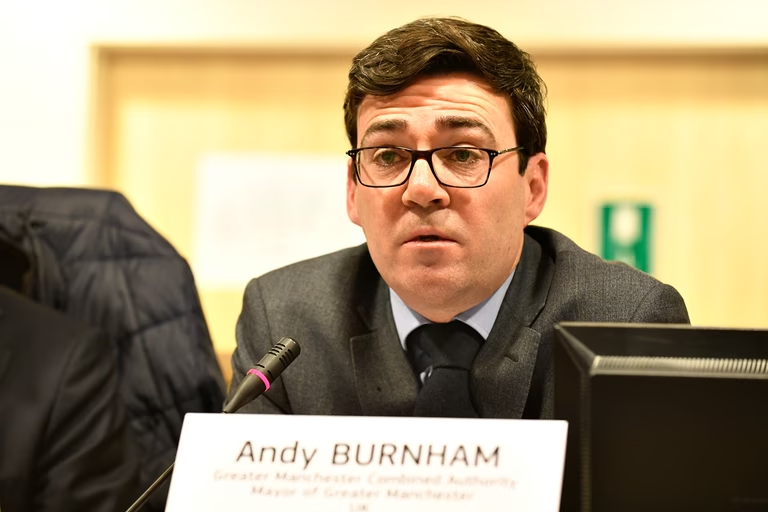
Andy Burnham
Explore the political career of UK Prime Minister Andy Burnham. From Mayor of Greater Manchester to Downing Street, discover his key policies and background.
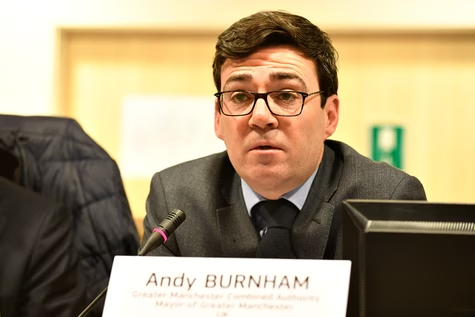
➡️ ANDY BURNHAM - The New Prime Minister of the UK
Discover the political journey of Andy Burnham and learn how he navigates the mounting pressure of becoming Prime Minister. Our political guide offers you in-depth information on his transformative successes in Greater Manchester, the expectations of a jaded British public, and his evolving vision for national leadership.
Connect with dozens of valuable resources, news coverage, and policy analyses – for restored voter trust, and a more stable and progressive political future for the UK.
Jump straight to our resources on ➡️ Andy Burnham
*****
General Information
Andy Burnham is a prominent British Labour Party politician recently serving as the Mayor of Greater Manchester. He has earned the title "King in the North" for his fierce advocacy of northern English interests, which are often overlooked due to London-centricity.
Burnham is one of the only UK politicians to regularly earn a net-positive favourability rating. As such, he is set to become the future leader of the Labour Party. The question of Labour leadership returned to the headlines after Keir Starmer's Labour underperformed in the May 2026 local elections.
It has been a tumultuous few years for British politics, with 5 different Prime Ministers since 2019, and deep-rooted dissatisfaction from voters with all parties.
Shortly after the May election results, Burnham announced that he is seeking a return to Westminster by contesting the upcoming Makerfield by-election. It went on to become a launchpad in his challenge to current Prime Minister Keir Starmer for the leadership of the Labour Party.
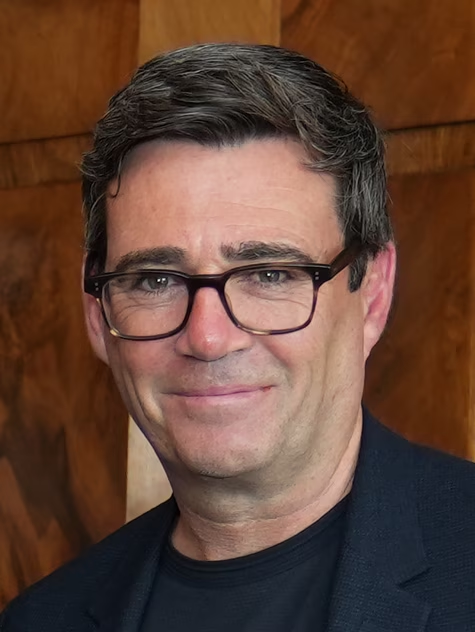
Political Career
Originally from Liverpool, Burnham grew up in a small village in Cheshire. His interest in politics began in his 20s, when he became a researcher for the late Tessa Jowell, who later served as a minister under Tony Blair and Gordon Brown.
He went on to become a special adviser to Culture Secretary Chris Smith and then was elected as the MP for his hometown of Leigh, in Greater Manchester, in 2001. He held this position until 2017. During this time, he also held cabinet positions as the Health Secretary and the Culture Secretary.
After Gordon Brown's resignation as Labour Party leader in 2010 following the general election defeat, Burham began the first of two leadership bids. In 2010, he lost to Ed Miliband, and in his second bid in 2015, Jeremy Corbyn took the top spot.
He went on to serve in Corbyn's shadow cabinet as the shadow home secretary. He stood down in 2017 to run to be the first mayor of Greater Manchester. This was a new position created to shift political power from London directly to the region, giving much more local control over important decisions.
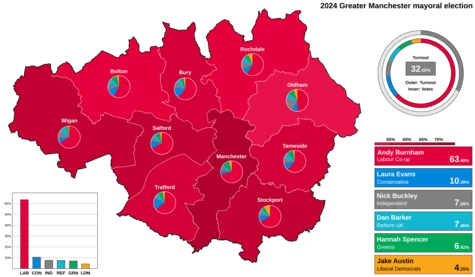
Burnham won with more than 60% of the vote and has since secured consecutive landslide victories in 2021 and 2024.
What Does Burnham Stand For?
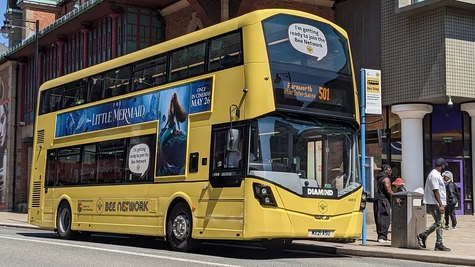
As mayor, Burnham has received praise for transforming the region's transport system. Outside of London, Manchester was the first area to bring the bus service back under public control.
During the Covid-19 pandemic, he earned himself the nickname King of the North for standing up to the Conservative government for treating the north with contempt over lockdown restrictions.
Although he did not meet his targets, he also put considerable effort into tackling the widespread issue of homelessness. Since he took on the role of mayor, he managed to reduce the prevalence of rough sleeping every year until 2021. After lockdown restrictions were relaxed, the problem soared again under hostile governmental policies on housing benefits, asylum seekers, and rent freezes.
Burnham is a staunch believer in devolving power from Westminster, introducing proportional representation, and has demonstrated a desire to renationalise energy, water, and rail. He has expressed support for raising taxes for the rich and introducing levies on assets and wealth.
His political positions have been criticised for resembling a shapeshifter, changing with the winds to give him the greatest chance of success. This has left many wondering whether his time as mayor in a northern city has prepared him to shape national policy.
He supports decarbonisation and sees it as an economic opportunity rather than a burden. He plans to use green initiatives to drive reindustrialisation, create jobs, and improve infrastructure.
On immigration, he aligns closely with the current Labour policy of a more restrictive and controlled approach.
His stance on the NHS dates back to his time as Health Secretary. He has long been a champion of a well-funded, free, and fully integrated NHS. He supports improved social care and the devolution of NHS budgets to local authorities.
He has called for stricter regulation of Big Tech and artificial intelligence. In education, he seeks to dismantle ‘academic snobbery’ by creating technical education pathways outside universities that equip students with job-ready skills equal to those of degrees.
Burnham’s approach to foreign policy and war has evolved significantly from his early days, when he voted in favour of military intervention, to his current advocacy of diplomatic restraint, human rights, and early ceasefires. Regarding Gaza, he was one of the earliest high-profile Labour figures to break free from their initial stance. He called for a ceasefire by all sides, supports a two-state solution, and advocates adequate humanitarian aid.
During the Brexit referendum, he was a staunch Remain supporter. To this day, he has expressed a desire for the UK to rejoin the European Union.
Path Back To Westminster & A Labour Leadership Contest
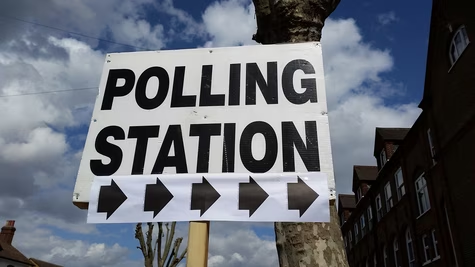
The resignation of MP Josh Simons has triggered a by-election in the parliamentary constituency of Makerfield, home to about 76,000 voters in the suburbs of Wigan and nearby towns and villages. This move was made specifically to create a vacancy for Burnham, stating it was ‘too big an opportunity to miss.’
The spotlight falls yet again on Greater Manchester as the result could pave the way for a new Prime Minister.
Makerfield has been a safe Labour seat since its creation in the 1980s, but in the local elections, Reform UK took the seat. The rise of their popularity across the country has become one of the main arguments for Keir Starmer to stand down.
Burnham, however, does not have a way to challenge him unless he is an MP, which is why this Makerfield election is so important. He faces a huge challenge from Reform, which has vowed to throw everything at the contest.
The election is scheduled for June 18th, 2026.
We are still in the early stages of the campaign, but the first poll has revealed that Burnham leads on 43% with Reform's Robert Kenyon closely behind on 40%. If Burnham wins, he can begin building his challenge for the Labour leadership.
Prime Minister Keir Starmer is experiencing historically low approval ratings. With a net favourability of roughly -46%, 70% of the British public view him unfavourably. Within the party, a significant number of Labour MPs agree.
Burnham faces stiff competition from the recently resigned Health Secretary, Wes Streeting, and former deputy Prime Minister, Angela Rayner. Burnham, however, is currently outpolling both his rivals among Labour members and has rare net approval ratings with the general public.
Stay tuned for further updates as events progress.
Author: Rachael Mellor, 02.06.26, latest update 21.07.26, licensed under CC BY-SA 4.0
More Resources
Curated Directory & Deep-Dive Resources on Andy Burnham
- Prime Minister's Office: 10 Downing Street - official 520186
- They Work For You - Andy Burnham 517111
- Who Can I Vote For - Andy Burnham's policies 517131
- Facebook 517112
- Instagram 517115
- Twitter/X 517113
- Andy For Mayor 517114
- Guardian 517127
- BBC News 517118
- The Conversation 517123
- Prospect Magazine 517135
- Channel 4 News 517136
- Financial Times 517134
- Andy Burnham - Wikipedia 517110
- 2026 Makerfield by-election - Wikipedia 518633
- 2026 Labour Party leadership crisis - Wikipedia 518634
- Andy Burnham 2015 Labour Party leadership campaign - Wikipedia 517133
- One thing must now be clear to Andy Burnham. The rightwing press is on a war footing – and he’s the enemy - Guardian 13.10.26 524541
- Burnham faces questions over push to scrap photo ID voting requirement - Guardian 11.10.26 524486
- Andy Burnham’s Labour Allows the Left to Breathe, a Little - Jacobin 07.10.26 524462
- Burnham has said the unsayable on Brexit. What happens now? - Conversation 02.10.26 524470
- For too long, only the right has expanded the boundaries of what governments can do. Can Burnham change that? - Guardian 02.10.26 523957
- Andy Burnham wants to help rescue the Tories’ signature policy - Economist 02.10.21 517121
- ‘The real deal’ or more of the same? How Burnham split the Labour left - Open Democracy 30.09.26 524422
- Burnham gambles on radical progressive plan to help Britain ‘rise again’ - Guardian 29.09.26 523714
- ‘New path’: UK’s Burnham promises huge expansion of public services - Al Jazeera 29.09.26 523611
- How Andy Burnham can fund defence spending without cutting welfare - LFF 25.09.26 523503
- Trump and Burnham’s first meeting was a success – but could this ‘good connection’ harm the prime minister at home? - Conversation 23.09.26 523697
- Andy Burnham seizes control - New Statesman 23.09.26 523500
- Burnham must establish an inquiry into Britain’s role in the Gaza genocide - Al Jazeera 14.09.26 522970
- Video: Andy Burnham goes back on his promises - Owen Jones 01.09.26 524030
- The Guardian view on Andy Burnham’s buses: a blueprint for governing Britain - Guardian 21.08.26 521845
- Burnham should beware the perils of cost of living policy - FT 21.08.26 521795
- Andy Burnham’s Plan for Britain Starts Above a Manchester Cocktail Bar - Politico 21.08.26 521793
- Will Prime Minister Andy Burnham move the UK closer to Europe? - Euronews 20.08.26 521794
- The Burnham bounce is an illusion - New Statesman 20.08.26 522083
- Can Andy Burnham rewire the ‘Treasury brain’ to boost growth? - Guardian 19.08.26 521846
- What has Burnham promised since he became PM, and when will it happen? - Guardian 19.08.26 521792
- Cabinet ministers’ mobile numbers found online after Burnham targeted - Guardian 17.08.26 521632
- Andy Burnham is almost out of time - Telegraph 15.08.26 521633
- Video: Zack Polanski delivers an urgent message to the Prime Minister - Bold Politics 15.08.26 523112
- Video: I don't use the word 'betrayal' lightly. But that's precisely what it will be if Andy Burnham approves Rosebank and Jackdaw. - Clover Hogan (Linkedin) 10.08.26 523246
- New UK PM Burnham takes to social media to challenge populist parties' dominance - Reuters 05.08.26 521634
- Britain’s new leader shifts power from Downing Street to Manchester with ‘No. 10 North’ - AP 01.08.26 521635
- Why Andy Burnham is no ordinary Labour prime minister - Politico 31.07.26 520920
- Having clawed his way to power, Andy Burnham wants to give some away - Economist 30.07.26 520921
- Brave New World or Groundhog Day? Burnham revisits old ground in speech on social care - Guardian 29.07.26 520922
- Ella Baron on Andy Burnham’s plans for youth employment – cartoon - Guardian 28.07.26 521258
- Andy Burnham borrows Mamdani's media playbook, not his politics - New Arab 28.07.26 520923
- Andy Burnham vows to use his ‘political capital’ to fix social care system - Guardian 27.07.26 520631
- Andy Burnham 'rules out' early election - FT 26.07.26 520634
- Andy Burnham’s Number 10 North changes the postcode, but not the politics - Al Jazeera 24.07.26 520633
- What we’ve learned from Andy Burnham’s first week as prime minister - Conversation 24.07.26 520632
- Britain's new government - Friedrich Naumann Foundation 23.07.26 520564
- All the Keir Starmer critics handed plum jobs under Andy Burnham - Politico 23.07.26 520565
- Andy Burnham’s first decisions in office reveal a lot about him - Economist 23.07.26 520563
- ‘He knows what he’s doing’: Burnham’s off-the-cuff remarks inspire headlines and headaches - Guardian 22.07.26 520562
- Burnham has big ideas - but what will they cost? - BBC 20.07.26 520160
- 8 Things Andy Burnham Should Do in His First 100 Days As Prime Minister - Novara Media 20.07.26 522145
- Six highlights from Andy Burnham’s first Downing Street speech - Guardian 20.07.26 520184
- Explainer: Andy Burnham’s first Labour cabinet: who’s in and who’s out? - Guardian 20.07.26 520183
- Andy Burnham says he will go ‘faster’ than Starmer. Why is that so hard? - Guardian 20.07.26 520180
- Burnham pledges to end rough sleeping in England in first speech as prime minister - Guardian 20.07.26 520179
- Fossil fuels, utilities and housing: what we know about Andy Burnham’s plans - Guardian 19.07.26 520181
- From leftwing voters to unions: can Burnham win back Labour bases lost by Starmer? – visualised - Guardian 19.07.26 520182
- Video: "I wish Andy Burnham well, it's in everyone's interest that we have a PM who is capable and facing the real challenges" - BBC 17.07.26 521300
- Andy Burnham, a mayor from England’s north, is poised to become Britain’s next prime minister - AP 17.07.26 519997
- All hail the king! Good vibes and Greggs as Burnham addresses the Andyites - Guardian 17.07.26 520185
- The King of the North, Andy Burnham, Won't Save Britain - NY Times 17.07.26 519996
- What can Andy Burnham actually do? - LSE 16.07.26 519999
- How green is Andy Burnham? Britain’s next PM faces tough climate decisions - Guardian 16.07.26 520959
- From Cambridge ‘impostor’ to New Labour star: Andy Burnham’s winding path to power - Guardian 16.07.26 519998
- Andy Burnham secures Labour leadership with landslide support of MPs - Guardian 13.07.26 519865
- Andy Burnham’s reactionary politics have no place in 2026 - Telegraph 12.07.26 519770
- The bulging in-tray of challenges Andy Burnham faces upon entering No 10 - Guardian 10.07.26 519771
- Andy Burnham apology for Labour stance on Gaza: Is UK’s position shifting? - Al Jazeera 10.07.26 519772
- Campaigner explains what Andy Burnham isn’t telling you about his ‘public control’ agenda - LFF 09.07.26 519815
- Zack Polanski slams Andy Burnham’s ‘shameful record’ on affordable housing as mayor - LFF 09.07.26 519814
- UK Labour’s Burnham apologises for response to Israel’s Gaza violence - Al Jazeera 09.07.26 519654
- Ed Balls: Burnham cannot miss this chance to tackle regional inequality - New Statesman 08.07.26 522087
- The global crises Andy Burnham cannot escape - New Statesman 08.07.26 519817
- Trans activists share true feelings on potential prime minister Andy Burnham - Pink News 06.07.26 519592
- Is any Labour MP brave enough to admit the truth about Andy Burnham? - Spectator 06.07.26 519593
- Leading Environmental Groups Set Six ‘Tests’ for Next Prime Minister - Greenpeace 06.07.26 522185
- Andy Burnham’s Course for the U.K. - Dispatch 05.07.26 519591
- Why Andy Burnham should bring back David Miliband – the man already tipped to replace him - Independent 05.07.26 519594
- Andy Burnham is making Manchester look like a joke - Spectator 04.07.26 519514
- Why Does Andy Burnham Have so Little to Say on Foreign Policy? - Novara Media 03.07.26 519767
- The six principles of AI – a king’s speech for Andy Burnham - Observer 03.07.26 519512
- Andy Burnham faces £7bn cuts to fund defence spending hike - The Times 02.07.26 521913
- UK’s likely next leader Andy Burnham vows to fully fund defence plans - Al Jazeera 02.07.26 519513
- Podcast: The Burnham blueprint, as told by one of its architects - Guardian 01.07.26 519377
- Andy Burnham’s win-win-win-win-win-win economy - New Statesman 30.06.26 522088
- Andy Burnham, “The Outsider” - New Statesman 29.06.26 519288
- A premier's premiere: Just about no one knows what Andy Burnham plans to do as Britain’s next leader - Insider 29.06.26 519287
- Andy Burnham’s meteoric rise tells us much about how politics and power are changing - Conversation 29.06.26 519289
- To save Britain, Burnham must take on the Treasury - New Statesman 29.06.26 522089
- Is Andy Burnham Labour's saviour, or just its best bet? - BBC 27.06.26 519232
- Podcast: Can Andy Burnham save Labour? - Independent Thinking 26.06.26 519495
- UK foreign policy to remain unchanged despite government transition, deputy PM Lammy says - Euronews 26.06.26 519189