Dangers of Big Tech & Silicon Valley
Explore how the rise of Big Tech and Silicon Valley monopolies threatens democracy, exploits user data, and exerts dangerous influence over politics.
DANGERS OF BIG TECH & SILICON VALLEY - The New Monopolies & the Threat to Democracy
Discover the concerning world of growing digital power and learn how we can actively protect democracy. Our Big Tech guide offers you in-depth information on Silicon Valley dominance, political influence, and monopolisation.
Connect with hundreds of valuable resources, initiatives, and organisations – for genuine regulatory reform, improved digital privacy, and a sustainable democratic future.
Jump straight to our resources on the ➡️ Dangers of Big Tech & Silicon Valley
*****
General Information
The Digital Revolution and rapid rise of Big Tech companies over the last 2 decades has led to vast market dominance, massive concentrations of power and money, and an unexpected and dangerous role in politics.
The world's five largest tech giants are all American companies – Alphabet (Google), Amazon, Apple, Meta (Facebook), and Microsoft. They all have their headquarters in Northern California's San Francisco Bay Area, otherwise known as Silicon Valley.
These companies exert massive control over the internet through operating systems, search engines, social media, e-commerce, and streaming services. This unprecedented influence allows them to set their own rules for competition, data privacy, information access, marketing, and audience engagement.
"Any company more powerful than the government is a company the government won't be able to hold to account - that's the very definition of too big to jail." - Cory Doctorow, author of 'The Internet Con'
How Big is Big Tech?
-
Google accounts for 91.5% of online searches. They maintain huge control over the search engine market.
-
Microsoft accounts for 72% of operating systems on desktop computers. An outage or cyberattack would have a widespread impact all over the globe. Their market dominance means that they can control software compatibility and set their own security standards.
-
Meta owns four of the largest social media platforms, accounting for 76% of all social media users.
-
The combined revenue of the big five in 2024 exceeded $1.5 trillion. They also hold major government contracts and have massive cash reserves, allowing them to buy out startup companies, boost their own stock prices, payout millions to shareholders, and rapidly invest in emerging technologies.
-
Big Tech now receives over 50% of global advertisement profits. In 2025, the market reached $1.19 trillion. This dominance undermines public media's diverse funding streams, which enable them to deliver content not driven by mass-market profit, such as educational pieces, local news, and critical analyses.
-
In the last 3 years, the emissions of tech giants have surged by 150%. Digital tech is now responsible for 3.5% of all greenhouse gas emissions. Studies have revealed that data centre emissions are estimated to be 662% higher than Big Tech claims.
The Threat to Democracy
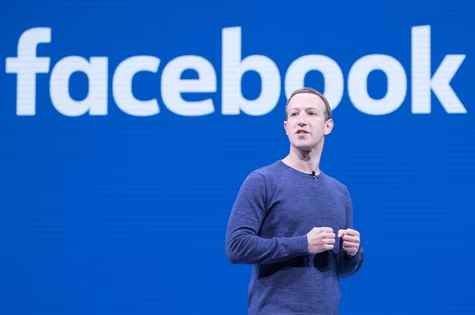
Big Tech is increasingly shaping the world we live in - the most alarming influence is on our democracies. This immense concentration of power in the hands of so few opens the door to surveillance, exploitation, control, lobbying, and the erosion of trust and truth.
With such immense control over how information is disseminated, shaping public discourse becomes child's play. The public depends upon open, fair, and transparent information to make decisions that democracies depend on.
Never before have corporations had such easy access to the government. Not only can Big Tech influence election outcomes, but through lobbying and threats to withhold investments, it can influence policy, prevent tougher regulation, and obstruct autonomy.
Targeted advertising and misinformation campaigns have hijacked elections and high-stakes referendums around the world. Big Tech's lobbying power is so immense that it now overshadows the might of the oil and gas industries. Now a key player in global policy and regulation, the interests of Big Tech are filtering into our data privacy and security, AI regulation, competition laws, and even climate policy.
At the start of Trump's second presidency, Elon Musk, as a 'special government employee' was given unprecedented access to government operations. As the unofficial head of the Department of Government Efficiency, he helped to slash 'excess regulations' and restructure key Federal Agencies. His supposed cost-cutting has threatened democratic stability and seriously compromised the functionality of key institutions.
With his massive global reach, Musk has also made false and misleading claims about key British politicians and issues such as policing and recent riots, spreading fear and deepening polarisation. His political interference almost led to a huge donation to Reform UK, a scandal-ridden rightwing party with a strong anti-immigration policy.

Another example of Big Tech forcing its corporate agenda into public discourse is Jeff Bezos's controversial purchase of The Washington Post. In an attempt to sway readers, he ordered the news giant to block the endorsement of Kamala Harris in the 2024 U.S. Presidential election. A public uprising led to them losing 200,000 paid subscriptions.
Regarding data mining and manipulation, the Cambridge Analytica scandal exposed just how easily Big Tech can sway our votes if it decides to, and how democracy is compromised when we lose control of our personal data. Around 50 million Facebook profiles were harvested without consent to target voters with personalised ads during the 2016 U.S. election and the Brexit referendum.
Algorithms are another tactic that Big Tech employ to control the flow of information that we receive. Curated content is designed to maximise engagement, which leads to echo chambers, the spread of misinformation, and deepening political polarisation. The German far-right party AfD successfully used X and TikTok algorithms to push their harmful agendas during the 2024 EU elections, disproportionately exposing their content to young voters.
Massive political campaign funding by billion-dollar tech companies allows them to buy political influence. In 2024, Silicon Valley poured more than $394 million into the U.S. presidential election. All major social media platforms became avenues for political ad spending. The cryptocurrency industry and Super PACS were also used to funnel money into campaigns.
Elon Musk was by far the largest individual donor of the 2024 election, donating $291 million to the Republican Party.
Other tactics by social media platforms include the weakening of restrictions on acceptable speech to promote the spread of misinformation and fear. Shortly after Trump's 2024 win, Meta ended their third-party fact-checking programme and weakened their 'Hateful Conduct Policy'. Leading AI developers such as OpenAI and Google have also recently removed censorship of hate speech and misinformation.

Other Major Areas of Concern
-
Dependency Risk - Governments, businesses, and individuals are now dependent on Big Tech's services. Satellites, data centres, and cloud services are essential government tools for communication and national security.
-
Monopoly Concerns - Such massive concentrations of power raise enormous antitrust questions.
-
Content Control - A small handful of tech giants control the flow of information that users see. Content moderation and algorithms impact freedom of expression and access to information.
-
Data & Privacy - Big Tech hoards masses of private user data, making security breaches a top concern.
-
Surveillance Capitalism - Extensive data collection is used for targeted advertising, and more worryingly, for law enforcement and intelligence purposes.
-
International Interference - Silicon Valley has a global reach. Trump has threatened the EU with retaliatory tariffs if they go ahead with new regulations on Big Tech.
-
Labour Exploitation At Home - The classification of workers as independent contractors strips workers at Amazon of their right to unionise and fight for better conditions. Tech companies have also been criticised for their use of algorithms to manage, monitor, and control staff, setting unrealistic targets which drive fear and anxiety.
-
Labour Exploitation Abroad - The vast majority of content moderation and AI training is outsourced to the Global South. Here, staff work without adequate protections for a salary far below a living wage. Content moderators are exposed to disturbing graphic content throughout their entire shift. They are given no support for the psychological harm, and high rates of PTSD, anxiety, and depression that they endure.
-
Influence On Modern Warfare - Big Tech and modern conflict are now deeply entwined. Elon Musk's Starlink and its role in the Russian Invasion of Ukraine highlighted the enormously unjust power that just one individual has over the course of a war.
-
AI In Warfare – The use of autonomous weapons raises huge ethical concerns. It reduces human control and accountability, is vulnerable to algorithmic bias, and increases the risk of conflict due to lower human costs.
-
Military & Intelligence Contracts - Big Tech defence contracts with the DoD and CIA raise serious ethical concerns.
-
The NASDAQ Tech Bubble - Big Tech is dominating the market, resulting in an incredibly vulnerable top-heavy situation with the potential to crash with even the slightest stumble from one of the Big Seven.
-
Rare Earth Minerals - Big Tech companies rely on global supply chains to feed them the raw materials they need for their technologies. These minerals are highly connected to forced labour, exploitation, trafficking, child labour, and even fuel conflicts.
Who Are The Tech Oligarchy?
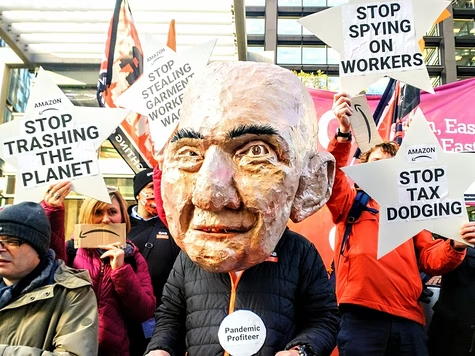
The tech oligarchy comprises a small group of incredibly wealthy, powerful leaders in the technology industry. These 'tech bros', who are all (unsurprisingly) male, have amassed immense control over digital infrastructure and increasingly push their own values on society and the political sphere.
Prioritising their own corporate interests, they have rigged the system in their favour and managed to blur the line between business and politics like never before.
In the past, this influence was more discreet, but with several tech billionaires set to become trillionaires in the next decade, their dominance has taken centre stage. Below, we list some of the wealthiest and most dangerous names in the industry.
-
Elon Musk (Tesla, SpaceX, X, and xAI) - He is the currently wealthiest person on Earth, is heavily involved in politics, and uses X to spread hate speech and his own political agendas.
-
Mark Zuckerberg (Meta) - Putting political discourse at risk with misinformation and questionable use of algorithms.
-
Jeff Bezos (Amazon) - Famous for ruthless capitalism, aggressive business tactics, immense monopoly power, poor labour practices, and tax avoidance.
-
Larry Page & Sergey Brin (Google) - Controversial user privacy and data collection practices, lack of accountability for the spread of misinformation, lack of transparent algorithm controls, and a lack of democratic mandate.
-
Larry Ellison (Oracle) - Significant financial backer of Republican causes and controversial figures such as Donald Trump. Oracle holds numerous government contracts that merge private corporate power with state surveillance. The Ellison family also controls a vast media empire, putting far too much control in the hands of one family.
-
Sam Altman (OpenAI) - Rapid AI development with a disregard for the long-term risks, prioritising his own wealth and power over the well-being of humanity.
-
Steve Ballmer (Microsoft) - Monopolistic and anti-competitive business practices designed to force users into the Microsoft sphere whilst breaching regulations and battling antitrust lawsuits.
*****
Can Big Tech Be Regulated?
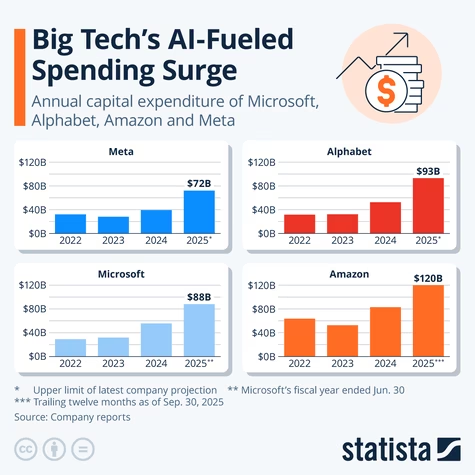
Research by MGI estimates that global tech spending will grow to $11.47 trillion in 2026 and shows no signs of slowing. The rise in cloud computing, artificial intelligence, and cybersecurity is fuelling the industry's profitability and lining the already bulging pockets of tech billionaires.
This unprecedented wealth, power, and access to politicians allows unfettered influence on all aspects of our societies. There are massive calls for the U.S. government to break up Big Tech to avoid a further slide into democratic breakdown and a new era of technofeudalism.
"Today's Big Tech barons have benefited from lax antitrust enforcement and outdated antitrust laws, from cozy relationships with supposed regulators, and from special protections in the law. All this must end."
- Josh Hawley, United States Senator
Despite Trump's best efforts to halt tech regulation in the EU, in 2022, landmark legislation to moderate online platforms was introduced. The Digital Services Act holds Big Tech accountable for illegal content, user protection, and transparency, creating a safer, fairer digital space and helping the EU avoid the dangers of disinformation. This was a huge win for democracy and will hopefully set the precedent for further legislation on the industry around the world.
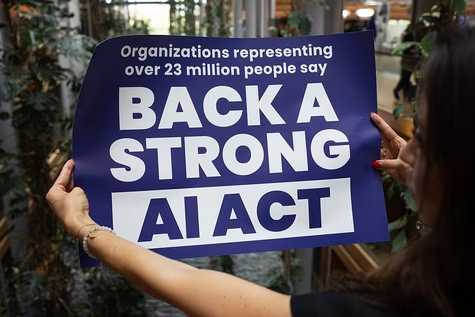
In 2024, the world's first comprehensive law on artificial intelligence was approved. The EU AI Act was another milestone spearheaded in Europe to set the standard for safe, ethical, and trustworthy AI development. It has put an end to the dangerous culture of self-regulation, as companies must now prove that their AI systems pose no risk to society. A new EU AI Office and national authorities will oversee compliance with data management, EU copyright law, manipulative AI, and the clear watermarking of AI content.
U.S. Senator Bernie Sanders is an outspoken critic of the Big Tech Oligarch. In December 2025, he called for a national moratorium on the construction of new AI data centres to prevent Tech Bros from controlling the future development of AI. He supports breaking up tech giants to curb their influence and advocates for changes to ensure that technology benefits the working class and not just the billionaire elite. Sanders also warns about the expansion of corporate surveillance, AI’s potential to widen the wealth gap further, and the risk of 100 million job losses over the next decade due to automation.
The tech industry drives economic and social inequalities, unsustainable levels of consumerism, greenhouse gas emissions, regressive policy, deregulation, undemocratic processes, unfair competition, labour exploitation, unchecked power of elite individuals, and the polarisation of society.
There is an urgent need for stricter regulation, accountability, and a separation of the elite and state like never before.
Author: Rachael Mellor and Dr. Norbert Stute, latest update: 16.07.26, licensed under CC BY-SA 4.0
More Resources
Curated Directory & Deep-Dive Resources on Dangers of Big Tech & Silicon Valley
- People vs Big Tech 501231
- Who Does That Server Really Serve? - GNU 501200
- The Big Problem that Big Tech cannot solve - Trust Lab 501238
- VIDEO: Lowkey EXPOSES Netanyahu’s TERRIFYING $14 billion Plan to Control YOUR MIND - DDN 18.06.26 (must watch + share) 518859
- How (And Why) AI is Eroding Democracy in the US - CD 16.06.26 518384
- ‘Why would you put a toxic product into the hands of a young child?’: director turned activist Beeban Kidron on why big tech needs its ‘tobacco moment’ - Guardian 13.06.26 519449
- ‘The world is sounding an alarm’: Why big tech is the new colonist - Al Jazeera 14.05.26 516179
- ‘The Creep State Is Watching’: Guerilla Art Project Takes on Big Tech’s Power Grab - CD 05.05.26 515418
- Watch: Amazon’s ‘Alexa’ will say “Free Ukraine” but avoids “Free Palestine” - Canary 28.03.26 512301
- Silicon Valley Is Drifting Farther and Farther Right - Jacobin 16.03.26 511243
- Can democracies still function when truth itself is destabilised? - Ecologist 13.03.26 511044
- Anthropic-Pentagon battle shows how big tech has reversed course on AI and war - Guardian 13.03.26 510809
- Big Tech Oversees Itself at Homeland Security - Jacobin 07.03.26 510724
- Social Media Addiction: Facebook Whistleblower Says Big Tech Has Known & Ignored Problem for Years - DN! 19.02.26 509168
- Big Tech’s ‘AI Climate Hoax’: Study Shows 74% of Industry’s Claims Unproven - CD 17.02.26 509668
- Big Tech Faces More Probes Over AI-Generated Child Sexual Abuse Material - CD 17.02.26 509667
- Data Center Giant Secures $14 Million Deal to Consume 40% of Pennsylvania Town’s Excess Water - CD 16.02.26 509039
- How Big Tech Learned to Stop Worrying and Love the Bombs - Jacobin 05.02.26 508801
- Scientists Say Clean Energy-Powered Data Centers Could Save Trillions in Climate, Health Costs - CD 21.01.26 506363
- British Activist Blasts ‘Sociopathic Greed’ of Big Tech After US Judge Blocks His Detention - CD 26.12.25 502577
- Australia’s social media ban has given us a way to fight big tech – and get my son back on his skateboard - Guardian 13.12.25 501218
- Netflix Must Be Stopped - Jacobin 12.12.25 501571
- Watchdog Denounces Trump AI Order Seen as Giveaway to Big Tech Billionaire Buddies Like David Sacks - CD 08.12.25 502832
- Why are Big Tech companies a threat to human rights? - Amnesty 29.08.25 501211
- When It Comes to Understanding the Dangers Posed by Big Tech, We’re Lost in the Cloud - The Nation 16.06.25 501237
- Tech Oligarchy Imperils Democratic Information Flows - Tech Policy 09.06.25 501250
- Big Tech Is Avoiding Responsibility – Here Is What the EU Can Do About It - European Democracy 26.03.25 501249
- Big Tech Chose a Side. Here’s What’s Next - Tech Policy 30.01.25 501247
- Democracy at risk in Davos: new report exposes big tech lobbying and political interference - Global Justice Now 15.01.25 501248
- Big Tech Has Our Attention — Just Not Our Trust - Bloomberg 16.10.24 501242
- Expert highlights danger of tech companies' power over society - ABC 28.09.24 501233
- Beware of Big Tech Steering AI Regulation - Project Syndicate 02.09.24 501232
- The Consequences of Big Tech's Unchecked Consolidation of Power - Tech Policy 06.08.24 501236
- Big Tech’s Overpowering Influence: Risks To Markets And Your Money - Forbes 30.06.24 501235
- Big Tech lobbying is derailing the AI Act - Social Europe 24.11.23 501239
- Big tech and their leaders are a danger to democracy - Leiden University 13.09.23 501234
- Fortune: "Silicon Valley is knowingly violating ethical A.I. principles. Society can’t respond if we let disagreements poison the debate." - Carnegie Council 23.05.23 501245
- The National Security Case for Breaking Up Big Tech - Knight Columbia 30.01.20 501241
- Big tech surveillance could damage democracy - Conversation 03.06.19 501240
- Silicon Valley needs regulation - NY Times 11.09.18 501243
- Why Silicon Valley can’t fix itself - Guardian 03.05.18 501244
- Silicon Valley's Regulatory Exceptionalism Comes to an End - Lawfare 23.03.18 501246
- SOCIAL MEDIA
- Citizen SURVEILLANCE (complete)
- Mass SURVEILLANCE & End of PRIVACY
- CORPORATE Media / Global Media Giants
- Internet Privacy / Big Data for Sale
- Audrey Tang - Taiwan
- Internet Privacy
- Big Brother
- Enemies of Democracy
- Cambridge Analytica Scandal
- Microtargeting
- Team Jorge
- Google Criticism (must read)