
Convention on the Elimination of All Forms of Discrimination Against Women - CEDAW
➡️ CEDAW - Convention on the Elimination of All Forms of Discrimination Against Women
CEDAW was adopted by the United Nations General Assembly in 1979. It officially entered into force as an international human rights treaty in September 1981. It is widely recognised as an international bill of rights for women designed to end the discrimination of women, which "violates the principles of equality of rights and respect for human dignity"
The treaty is the result of 3 decades of work by the UN Commission on the Status of Women. It highlights the areas in which women are denied equality with men, officially defines the meaning of equality, and outlines how it can be achieved through an agenda for action.
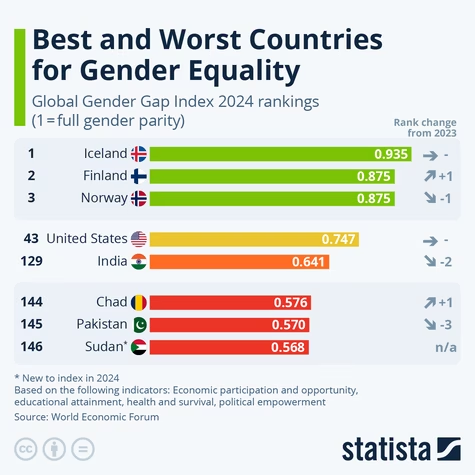
Discrimination against women is deep-rooted, systemic, and even deadly. It can be witnessed in all areas of women's lives and, sadly, is a global phenomenon.
Jump straight to our resources on ➡️ CEDAW
Explore our comprehensive guides on -
-
Women & Girls Rights to Education
-
Women's Issues in Developing Nations
-
Harmful Societal Mindsets & Patriarchal Norms
-
Women's Political Participation
-
Opposition to Women's Rights
As of 2026, 189 states have ratified CEDAW. Parties to the treaty are legally bound to take "all appropriate measures, including legislation, to ensure the full development and advancement of women, for the purpose of guaranteeing them the exercise and enjoyment of human rights and fundamental freedoms on a basis of equality with men."
A further 114 have ratified the Optional Protocol, which allows the committee to receive and consider complaints from individuals or groups within its jurisdiction. The CEDAW Committee consists of 23 independent experts on women's rights from around the world. They monitor and scrutinise efforts to end discrimination and analyse mandatory reports submitted by state parties.
The Holy See, Iran, Somalia, Sudan, and Tonga are not signatories to CEDAW. The United States and Palau are signatories but have not ratified the treaty. As a global force and role model, the U.S. faces scrutiny for failing to uphold international human rights norms set out by CEDAW.
Their absence prevents them from shaping international standards on women's rights and allows inequality, economic disparity, and abuse against women to continue. Discrimination cases on gender are also impeded.
The Cities for CEDAW initiative promotes gender equality at the local level and has been implemented in major U.S. cities such as San Francisco, Berkeley, Los Angeles, Pittsburgh, and Washington.
Discrimination Against Women
-
The global number of child brides is estimated at 650 million. Child marriage ends a girl's education, encourages adolescent pregnancy, limits her chance at employment, promotes financial dependence, and exacerbates poverty.
-
Over 200 million women and girls in 30 countries have undergone female genital mutilation. These girls will suffer lifelong consequences such as serious health complications. FGM victims report higher school dropout rates and are especially vulnerable to child marriage. These women have a higher risk of infertility and are twice as likely to die during childbirth.
-
Women and girls living through violent conflict are incredibly vulnerable. They bear the brunt of sexual violence, exploitation, and trafficking.
-
An estimated 82 million women worldwide lack legal protection against workplace discrimination.
-
More than 2.7 billion women are subjected to laws which restrict the types of jobs they can do, limiting their prospects and financial opportunities.
-
Despite the vast majority of women in the Global South working in agriculture, just 15% of landholders are women.
-
The gender pay gap persists. In 2018, women earned around 78% of what men are paid.
-
Women's political participation is increasing, but the progress is not universally enjoyed. Women still only make up just 25% of parliamentarians worldwide.
-
Out of all the humanitarian aid supporting gender equality, just 1% went to women's rights organisations in 2025.
Successes of CEDAW
CEDAW is a fundamental international legal instrument that helps courts to prosecute cases of gender discrimination. It has led to significant changes worldwide that have advanced women's rights.
-
Legal Reforms - With a new legal obligation, countries have updated their constitutions and passed new legislation to help eliminate discrimination. Laws against sex-selective abortion were introduced in China. Mongolia brought in a law on gender equality. Botswana overturned a law that granted citizenship to children of men married to foreigners but not to children of women married to foreigners.
-
Women's Leadership & Political Participation - CEDAW legally states that women must not be discriminated against regarding voting, holding office, and participating in non-governmental organisations. In Nepal and Rwanda, CEDAW principles have been incorporated, requiring a minimum of 33% to 50% female representation in federal and local bodies. Mexico has seen a 43% increase in women's representation in public leadership positions, making it one of just a few countries with gender parity in its Congress.
-
Family & Work - Since adopting CEDAW, Rwanda has prohibited sex-based discrimination in land ownership. Improved maternity and childcare laws have been introduced in Japan, the Philippines, Germany, Poland, Portugal, Spain, Austria and the UK. Turkey reformed many of its laws, which now allow women to keep their maiden names, work outside the home and keep their own wages. They also raised the marriageable age to 17.
-
Gender-Based Violence - CEDAW has facilitated the criminalisation of all forms of violence against women in Burkina Faso. Femicide was criminalised in Panama. Domestic violence laws were introduced in Turkey, Nepal, South Africa, and the Republic of Korea. Anti-trafficking laws were established in Ukraine and Moldova. A national inquiry into missing and murdered Indigenous women in Canada delivered 231 calls for justice.
*****
CEDAW remains a vital tool 45 years after its ratification. Unfortunately, its success remains vastly unequal. Progress which may have been experienced in Europe, for example, may not be seen in some African countries for many years to come.
Policies and programs for women's rights and gender equality must be properly funded. We need stronger national implementation, and the introduction of quotas and targets could help to promote greater accountability.
We must ensure that women know their rights by utilising free, reliable resources such as this one. On a local level, harmful cultural traditions and stereotypes must be challenged.
In the wise words of Ruth Bader Ginsburg - "CEDAW is a vital tool in our ongoing fight for gender equality, setting a standard for nations to follow."
The progress we have made is just the first stepping stone to a world where all women can live to reach their full potential, are not discriminated against solely because of their gender, and can live without fear or reprisal.
Author: Rachael Mellor, 02.02.26 licensed under CC BY-SA 4.0
For further reading on CEDAW see below ⬇️
More Resources
Curated Directory & Deep-Dive Resources on Convention on the Elimination of All Forms of Discrimination Against Women - CEDAW
- OHCHR - Convention on the Elimination of All Forms of Discrimination against Women New York, 18 December 1979 498833
- EveryWoman.org - Global EW Campaign 523184
- OHCHR - Working Group on discrimination against women and girls 499533
- CEDAW Quick & Concise: Explaining the Principle of Non Discrimination - UN Women 498834
- UN Convention on the Elimination of All Forms of Discrimination Against Women (1979) - Wikipedia 478922
- Gender Equality and State Responsibility: Enforcing CEDAW ( Convention on the Elimination of Discrimination Against Women ) Through the ICJ - Racism 30.09.25 498839
- Afghanistan: Joint civil society statement on CEDAW initiative - ISHR 29.09.25 505060
- Algeria lifts CEDAW reservations, rekindling Islamist-secular divide - Arab Weekly 25.08.25 505059
- Torture and discrimination of women in Belarus: The Legal Initiative appealed to CEDAW with a demand to launch an investigation - Viasna 19.08.25 505061
- Standing Firm on Women’s Right to Live Free of Violence - HRW 14.07.25 498848
- Women’s rights concerns highlighted ahead of Ireland’s CEDAW examination - Irish Legal News 16.06.25 498836
- Driving change: Using CEDAW to increase women's participation in decision-making - ILGA 02/06/25 505058
- Judge Them by Their Actions, Not Their Words: Legal and Political Recognition of Governments and the Prospective CEDAW Case Against Afghanistan Before the ICJ - Opinio Juris … 498841
- Pacific Governments Strengthen National Reporting Through Mock CEDAW Sessions Ahead of this week’s historic Technical Cooperation Session - UN Women 10.04.25 498847
- Why Did Japan Cut Funding to the UN Committee on the Elimination of Discrimination Against Women? - The Diplomat 18.03.25 498838
- Nepal: ICJ welcomes CEDAW’s recommendations on Conflict-Related Sexual Violence and Rights of Women and Girls with Disabilities - ICJ 07.03.25 498840
- "Severe reprisals against women human rights defenders" What did CEDAW say in its recommendations to Belarus? - Viasna 27.02.25 498842
- WILPF Statement to the CEDAW Committee’s General Discussion on Gender Stereotypes - RCW 17.02.25 502099
- Symposium by GQUAL on CEDAW’s GR40: A Catalyst for Gender Equity and Climate Justice - Opinio Juris 06.02.25 498844
- Symposium by GQUAL on CEDAW’s GR40: Gender Parity in Peace Operations – A Receding Goal? - Opinio Juris 05.02.25 498846
- Symposium by GQUAL on CEDAW’s GR40: Gendering and Decolonizing Human Rights Bodies – CEDAW GR 40’s Impact on Women’s Representation in International Decision-making Organs - … 498837
- Symposium by GQUAL on CEDAW’s GR40: Gender Parity, Power and Influence – The Path Less Taken - Opinio Juris 04.02.25 498845
- Reinvigorating Equal and Inclusive Participation of Women in International Decision-making – CEDAW’s General Recommendation 40 and a Renewed Interpretation of Article 8 of th… 498843
- Half the power: UN women’s rights committee issues guidance on women’s equal and inclusive representation in decision-making - OHCHR 24.10.24 505063
- Critiques of the CEDAW Regime, International Law, and International Human Rights - Oxford Academic 03/24 505074
- The CEDAW handbook: Still a vital tool, 20 years later - IPU 28.06.23 505077
- Seeing the potential in the CEDAW - Kaleidoscope Trust 28.03.22 505067
- “Time Is A-Wasting”: Making the Case for CEDAW Ratification by the United States - JTL 20.12.21 505312
- Prospects for Realizing International Women’s Rights Law Through Local Governance: the Case of Cities for CEDAW - NCBI 09/21 505078
- Is CEDAW an Effective Tool in Preventing Femicide? - SSRN 03.08.21 505080
- Ratification, Reservations, and Review: Exploring the Role of the CEDAW Compliance Mechanisms in Women’s Rights - JPIA 05.05.21 505072
- Women’s Rights are Human Rights: CEDAW’s Limits and Opportunities - BJIL 04.04.21 505066
- Queering Women’s Rights: Re-examining CEDAW - Human Rights Pulse 01.03.21 505073
- Working paper: What’s the Harm? CEDAW and the Relationship Between Human Rights and Culture - McGill, 2021 505076
- The U.S. hasn’t signed the world’s foremost women’s rights treaty. Activists have gotten local versions passed instead - GA 07.03.20 505315
- Why Won’t the U.S. Ratify the CEDAW Human Rights Treaty? - Though Co 03.01.20 505316
- CEDAW and the USA: When Belief in Exceptionalism Becomes Exemptionalism - Boell 10.12.19 505314
- The challenge of implementing the CEDAW Convention in the UK - LSE 16.07.19 505062
- CEDAW discusses situation of women in United Kingdom, Serbia, and Botswana with representatives of civil society - OHCHR 25.02.19 505081
- Debunking the CEDAW enigma – an international bill of rights for Women - WEN 22.08.18 505065
- A Strong Voice For Women: The CEDAW Committee Reviews Canada - OHRH 13.01.17 505075
- 34 Years After Signing, United States Still Hasn’t Ratified CEDAW - Civil Rights 17.07.14 505313
- Journal: Gender and democratic citizenship: the impact of CEDAW - Oxford Academic 30.03.12 505069
- Report: A Lever for Change: Using the Optional Protocol to the Convention on the Elimination of All Forms of Discrimination against Women - Equality Human Rights, 2010 505079
- CEDAW's Flaws: A Critical Analysis of Why CEDLAW is Failing to Protect a Woman's Right to Education in Pakistan - Scholar Commons, 2009 505068
- CEDAW: It’s Old, It Doesn't Work, and We Don’t Need It - WCL, 2003 505082
- Advancing Women's Rights: Leveraging CEDAW and the Istanbul Convention - WRC 505064
- Women's Rights and the Periphery: CEDAW's Optional Protocol - EJIL 505070
- CEDAW: Achievements and Challenges - Common Wealth Library 505071