
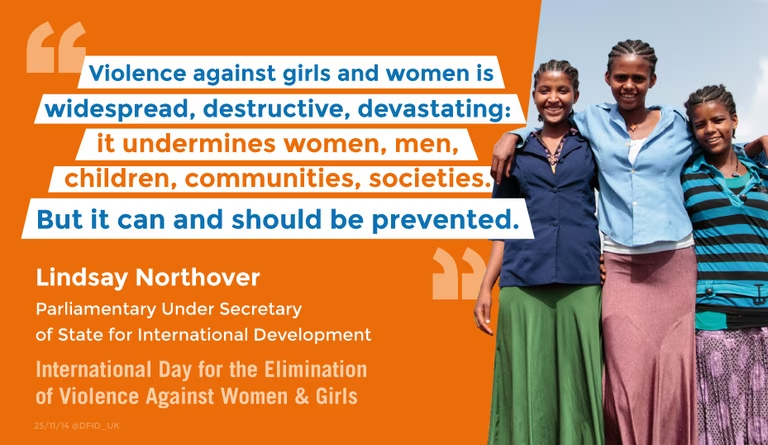
International Day for the Elimination of Violence against Women - November 25
Explore resources on the UN International Day for the Elimination of Violence Against Women (Nov 25) & the 16 Days of Activism against gender-based violence.
INTERNATIONAL DAY FOR THE ELIMINATION OF VIOLENCE AGAINST WOMEN - November 25
Discover the crucial fight for women’s rights and a world free from gender-based violence. Our guide offers in-depth information on gender equality, the need for systemic change, and how to stop domestic abuse and femicides.
Connect with valuable resources, initiatives, and organisations—for improved legal protections and hopes of a safer future for everyone.
Jump straight to our resources on ➡️ International Day for the Elimination Of Violence Against Women
*****
General Information
Officially designated by the United Nations General Assembly in 1999, this day seeks to raise awareness of gender-based violence around the world and eradicate it, for good. It is a sombre reminder of the scale of the issue, the urgency for systematic change, and the need to accelerate action towards gender equality.
"One woman or girl is killed every 10 minutes by their intimate partner or family member" - UN Women
Explore our comprehensive guides on 16 Days of Activism Against Gender-Based Violence Nov 25 – Dec 10, the One Billion Rising movement, women as victims of war, and the trafficking of women and girls.
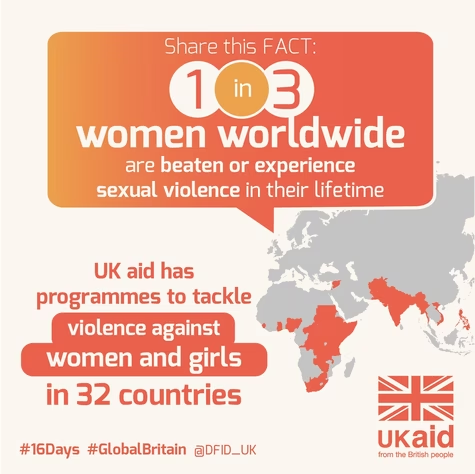
Globally, 1 in 3 women have been subjected to physical and/or sexual violence. In fragile countries with weak institutions, in economic crisis, or with large numbers of refugees, the numbers are even higher. The increasing prevalence of war and the severity of the climate crisis have exacerbated the problem, as displacement, resource scarcity, and the disruption of services increase the risk of violence.
The date November 25 was chosen to honour the plight of the Mirabal sisters, three political activists and revolutionaries from the Dominican Republic. They led the resistance movement against dictator Rafael Trujillo and were brutally assassinated in 1960. Their deaths turned them into symbols of democratic and feminist resistance and eventually helped to topple the brutal leader.
International Protections For Women
Despite the existence of more than 1,500 legislative measures across 193 countries to address violence against women, it is still a major public health problem and a serious violation of women's rights.
International declarations outline the rights women have to life, security, and their right to be free from discrimination and torture. This legislation has helped countries develop their own national policies, update and improve their laws, and establish a legal framework for gender equality.
-
1979 - The Convention of the Elimination of All Forms of Discrimination against Women (CEDAW)
Known as the International Bill of Women's Rights, this UN treaty defined for the first time what discrimination against women actually is. It then created an agenda to put an end to it. It has been ratified by 189 states that have committed to ending all forms of discrimination against women.
-
1993 - Declaration on the Elimination of Violence against Women (Resolution 48/104)
Adopted by the UN General Assembly to recognise the urgent need for the universal application of rights for women. It recognised violence against women as a human rights violation and was the first international instrument to address this issue. It provided the first-ever framework for national and global action.
The most progressive blueprint to date for advancing women's rights. It identified key areas in need of urgent attention and provided the roadmap for gender equality in all areas of life. More than 95% of institutional mechanisms for domestic and intimate partner violence were established after its creation.
-
2008 - UNiTE to End Violence against Women
Not a protection as such, but a global campaign managed by UN Women to catalyse governments, civil society, women's organisations, the private sector, and the media to join forces to end the global pandemic of violence against women and girls.
-
2014 - Council of Europe Convention on Preventing and Combating Violence Against Women and Domestic Violence
This landmark treaty on a pan-European level aims to protect women against all forms of violence. The convention also established a dedicated monitoring system (GREVIO) to ensure the effective implementation by parties.
Violence Against Women – An Epidemic
-
More than 370 million women and girls have experienced rape or sexual assault before the age of 18. When non-physical forms of sexual violence, such as online or verbal abuse, are included, the number almost doubles.
-
Out of all female homicides 60% are committed by intimate partners or family members.
-
Less than 40% of women who fall victim to violence seek help of any kind.
-
In 2022, only 14% of all women and girls lived in countries with robust legal protections that guarantee their fundamental human rights.
-
More than 60% of countries still lack rape laws based on the principle of consent.
-
Women with disabilities report a higher rate of all forms of intimate partner violence than women without.
-
Ninety-one per cent of trafficking victims for sexual exploitation are females.
-
In Egypt, an estimated 500,000 working days are lost each year due to marital violence.
-
Across the EU, the cost of gender-based violence was estimated at €289 billion a year.
Barriers & Challenges
Progress towards ending gender-based violence is stalling, as is progress towards many of the Sustainable Development Goals, which also affect women deeply.
In many societies, deeply entrenched cultural and societal norms perpetuate gender inequality and normalise violence against women. Traditional gender roles and patriarchal structures hinder change. These factors make it difficult to implement effective policies and interventions, especially when much of the violence is happening behind closed doors, and stigmatisation and fear of retribution prevent survivors from speaking up.
A lack of adequate resources and support systems for survivors, especially in developing nations, prevents women from accessing legal aid, healthcare, and safe housing. With no alternative, women are abandoned in a perpetual cycle, defenceless and voiceless.
Despite the urgency, funding to end violence against women has fallen by 13% between 2018/19 and 2020/21. The failure to address this funding gap is further worsened, as 99% of Official Development Assistance (ODA) never reaches local women's rights organisations.
Countries without legislation on violence against women experience higher rates and poorer outcomes for women. Conflict, climate change, fragility, oppressive leadership, and poverty all hit women the hardest. Countries with the highest levels of violence against women are India, Afghanistan, Syria, Somalia, Saudi Arabia, Pakistan, the Democratic Republic of Congo, Yemen, Nigeria, and the United States of America.
*****
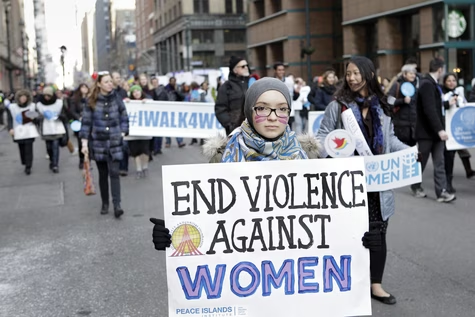
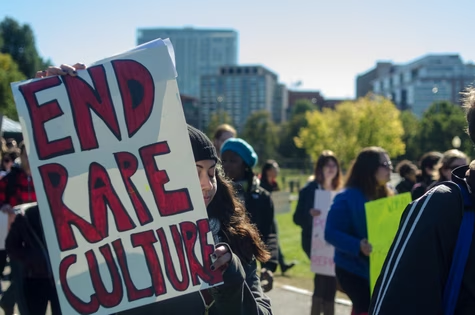
We must seize every opportunity that the Day for the Elimination of Violence Against Women brings. Speak up, join protests, raise awareness, and share articles such as this one on social media.
We cannot hope to end the harmful practices and societal norms that perpetuate this epidemic without calling out sexist language, behaviours, and practices. Whether at work, on the street, or at home, we demand a culture of respect, equality, and zero tolerance for sexual violence and harassment.
Educational campaigns on women's rights and access to legal representation, housing, and support are essential if policies to bridge the gender equality gap are to succeed.
"There is one universal truth, applicable to all countries, cultures and communities: violence against women is never acceptable, never excusable, never tolerable." - Ban Ki-moon
Author: Rachael Mellor 19.11.25, latest update 07.09.26, licensed under CC BY-SA 4.0
More Resources
Curated Directory & Deep-Dive Resources on International Day for the Elimination of Violence against Women - November 25
- COE - GREVIO 242031
- 16 Days Campaign 262224
- International Day for the Elimination of Violence against Women 25 November - UN 241880
- International Day for the Elimination of Violence against Women - Wikipedia 242022
- VIDEOS: EVAW 2024 - by Peace One Day 498074
- VIDEOS: EVAW 2023 - by Peace One Day 498075
- Istanbul Convention - Wikipedia 242029
- Standup International 242025
- Stand Up for Human Rights 242026
- UN official commemoration of the International Day for the Elimination of Violence against Women - UN Women 241879
- @UN_SPExperts - UN Special Procedures - Twitter 242027
- UN Women - Instagram 262240
- #EndVAW 499116
- @UN_Women 262234
- #16Days 262233
- #16DaysofActivism 262235
- #ForAllWomenAndGirls 498723
- #GenderBasedViolence 262236
- #orangetheworld 242024
- Orange the WORLD - Facebook 262241
- #Orangetheworld - Instagram 262238
- USAID 2021 statement 262222
- PAHO - International Day for the Elimination of Violence Against Women 2021 262232
- YouTube - International Day for the Elimination of Violence against Women 262244
- COE - International Day for the Elimination of Violence against Women 2021 262217
- Protesters worldwide demand end to violence against women - Al Jazeera 26.11.25 499113
- Tweet: Thousands of protesters marched through Madrid, Spain, on November 25 to mark the International Day for the Elimination of Violence against Women. - @Reuters 26.11.25 499115
- Violence against women: UN sheds light on global femicide crisis, digital abuse - UN News 25.11.25 499318
- Partners, family members killed 137 women each day in 2024 - Al Jazeera 25.11.25 499229
- A renewed call to end violence against women - European Commission 25.11.25 499112
- Tweet: “When women are destroyed, it’s not a women’s question. It’s a human question.” Denis Mukwege was awarded the 2018 #NobelPeacePrize for his work fighting against the u… 499114
- “No woman should live in fear of violence” - Council of Europe 24.11.25 498952
- International Day Against Violence Toward Women Finds Israel in Crisis - The Medialine 24.11.25 498954
- Statement: International day for the Elimination of Violence Against Women And Girls - Caritas 24.11.25 498953
- United Nations: Digital Violence Against Women Is Real Violence - Forbes 22.11.25 498721
- AI and anonymity fuel surge in digital violence against women - UN News 20.11.25 499322
- Lifetime toll: 840 million women faced partner or sexual violence - WHO 19.11.25 498720
- On International Day, Secretary-General Urges United Front to Stop Digital, Offline Violence against Women - UN 17.11.25 498722
- International Day for the Elimination of Violence Against Women, 2025 - IPS 13.11.25 500118
- 25N, International Day for the Elimination of Violence against Women - Pressenza 11/23 386126
- Virtual event: United Nations Official Commemoration of the International Day for the Elimination of Violence against Women 11/21 262223
- November 25: the Silence of Men - Pressenza 03.12.21 264449
- Turkish police fire tear gas at female protesters in Istanbul - Al Jazeera 26.11.21 262402
- The UK is facing an epidemic of violence against women and girls - Al Jazeera 25.11.21 262399
- Infographic: Mapping violence against women - Al Jazeera 25.11.21 262398
- All forms of violence against women and girls must stop - experts - Relief Web 24.11.21 262220
- Media advisory: International Day for the Elimination of Violence against Women (25 November) - UN Women 17.11.21 262218
- Mexico's emergency calls on violence against women spiked in 2020 - Global Citizen 26.01.21 242036
- FROM THE FIELD: Answering the call for help in Thailand - UN News 30.11.20 242033
- In picture: Protesters demand action on violence against women - Reuters 27.11.20 242037
- Free expression and the internet are key to combating violence against women - ifex 25.11.20 242038
- EU vows to put gender equality at heart of its foreign aid - Euro News 25.11.20 242034
- Webinar: UN official commemoration of the International Day for the Elimination of Violence against Women - UN Women 25.11.20 242041
- Video: International Day of Eliminating Violence against Women - UN Live stream on 25.11.20 262219
- International Day for the Elimination of Violence against Women 25 November - UN 262221
- Jelena Drenjanin: “The time to stop violence against women is now” - COE 24.11.21 262226
- On International Day, UN chief says ‘violence against women is not inevitable’ - UN News 24.11.21 262225
- Violence against women: When daily life becomes a nightmare - DW 24.11.21 262228
- Flemish cities light up to raise awareness of violence against women - Brussel Times 24.11.21 262227
- Measuring the shadow pandemic: Violence against women during COVID-19 - Relief Web 24.11.21 262231
- Gender-based online abuse surged during the pandemic. Laws haven’t kept up, activists say - Washington Post 24.11.21 262230
- Video: How can I help end violence against women and girls? - UN Women 23.11.21 262246
- Video: How do I help a silent victim of violence? - UN Women 23.11.21 262247
- Video: How do we end violence against women in conflict zones? - UN Women 23.11.21 262248
- Video: Which global policies protect women and girls from violence? - UN Women 23.11.21 262249
- Video: UN Women Executive Director: “Violence against women is a global crisis” - UN Women 22.11.21 262245
- Thousands march in France protesting violence against women - Al Jazeera 20.11.21 262229
- Newcastle turns orange to challenge violence against women - University of Newscastle, Australia 20.11.20 242035
- 16 Days, 16 Films: Raising awareness on violence against women - The Star 06.10.20 242040
- Orange The World for the International Day For The Elimination Of Violence Against Women - Forbes 22.11.19 242039
- Violence against women: Europe must become a zone of zero tolerance - COE 25.11.15 242030
- First International Day for the Elimination of Violence Against Women - History 25.11.99 242023
- Essential Services Package for Women and Girls Subject to Violence - UN Women, UNFPA, WHO, UNDP & UNODC 03/15 297099
- Fighting sexual misconduct in the midst of a pandemic - 2020 in review - UN High Commissioner for Refugees 301296