
Real News
Find credible, independent news by topic or country. Access global media outlets, investigative blogs, podcasts, and expert commentary in one platform.
REAL NEWS - Shaping An Informed & Engaged Future
Discover the vital world of factual, investigative journalism and learn how we can actively protect truth and democracy. Our real news guide offers you in-depth information on press freedom, media literacy, censorship, under-reported stories, and the battle against fake news.
Connect with hundreds of valuable resources, independent media outlets, and organisations – for genuine corporate media accountability, improved public awareness, and a better-informed future.
Jump straight to our 2,000 resources on ➡️ Real News
*****
General Information on News
News free from bias and censorship is essential to democracy, as well as political, social, and economic development.
Despite this, more than 80% of the world (almost 7 billion people) reside in countries where freedom of expression is suppressed, and journalists face harassment, threats, imprisonment, and even death just for exposing the truth.
A society that cannot trust the news is left uninformed, disempowered, and unable to hold leaders accountable. In the U.S., trust in the mass media has fallen to a record low of 28% in 2024. Globally, just 40% of people trust most news.
German speakers should visit our sister site, Bessere Welt Info, for 900 links to ➡️ Nachrichtenportale from a European perspective.
‘What we know is everything, it is our limit of what we can be,’ - Julian Assange.
*****
What Is Real News?
Real news is based on verifiable facts, credible sources, and ethical journalism standards. It is characterised by balanced reporting, transparency, and objectivity.
We have searched high and low to provide a platform where you can find only the most reliable news sources, all in one place. In our critical comments category, find top analysis of events from around the world and a special focus on issues in both the U.S. and the UK.
In real news by region, you can search for country-specific media outlets dedicated to issues in that area, and written by journalists on the ground, from a local perspective. If you are looking for news on a specific topic, discover a treasure trove of media organisations that specialise in your field of interest.
Find the most credible news sites on important issues such as environment, climate change, human rights, social justice, sustainability, peace, and all other major topics relating to our future.
Video news has transformed the way events are delivered to the public. Our recommended video news providers broadcast up-to-the-minute, reliable, and engaging stories.
As one of the fastest and most compelling ways to convey news, video is an excellent format to educate the world.
For news on the go, radio and podcasts have made keeping up with global events easier than ever. Check out our top selections of reliable and informative hosts, including The Take from Al Jazeera, and in-depth expert interviews from Democracy Now!
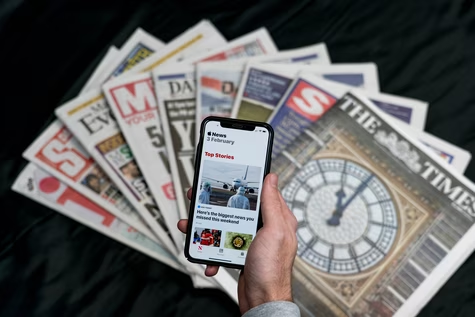
With social media now the primary source of news for more than 2.4 billion users, and with an unfathomable amount of information at our fingertips, it is essential that we can decipher fact from fiction. Endless scrolling, shock headlines, and unsourced articles and images are huge problems when trying to understand important issues.
We recommend following Better World Info's carefully chosen up-to-the-minute Twitter lists, featuring experts from all fields, and sorted by category. Check out our top social media accounts on Twitter, Facebook, and Instagram, featuring inspiring organisations and individuals to follow.
If you enjoy longer reads that provide the full picture, our recommended blog category is for you. We suggest informative and independent bloggers who focus on global issues. Don't forget to check out the Better World Info blog for new releases.
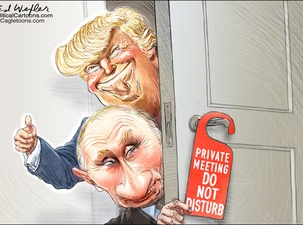
Finally, if you are craving something a bit different, we have collected a host of other kinds of special media we love, such as good news, political cartoons, censored and under-reported stories, and our personal highlights of real news that fall outside of standard categories.
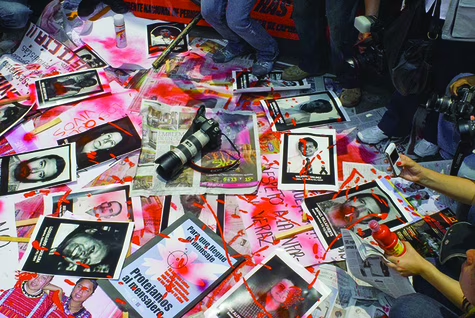
Why Is Freedom of the Press So Important?
A free, independent media allows the public to make informed decisions and hear opinions and comments from different perspectives - all free from governmental influence.
Journalists expose corruption, rights abuses, and greed, provide a platform for discussion, and serve as watchdogs of the powerful. It is no surprise that many governments and corporations wish to silence and censor the media.
To stifle criticism, many media organisations receive investment in return for editorial influence. Independent organisations remain starved of funds and are unable to compete with their subsidised rivals.
Media conglomerates have a similar effect: they weaken democracy and lead to less local news coverage. Find a wealth of information on the issue of corporate media giants, including corporate propaganda, perception management, whitewashing, and pro-war narratives.
Journalism has now become one of the most dangerous professions in the world. From 2016 to the end of 2021, UNESCO recorded 455 killings of journalists.
The year 2024 marked the deadliest year for journalists yet. At least 124 journalists and media workers were killed, nearly two-thirds of them were Palestinians reporting on the war on Gaza.
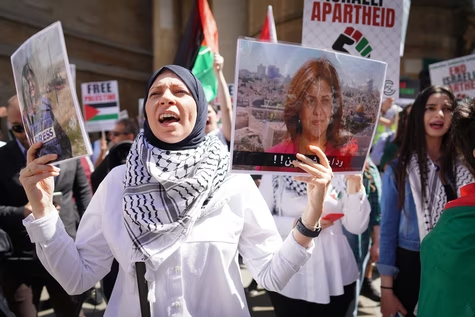
Just as concerning is the global rate of impunity for these murders. Nine times out of ten, the case remains unresolved, creating a continued cycle of violence.
We feature special guides to the courageous journalists Shireen Abu Akleh and Anna Politkovskaya, who were both tragically killed in the pursuit of truth and justice. Latin America is one of the most dangerous places for journalists, particularly in Mexico and Haiti.
Discover further information on press freedom and journalists as targets in Turkey, the UK, the U.S., and Israel, as well as freedom of expression as a fundamental human right, and the European Safety of Journalists Platform.
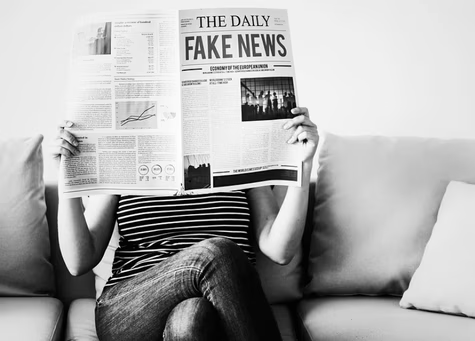
How To Tell Real News From Fake News - Media Literacy
-
Always check the credibility of the source. Research the website by checking the URL, its mission statement, the site's transparency, and whether it is easy to find its contact information.
-
Who is the author? All articles with integrity will name the author, provide a brief biography, and include contact information. Search for other articles under their name on different sites to look for consistencies, such as topics covered.
-
When was the story originally published? Check that you aren't mistaking a story for an event that happened in the past for an event that is currently developing.
-
Do not fall for shock headlines. Sensationalist headlines are misleading, out of context, and often exaggerated. They are designed solely to draw your attention and create reader bias before you have even started the main text. If it seems too good to be true, it probably is.
-
Are there any supporting sources? Credible journalists will list their sources either by embedding hyperlinks throughout the text or by providing a reference list at the end. Check these sources and see if they corroborate with the original article.
-
Was it intended as satire? Many news outlets use cartoons, out-of-context quotes, statistics, and images for comedic effect. Humour draws readers in and is entertaining, but it can also lead to misinterpretation.
How Can We Support Real News?
As independent media outlets are not subsidised by the government or other institutions, financial support is essential to maintain high-quality journalism. Subscriptions and donations are an excellent way to keep real news alive and journalistic standards high.
As social media becomes a dominant news source, these platforms have taken a huge share of advertising revenue with them. One argument against paying for news is that there is so much information available online for free, so why pay?
The truth is, good journalism is expensive. Readers who subscribe can source information critical of officials and the elite, delve deeper into topics, gain a broad, unbiased perspective on events, and trust the news they consume.
Another major benefit of paying for news is reduced advertising and better control over your personal data.
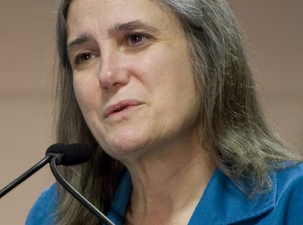
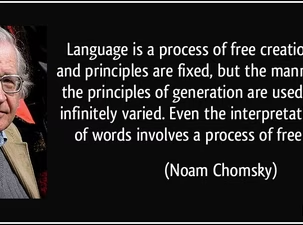
Our unique directory of journalists highlights the work of the world's most influential broadcasters, investigative journalists, and foreign correspondents. Learn more about the work of Glenn Greenwald, Noam Chomsky, Amy Goodman, and Abby Martin.

For more information on whistleblowers, check out our excellent guides on Julian Assange and his WikiLeaks project, Edward Snowden, Frances Haugen, Brittany Kaiser, Daniel Hale, and Chelsea Manning.
May 3rd marks World Press Freedom Day. This day is our opportunity to recognise the importance of a free press and remind us of the dangers and challenges that journalists face every day.
Real News For A Better World
Our Real News platform is designed to support activists, NGOs, non-profits, campaigners, educators, students, and anyone interested in making our world a better place. By providing access to real news outlets, sorting fact from fiction, and highlighting the work of incredible journalists, we hope to enable the spread of reliable and trustworthy information.
"Journalists are not entertainers. We are reporters. We go to places that are unpopular. We broadcast voices that are controversial. We are not here to win popularity contests. We are here to cover the issues critical to a democratic society. We have to pressure the media, to shame the media into going into these forgotten places where so many are sent to waste away in silence." - Amy Goodman.
*****
As a collaborative platform, Better World Info invites experts, NGOs, and activists to get involved!
Share your valuable resources, such as studies, reports, and campaigns, with our community and help spread the word about Better World Info.
We are a constantly expanding project dedicated to disseminating reliable, critical, and investigative information – for an informed, inquisitive, and critical world.
Author: Rachael Mellor, 22.10.23, latest update 08.07.26, licensed under CC BY-SA 4.0
More Resources
Curated Directory & Deep-Dive Resources on Real News
- Critical Comments 237
- Real News 335
- Video News 295
- Radio & Podcasts 123
- Top Social Media 649
- Recommended Blogs 76
- Other Media 269
- German Media Info (opens an external link) 1
Hot Topics
More Resources
Curated Directory & Deep-Dive Resources on Real News
- Eisenhower Media Network - tw 436127
- @OfficialZNET - Independent media. 435543
- @decensorednews - News with focus on primary source research. 435542
- @BTnewsroom 350625
- @globalmagazin 311812
- Truthout - Twitter 285757