World Day of Social Justice - February 20
An important day to raise awareness of global social injustice and promote efforts to eradicate poverty, gender inequality, exclusion, and other rights violations.
➡️ WORLD DAY OF SOCIAL JUSTICE, February 20 – Renewed Commitment
Established by the United Nations in 2007, this day raises awareness of the prevalence of social injustice around the world. It also promotes efforts towards eradicating poverty, gender inequality, exclusion, and other rights violations.
The 2026 theme is "Renewed commitment to social development and social justice." It comes at an important time, just after the Second World Summit for Social Development and the adoption of the Doha Political Declaration, which is our global commitment to accelerate social development.
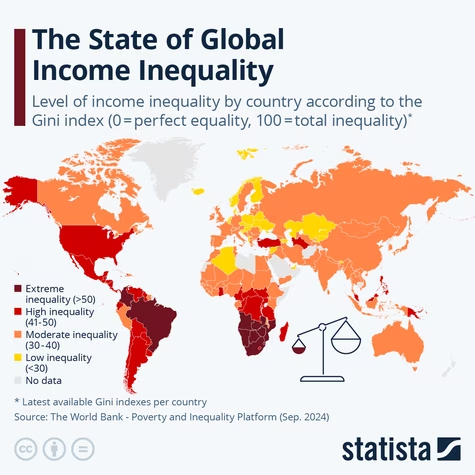
The top 0.001%, around 60,000 multimillionaires, now hold three times more wealth than the poorest half of the world's population combined. One in five people globally reports experiencing discrimination. Roughly 3.4 billion people live on less than $5.50 a day. The time to close the social justice gap is now.
"Injustice anywhere is a threat to justice everywhere" - Martin Luther King Jr
*****
Jump straight to our resources on ➡️ World Day of Social Justice
Explore our comprehensive guides on -
-
The Sustainable Development Goals (SDGs)
-
Social Policy & Social Protection in a Developing Setting
The State of Global Social Justice
The 2025 International Labour Organisation (ILO) State of Social Justice report paints a bleak picture of slowed progress on tackling poverty, child labour, and inequality. This "flagship report positions social justice not as a luxury but as a foundational pillar for peace, stability, cohesion, and sustainable development".
Progress:
-
Rates of child labour have fallen from 20.6% in 1995 to 7.8% in 2024.
-
Global secondary school completion rates have increased by 22% since 2000.
-
Extreme poverty dropped from 4 in 10 people in 1995 to 1 in 10 in 2023.
Challenges:
-
800 million people still live on less than $3 per day.
-
One in four people lacks access to safely managed drinking water.
-
The top 1% of the population earn 20% of global income and hold 38% of wealth.
-
The labour force participation gap between men and women has narrowed by only 3% since 1995.
-
A massive 58% of all workers are still in informal employment.
New Threats to Social Justice
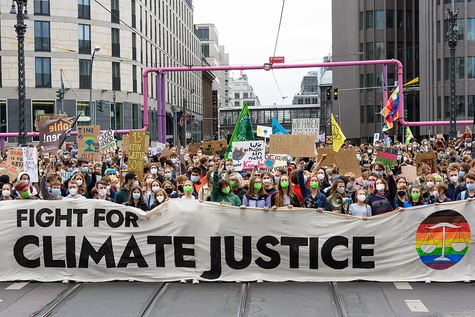
Climate Injustice
The climate crisis is exacerbating existing inequalities, especially in developing nations. The Emergency Events Database reports a record rise in natural disasters globally since the 1960s, detailing over 26,000 mass disasters. The number of reported natural disaster incidents increased from 39 in 1960 to 399 in 2023.
Annually, 218 million people are affected by natural disasters, and 68,000 lives are lost every year because of them. The impacts of natural disasters are unevenly distributed. Some regions are more prone due to geographical factors, and some are more vulnerable due to economic and social factors. These climate-sensitive regions are victims of climate injustice, as those who historically contributed least to the climate crisis are suffering the worst effects of it.
More than 91% of extreme weather-related deaths occur in developing countries, further demonstrating the unequal burden of marginalised and vulnerable populations. With 2024 marking the warmest year on record globally, humanity has failed to keep global heating to within safe limits.
The climate crisis is now one of the biggest threats to humanity, with far-reaching impacts on peace, health, human rights, social justice, and our environment. There are 250 million people who have been displaced by environmental changes, and counting. As a driver for displacement, conflict, and land and resource grabs, climate change is now a leading cause of humanitarian crises and widespread injustice.
Big Tech & Artificial Intelligence
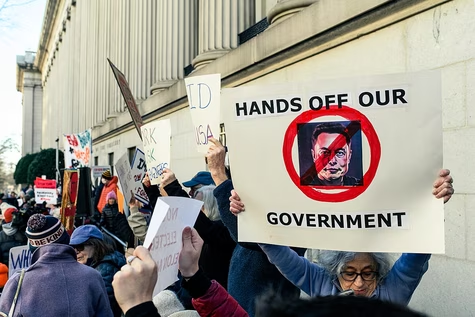
Emerging technologies are advancing at breakneck speed, far outpacing regulation and safety policies. The tech industry drives economic and social inequalities, unsustainable levels of consumerism, greenhouse gas emissions, regressive policy, deregulation, undemocratic processes, unfair competition, labour exploitation, unchecked power of elite individuals, and the polarisation of society.
Big Tech is also a huge threat to democracy. This immense concentration of power in the hands of so few opens the door to surveillance, exploitation, control, lobbying, and the erosion of trust and truth. With such immense control over how information is disseminated, shaping public discourse becomes child's play. The public depends upon open, fair, and transparent information to make decisions that democracies depend on. Big Tech can easily influence election outcomes, and through lobbying and threats to withhold investments, it can also influence policy, prevent tougher regulation, and obstruct autonomy.
There is an urgent need for stricter regulation, accountability, and a separation of the elite and state like never before. Research by MGI estimates that global tech spending will grow to $11.47 trillion in 2026 and shows no signs of slowing. The rise in cloud computing, artificial intelligence, and cybersecurity is fuelling the industry's profitability and lining the already bulging pockets of tech billionaires, further widening wealth disparities.
Concerns about discrimination in AI are also pressing, especially when used in welfare, policing, migration, and healthcare. AI recruitment tools have been found to discriminate against women and minorities, and algorithms in finance have disadvantaged marginalised groups in lending and banking.
Surveillance is being increasingly used to target activists, rights defenders, and journalists in a move that threatens press freedom and free speech. Facial recognition software is riddled with misidentification issues of Black and Asian individuals.
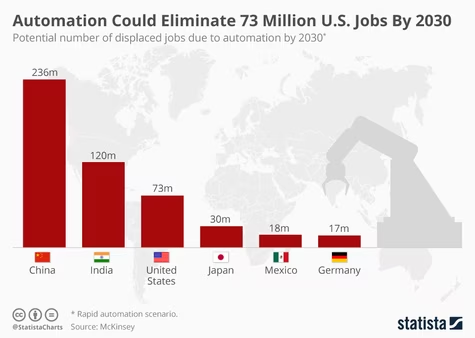
AI has the potential to cause large-scale job displacement, which disproportionately affects lower-income jobs. This will widen income inequality gaps even further as the demand for lower-skilled workers reduces. We are already witnessing the amplification of existing biases, automation of discrimination, and the gap between privileged and marginalised groups grow ever larger. Technology is a huge social justice issue which must be addressed if we are ever to achieve fairness in our societies.
Conclusion
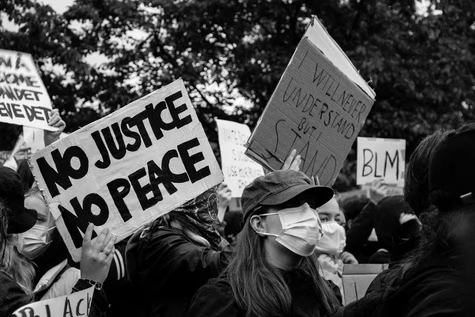
The world is currently experiencing three major societal transitions: climate change, technological change, and demographic change. How they are managed along with other existing injustices will strongly determine our success in creating a more inclusive, equal, and just world.
While some gains have been made, persistent structural inequalities, labour issues, gender disparities, and declining trust in institutions are barriers to inclusive and sustainable development. Multilateral cooperation, funding, and stronger policies in economic, social, and environmental areas are essential.
The loss and damage fund, for example, was poised to be a significant breakthrough for developing countries on the frontline of climate change. Financial commitments, however, have fallen well short of the $400 billion needed annually to adequately address climate injustices.
The World Day of Social Justice is a much-needed boost, providing renewed momentum and recognising that peace and security are impossible without social development. While we navigate our changing world, we must put equity and solidarity at the heart of policies, institutions, and communities.
"Justice does not flow automatically from economic growth but must be actively pursued through political will, institutional reform, and inclusive governance, with policy choices shaping whether transitions lead to opportunity or exclusion." - ILO
Author: Rachael Mellor, 25.02.26 licensed under CC BY-SA 4.0
For further reading on World Day of Social Justice see below ⬇️
More Resources
Curated Directory & Deep-Dive Resources on World Day of Social Justice - February 20
- Social Justice Day - United Nations 175047
- World Day of Social Justice - Wikipedia 175048
- World Day of Social Justice - UN 398346
- Google News 175049
- Event: World Day of Social Justice, ILO 20.02.24 10.00 AM 398345
- #WorldDayofSocialJustice - tw 273998
- #SocialJusticeDay - tw 274047
- #WorldSocialJusticeDay - tw 274049
- #worldsocialjusticeday2022 - tw 274048
- #WorldDayofSocialJustice - fb 274051
- #SocialJusticeDay - fb 274052
- #socialjusticeday - ig 274053
- #worlddayofsocialjustice - ig 274054
- #worlddayofsocialjustice2022 - ig 274055
- YouTube - World Day of Social Justice 273997
- World Day of Social Justice - telesurTV 175050
- World Day of Social Justice: Theme, history, significance and all you need to know 274050
- World Day Of Social Justice 2026 on "Renewed Commitment to Social Development and Social Justice" - UN 20.02.26 510229
- World Day of Social Justice 2026 - SDG Resource Centre 20.02.26 510230
- World Day of Social Justice 2026: A call to conscience - Islamic Relief 20.02.26 510231
- World Day of Social Justice 2026: What role should business leaders play in advancing social justice? - Fair Play Talks 20.02.26 510232
- World Day of Social Justice - Borgen Project 06.04.25 465037
- World Day of Social Justice Statement by Education Cannot Wait Director Yasmine Sherif - IPS 20.02.25 460618
- World Day of Social Justice 2025 - ILO 20.02.25 461083
- World Day Of Social Justice 2024: Why Are Equal Rights Mandatory For Inclusive Growth? - Free Press Journal 19.02.24 398348
- Tweet: 20 February is World Day of Social Justice! Join the ILO discussion with high level speakers on how to put social justice at the centre of policy agendas - @ilo_CEE 19… 398347
- Meet the social justice warriers of India for this year's World Day of Social Justice - CSR Journal 18.02.20 199113
- World Day Of Social Justice To Be Observed On Feb 20 - Urdu Point 2/18 175051
- Ahead of Social Justice Day, UN agency calls for fair labour migration governance - UN News 2/18 175052