
Ubuntu Philosophy
Explore Ubuntu philosophy and the principle of "I am because we are." Learn how community, compassion, and interconnectedness promote a better world.
UBUNTU PHILOSOPHY - South African Counter To Western Individualism
Discover the concepts behind Ubuntu philosophy and learn how we can all begin to rebuild community. Our guide offers you in-depth information on interconnectedness, communal harmony, and empathy.
Connect with valuable resources for genuine collective well-being, improved human connection, and a less divided future.
Jump straight to our resources on ➡️ Ubuntu Philosophy
*****
General Information
Ubuntu is a humanist African philosophy that translates to "I am because we are". The idea emphasises that humanity is a shared experience and that we find our place through relationships with others.
Core principles of Ubuntu include compassion, community, respect, dignity, and empathy. These concepts are frequently overlooked in Western societies, as success is often measured by individual goals. In contrast, Ubuntu prioritises community needs over individual desires.
Ubuntu is not a political system but a way of life. It emphasises that fostering a sense of communal humanity makes everyone stronger.

The History Of Ubuntu
The name Ubuntu comes from the Nguni Bantu language of Southern Africa. There are many different interpretations, but the most common ones translate to "A person is a person through other people" and "humanity to others."
Ubuntu refers to a set of Bantu-origin African value systems. The concept appeared in South African written sources from as early as the mid-19th century, but its existence predates written records.
The philosophy has developed over time and has many other names in other African languages. Many Africans apply Ubuntu in their daily lives; its ideas can also be seen in business, education, and politics.
Despite its many definitions and interpretations across ethnic groups, the common theme is always collectivism over individualism. We are not isolated individuals, but rather, we are a part of a greater whole where everyone's growth is connected to the success of the community.
In daily life, Ubuntu promotes equality. For example, by distributing wealth, the community can protect itself from issues such as individual crop failures. It creates a culture of vested interest in the community and its collective prosperity.
Another key theme of Ubuntu is restorative justice and reconciliation. In contrast to the Western standard of punitive action, Ubuntu focuses on healing broken relationships, repairing harm, and fostering sustainable peace. This ideology was a key theme in South Africa's post-apartheid transition.
Ubuntu became popularised as a worldview in the 1950s, drawing attention for countering the increasingly individualistic culture spreading in the West. The first publication featuring Ubuntu as a philosophical concept was published in 1980, "Hunhuism or Ubuntuism: A Zimbabwe Indigenous Political Philosophy", written by historiographer and educationist Stanlake J. W. T. Samkange.
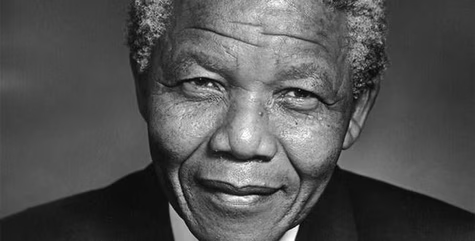
Influential Champions Of Ubuntu
-
Nelson Mandela - Mandela is one of the most widely known practitioners of Ubuntu. During South Africa's transition from apartheid to democracy, he embraced the values of reconciliation, forgiveness, and unity. Inviting his former jailers to his inauguration was an embodiment of Ubuntu principles.
-
Archbishop Desmond Tutu - Tutu brought the concept of Ubuntu to the global stage with his definition as the "essence of being human". He used the values of Ubuntu to guide his work with the Truth and Reconciliation Commission, the official body tasked with investigating and reporting on past human rights violations in South Africa. He used it as a framework to shift the focus from revenge to national healing.
-
Wangari Maathai - Maathai is a Kenyan environmentalist who was awarded the Nobel Peace Prize in 2004 for her contributions to sustainable development, democracy, and peace. Her work is heavily influenced by traditional African values and, in the spirit of Ubuntu, draws connections between environmental conservation, community well-being, and women's rights.
-
Queen Nzinga Mbande - Mbande was a 17th-century monarch of kingdoms which now lie in present-day Angola. Her leadership is an early example of Ubuntu-inspired leadership. She is deeply respected for her 3-decade-long resistance to Portuguese colonial expansion and for her dedication to the collective well-being of her people.
-
Seretse Khama - Khama served as the first President of Botswana, holding the position from 1966 to 1980. Embodying the philosophy of Ubuntu through inclusive governance, his leadership transformed Botswana from one of the poorest nations in Africa to one of the most stable.
-
Audrey Tang, a Modern Non-African Example - Tang is the highly celebrated Cyber Ambassador of Taiwan, whose work focuses on using technology to strengthen democratic processes and foster social connections. Embracing the concept of interconnectedness in Ubuntu, her core concept of "Plurality" advocates for technology that helps people work with differences rather than be divided by them. She believes that technology can give citizens a direct role in policymaking and rebuild trust.

South Africa's Post-Apartheid Transition
The concept of Ubuntu was instrumental in South Africa's peaceful transition to democracy. It helped prioritise reconciliation and restorative justice, thereby avoiding civil war, further violence, and acts of retribution.
With a focus on compassion, forgiveness, and human dignity, Archbishop Desmond Tutu used Ubuntu to lay the foundation for the Truth and Reconciliation Commission (TRC). The ideology was used to help heal the deeply divided society.
The Epilogue of the Interim Constitution of South Africa (1993), which established the legal foundation for national reconciliation, states "there is a need for understanding but not for vengeance, a need for reparation but not for retaliation, a need for ubuntu but not for victimisation".

The Global Relevance Of Ubuntu
Urbanisation, modern politics, individualism, nationalism, and capitalism sadly often undermine many of Ubuntu's values, including empathy, compassion, and community spirit. Humanity to others is rarely considered a priority in the West.
Academics, human rights defenders, and social workers support integrating Ubuntu values into Western societies. It is not just an African ideology as it offers a framework for building harmonious relationships, fostering social cohesion, respecting our environment, promoting sustainability, and creating more inclusive communities. In fact, it can be applied to all aspects of modern life, regardless of geographical location.
In a world often divided by individualism and competition, Ubuntu values are a reminder of the power of communities, shared responsibility, and collective well-being. On a larger scale, it can be integrated into justice systems, social work, AI development, and corporate social responsibility business models.
In fast-paced, success-driven Western societies, it is easy to feel isolated, become selfish, and ignore the struggles of those around us. Ubuntu teaches us that we are stronger together. If individuals, corporations, and governments were to embrace this lesson, the world would be a much kinder, more empathetic, and more inclusive place.
Instead of world leaders ruling with ultimate authority, driven by efficiency and data-driven decision making, the Ubuntu philosophy turns that notion on its head. It teaches us that leadership should be participatory and benefit the many, not the few.
In education, Ubuntu can be used to reshape relationships among teachers and students, and among students themselves. Students can help each other succeed, diversity is celebrated, and all voices are valued. Incorporating Ubuntu into teaching shifts the focus away from academic achievement and onto nurturing the person as a whole.
In conflict regions, Ubuntu values have been used to promote peaceful mediation, encourage dialogue, and restore harmony. Conflicts driven by greed and the desire for power are met with empathy, consensus-based solutions, and a commitment to the greater good for humanity.
Justice is then achieved by repairing harms, facilitating forgiveness, and ensuring that all opportunities for sustainable peace are taken.

Ubuntu For A Better World
Ubuntu has been described as the antidote to the Western culture of individualism that often ignores the "common good". As demonstrated many times, Ubuntu has proven the power of compassion and collective responsibility.
Embracing the philosophy of Ubuntu, Better World Info advocates a shared international response to global challenges such as climate change and war. They see knowledge as a communal resource and believe that everyone should have access to free, impartial, and trustworthy information.
With over 750,000 curated links on important global issues, they help to democratise information and empower citizens to take action. Better World Info works hard to connect individuals and organisations around the world to foster a "network of humanity".
Covering themes such as peace, social justice, nonviolence, democracy, and human rights, there is much common ground between the Ubuntu philosophy and Better World Info. Both are vital tools to catalyse progress towards a more equal, prosperous, and sustainable world.
Author: Rachael Mellor, 24.03.26, latest update 01.09.26, licensed under CC BY-SA 4.0
More Resources
Curated Directory & Deep-Dive Resources on Ubuntu Philosophy
- Ubuntu philosophy - Wikipedia 511022
- YouTube Search 511431
- Google News 511433
- Google Images 511436
- Google Scholar 511435
- The beautiful African philosophy of Ubuntu – An antidote to individualism - Listening Partnership 511430
- Zimbabwe Launches Five-Year National AI Strategy, Rooted in Ubuntu Philosophy and Sovereign Data Principles - iAfrica 16.03.26 511785
- Beyond Western Peacebuilding Frameworks: Assessing Ubuntu’s Effectiveness in African Conflict Resolution - Peace News 04.03.26 511784
- Africa’s Ubuntu economics takes the G20 stage - OMFIF 28.11.25 511782
- South Africa’s G20 Ubuntu legacy for Africa - African Business 07.11.25 511786
- Integrating Ubuntu: embedding African philosophy into disaster risk reduction and management - Frontiers 03.09.25 511781
- Understanding the Meaning of Ubuntu: A Proudly South African Philosophy - The Culture Trip 27.08.25 511783
- Ubuntu philosophy, values, and principles: An opportunity to do social work differently - Sage Journals 23.01.25 511696
- While much Western philosophy places the individual at the center of existence, Ubuntu is a system of thought structured around the community - Reddit, 2025 511697
- Ubuntu philosophy, values, and principles: An opportunity to do social work differently - JSW, 2025 511777
- Ubuntu - School of Philosophy 04.12.23 511699
- Ubuntu - School of Philosophy & Economic Science 12/23 511429
- How would Ubuntu respond to the crises in the world today - LSE 15.11.23 511695
- How would Ubuntu respond to the crises in the world today - LSE 11/23 511434
- Ubuntu, Peacebuilding, and Development in Africa: Reflections on the Promises and Challenges of a Popular Concept - Springer Nature Link 18.10.23 511788
- What is Ubuntu Philosophy & What Can We Learn From it? - Allison Task 23.02.23 511778
- Video: What we can learn from the African philosophy of Ubuntu - BBC Global 25.02.22 511701
- Ubuntu: I Am Because We Are - Lion's Roar 09.02.22 511702
- Regions of the world - T&F Online 30.07.21 511700
- Video: Living Ubuntu; we rise by lifting others | Getrude Matshe | TEDxAuckland 4/21 511432
- An Analysis of the Influence of Ubuntu Principle on the South Africa Peace Building Process - JGPC 12/15 511789
- Journal: African "Ubuntu" Philosophy and Global Management - JSTOR, 2009 511780
- What does ubuntu really mean? - Guardian 29.09.06 511779
- 'I Am Because We Are': The African Philosophy of Ubuntu - TT Book 511698
- Hunhu/Ubuntu in the Traditional Thought of Southern Africa - IEP 511703
- Ubuntu: The African Philosophy of interconnectedness - Leadership Forum 511775
- The beautiful African philosophy of Ubuntu – An antidote to individualism - Listening Partnership 511776
- Ubuntu is an inspiration for leaders worldwide - Kennedy Benelux 511787