
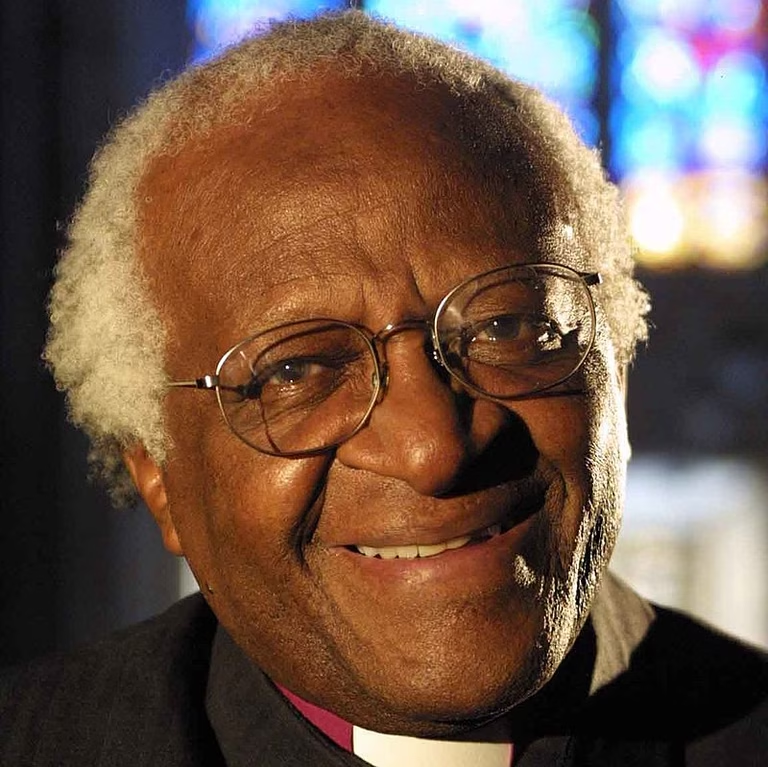
Desmond Tutu (South Africa)
Excellent resource on the late Archbishop of Cape Town – fought for climate, peace, education and minorities | Truth and Reconciliation Commission
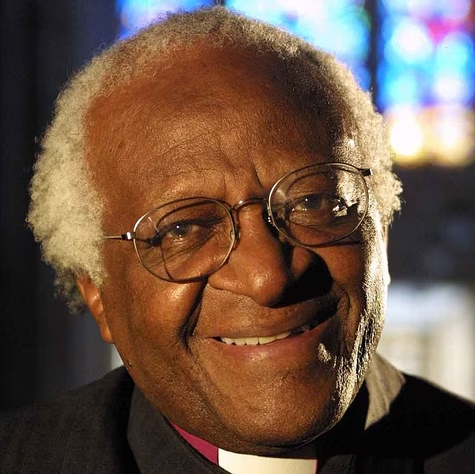
Desmond Tutu, a beacon of moral integrity and an indefatigable advocate for justice, stands as one of the most revered figures in the struggle against apartheid in South Africa. As the first black Archbishop of Cape Town and a Nobel Peace Prize laureate, Tutu wielded his influence to champion human rights and equality. His unwavering commitment to non-violence and reconciliation played a pivotal role in dismantling the oppressive apartheid regime. Tutu's voice resonated far beyond the borders of South Africa, inspiring global movements for social justice. His legacy continues to guide those who strive for a fairer, more compassionate world.
*****
Desmond Tutu was a towering figure in the fight for human dignity and equality. Born in 1931 in Klerksdorp, South Africa, he rose to prominence during the darkest days of apartheid. As an Anglican clergyman, Tutu's moral authority was undeniable. He became the first black General Secretary of the South African Council of Churches, using his position to challenge the brutal policies of racial segregation.
Tutu's approach was marked by a profound commitment to non-violence and reconciliation. Awarded the Nobel Peace Prize in 1984, he was recognised for his exceptional role in opposing apartheid without resorting to violence. His leadership was instrumental in the formation of the Truth and Reconciliation Commission, which aimed to heal the wounds of apartheid through truth-telling and forgiveness.
Beyond his work in South Africa, Tutu was a global advocate for human rights, speaking out against injustice wherever it occurred. His advocacy extended to issues such as poverty, HIV/AIDS, and climate change, reflecting his belief in the interconnectedness of human struggles. Tutu's legacy is one of hope, resilience, and an unyielding belief in the power of forgiveness and unity.
More Resources
Curated Directory & Deep-Dive Resources on Desmond Tutu (South Africa)
- Biography of Desmond Tutu - Nobel Peace Prize 1984 10851
- Desmond Tutu Nobel Lecture 1984 10850
- Desmond Tutu - Wikipedia 10861
- Desmond Tutu Peace Center - Cape Town 10853
- Global Elders - Wikipedia 10865
- The ELDERS 10864
- Books by Desmond Tutu (amazon) 10862
- YouTube 10868
- Our Tweet on Desmond Tutu - please share 266714
- Our Facebook post on Desmond Tutu - please share 266716
- Our Instagram post on Desmond Tutu - please share 266715
- Anglican Diocese of Cape Town - Wikipedia 10895
- Curriculum Vitae of Desmond Tutu - Nobel Peace Prize 1984 10852
- Creative Quotations from Desmond Tutu 10881
- CommonDreams 10871
- Desmond Tutu Peace Foundation - Twitter 10856
- Nobel Peace Prize - Desmond Mpilo Tutu 1984 10877
- Democracy Now! 10872
- Guardian News 10870
- Google News 10869
- Google Scholar 10876
- Google Search 10875
- Interviews with Desmond Tutu on PBS 10880
- Jackie Robinson (1919-1972) - Wikipedia 10898
- King's College London - Desmond Tutu 10857
- Lesson Plan - Desmond Tutu 10893
- Naomi Tutu - Speaker Profile 10896
- PEACE JAM 10866
- PeaceJam Profile - Desmond Tutu 10860
- PeaceJam - Wikipedia 10867
- Questia Books 10874
- Scholarships at KCL (Desmond Tutu) 10858
- South Africa under Apartheid - Wikipedia 10878
- Tutu Foundation UK - London 10859
- Trevor Huddleston (1913-1998) - Wikipedia 10897
- Ubuntu philosophy - Wikipedia 266769
- #BishopTutu 266717
- #DesmondTutu 266713
- #TruthandReconciliation 266725
- Archbishop Desmond Tutu: tributes paid to ‘a moral giant’ after anti-apartheid hero dies – latest updates (Guardian) 266726
- Humanity and Hope: Desmond Tutu - Pressenza 11.04.23 340310
- Why We as Global Citizens Must Continue Archbishop Desmond Tutu’s Legacy - Global Citizen 12.01.22 269637
- Remembering Desmond Tutu, Superstar of PeaceJam - Westword 06.01.22 267482
- What is aquamation? The process behind Desmond Tutu’s ‘green cremation’ - Guardian 02.01.22 267694
- Video: Desmond Tutu's daughter leads tributes as South African cleric laid to rest - Guardian 01.01.22 267599
- Desmond Tutu laid to rest at state funeral in Cape Town - Guardian 01.01.22 267598
- Can white South Africa live up to Ubuntu, the African philosophy Tutu globalised? - Guardian 31.12.21 268843
- Hundreds pay respects to Desmond Tutu ahead of low-key funeral - Guardian 31.12.21 267500
- In Pictures: Songs and tears at interfaith service for Tutu - Al Jazeera 30.12.21 267397
- When Desmond Tutu stood up for the rights of Palestinians, he could not be ignored - Guardian 30.12.21 273527
- Desmond Tutu, Rest in Power - Democracy Now! 29.12.21 267349
- Amnesty International pays tribute to Archbishop Desmond Mpilo Tutu 1931 – 2021 - Amnesty 29.12.21 268901
- “His Spirit Reflected a Giant”: Mumia Abu-Jamal Remembers Archbishop Desmond Tutu’s Visit on Death Row - Democracy Now 28.12.21 267158
- Archbishop Desmond Tutu to lie in state in Cape Town for two days - Guardian 28.12.21 267131
- Archbishop Desmond Tutu (1931-2021) on Apartheid, War, Palestine, Guantánamo, Climate Crisis & More - Democracy Now 27.12.21 267159
- Tutu’s passing is a reminder of the ANC’s unfinished business - Al Jazeera 27.12.21 267336
- ‘We looked up to him’: South Africa begins week of mourning for Desmond Tutu - Guardian 27.12.21 266875
- Archbishop Desmond Tutu: father of South Africa’s ‘rainbow nation’ - Conversation 26.12.21 267545
- Archbishop Desmond Tutu, Defender of Human Rights in South Africa and Beyond, Dies at 90 - CD 26.12.21 267048
- Archbishop Desmond Tutu, giant in fight against apartheid South Africa, dies at 90 - Guardian 26.12.21 266712
- Archbishop Desmond Tutu was the best kind of troublemaker - Economist 26.12.21 266772
- Anti-apartheid hero Archbishop Desmond Tutu dies aged 90 - Guardian 26.12.21 266791
- Desmond Tutu left us - Roberto Valent 26.12.21 273528
- Desmond Tutu taught us all the true meaning of greatness - Guardian 26.12.21 266887
- The Elders mourn the loss of Archbishop Desmond Tutu 26.12.21 266719
- The Most Rev Desmond Tutu obituary - Guardian 26.12.21 266766
- South Africa set for battle over legacy of ‘moral compass’ Desmond Tutu - Guardian 26.12.21 266790
- ‘A patriot without equal’: world mourns death of Desmond Tutu - Guardian 26.12.21 266792
- 'A generous, wonderful life': tributes pour in for Archbishop Desmond Tutu – video 26.12.21 266768
- Desmond Tutu, Whose Voice Helped Slay Apartheid, Dies at 90 - NY Times 26.12.21 266718
- Desmond Tutu taught us all the true meaning of greatness - Bob Geldof 26.12.21 266764
- Anti-apartheid hero Archbishop Desmond Tutu dies aged 90 - Guardian 26.12.21 266727
- Video: Remembering Archbishop Desmond Tutu - The Elders 26.11.21 266720
- Archbishop Desmond Tutu: a life in pictures - Guardian 26.12.21 266767
- Desmond Tutu wins Templeton prize for advancing 'spiritual progress' - Guardian 4/13 10882
- Why I had no choice but to spurn Tony Blair - Observer 9/12 10883
- Tony Blair and George Bush should be tried over Iraq, claims Desmond Tutu - Metro 9/12 10884
- The Russell Tribunal on Palestine can promote peace, truth and reconciliation - Guardian 11/11 10885
- Desmond Tutu calls for wealth tax on white South Africans - IrishTimes 8/11 268860
- At 79, Tutu gives up public life to 'grow old gracefully' - Independent 7/10 10886
- It's time to rid the world of nuclear weapons - Guardian 5/10 10887
- Tutu: Gaza blockade abomination - BBC 5/08 10888
- Conversation with Archbishop Tutu - Bill Moyers 12/07 10889
- Fmr. South African Archbishop Desmond Tutu: Israel Should Heed Lessons of Scripture - and Apartheid 11/07 10890
- Archbishop Desmond Tutu - PBS 10/99 10891
- Archbishop Desmond Tutu with Bill Moyers 4/99 10892
- Bishop Desmond Tutu's Address to the Interfaith Pilgrimage of The Middle Passage - Atlanta 9/98 (Archive) 10894
- Cape Town - Wikipedia 10900
- Date & Time - Cape Town 10899
- Google Images 10873
- Desmond Tutu Diversity Trust - South Africa (Archive) 10854
- Desmond Tutu Peace Foundation - New York (Archive) 10855
- NONVIOLENCE
- Nelson Mandela (South Africa)
- Reconcilation - Post Conflict
- The Elders (Global)
- PeaceJam - young leaders
- KEYSTONE XL Pipeline & TAR SANDS
- IRAQ
- Apartheid in South Africa (1948-1994)
- APARTHEID WALL & Palestinian Bantustans
- SOLIDARITY with Palestine & Gaza Flotilla
- Church of England
- South Africa
- The Nobel Peace Prize
- World Summit of Nobel Peace Laureates