Ongoing U.S. Interference
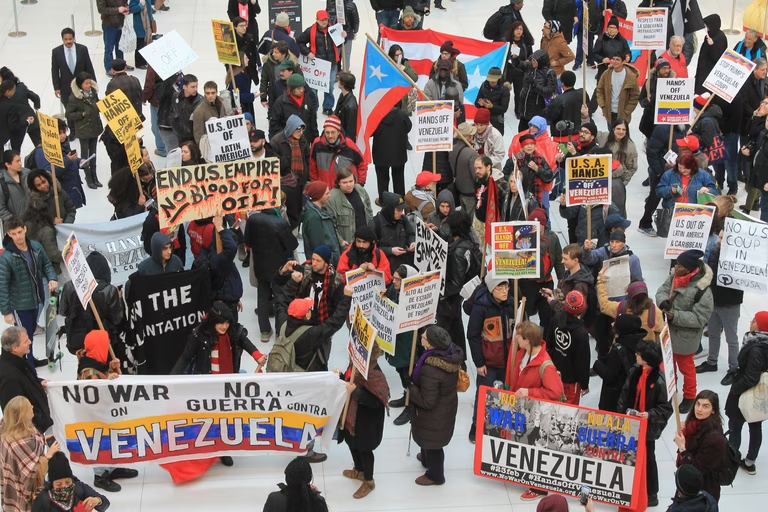
Ongoing U.S. interference in Venezuelan politics and oil has devastated the country. The recent kidnapping of President Maduro broke international laws.
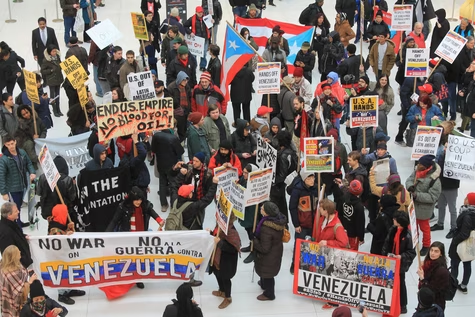
➡️ U.S. INTERFERENCE IN VENEZUELA – Naked Imperialism & A Dangerous Precedent
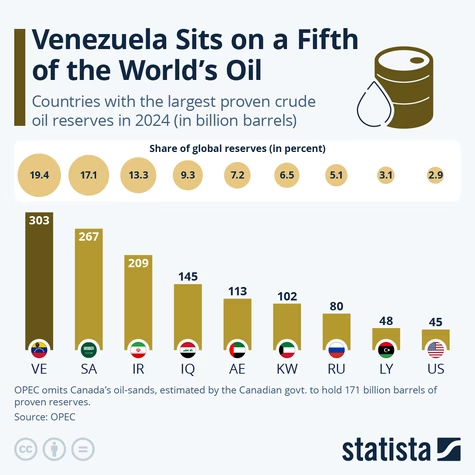
The U.S. has a long history of meddling in Latin America, and Venezuela is no exception. In the 20th century, the vast majority of U.S. interference was motivated by Venezuela's massive oil reserves.
They have backed repressive dictators, brutal regimes, and military dictatorships, as long as they were generous to transnational corporations.
Under the thin guise of narco-terrorism, the most recent military intervention, 'Operation Absolute Resolve', resulted in the kidnapping of Venezuelan president Nicolás Maduro and his wife.
Shortly after U.S. President Donald Trump proclaimed, "American dominance in the western hemisphere will never be questioned again"
Jump straight to our resources on ➡️ U.S. Interference in Venezuela
Explore our comprehensive guides on -
-
➡️ U.S. Regime Change in Venezuela
-
Political Situation in Venezuela
-
U.S. Sanctions on Venezuela
-
U.S. Imperial Wars Abroad
-
Human Rights in Venezuela
*****
Two Decades Timeline of Escalating Tensions
-
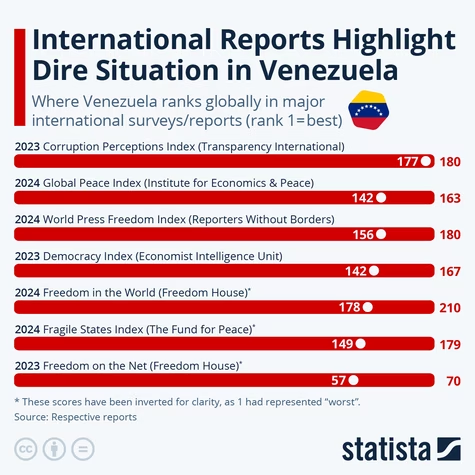
1999 - Controversial left-wing socialist Hugo Chavez became president and challenged U.S. imperialism. In 2007, he completed the nationalisation of foreign oil projects in Venezuela, a project which began in 1976. The now state-owned oil sector was named PDVSA.
-
2000s - Chavez works hard to strengthen ties with Russia, China, and Iran. He uses massive oil profits to fund social programmes, but corruption and mismanagement impede progress. Chávez expels U.S. NGOs and diplomats.
-
2002 - An attempted coup removes Chavez from office for 48 hours. The U.S. denies involvement.
-
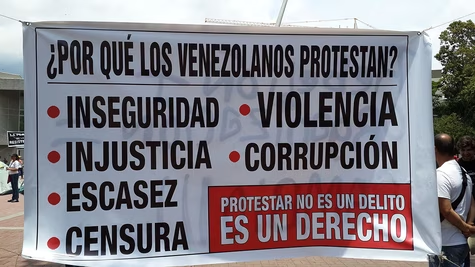
2013 - Maduro, as the longstanding deputy to Chavez, takes the presidency after winning the election by a fraction. Relations with the U.S. continue to decline, as does the country's economic situation. Corruption scandals persist, and citizens begin to protest.
-
2014 - The start of U.S. sanctions. Citing human rights abuses, visa restrictions and sanctions are placed on high-level Venezuelan officials. The sanctions push Venezuela into an economic crisis. Inflation is sky high, and massive migration begins as shortages of food and medicine take hold. A World Bank tribunal ruled that Venezuela must pay ExxonMobil $1.6 billion for ousting the company after the nationalisation of its oil industry.
-
2017 - Serious economic crisis continues. Venezuela is blocked from U.S. financial markets, and sanctions on oil imports skyrocket. Inflation reaches 345%. The country is in collapse.
-
2018 - Maduro is reelected in an election where the opposition was barred from running. The results were boycotted, and with the support of the U.S. and other allies, Juan Guaido declared himself president. Sanctions on Venezuelan oil are extended to gold, mining, and banking industries.
-
2024 - In an election criticised by the United Nations, Maduro yet again takes the helm. The U.S., along with several Latin American nations, questions the election results and calls for a recount.
Venezuela Under Trump 2.0
On the day of Donald Trump's inauguration, one of his first moves was to sign an executive order labelling criminal organisations and drug cartels as 'foreign terrorists'. One of his main areas of concern was the alleged cooperation of Maduro with drug cartels to enable drug trafficking and illegal immigration into the U.S.
In August 2025, 3 missile destroyers were positioned in the waters off Venezuela. Over the following weeks, this increased to a fleet of 6,000 sailors and marines, along with fighter jets and submarines. By September, Trump gave the go-ahead for the start of a series of attacks on alleged drug-carrying vessels. The people on these boats were suspected criminals and were killed without trial. This led to serious concerns about the legality of these strikes.
Attempts by the Senate to require the president to seek authorisation before carrying out further strikes were voted out, and the strikes continued. On October 31st, U.N. human rights chief Volker Türk called for an investigation into the strikes in light of the extrajudicial killings in 14 separate attacks.
The attacks continued, and the Senate this time voted on limiting Trump's ability to conduct an attack on Venezuelan soil without authorisation. It failed to pass. By mid-November, there were 12,000 U.S. naval troops in the region. The investigations by lawmakers continue, but in December, the U.S. seized a Venezuelan oil tanker carrying 2 million barrels of crude oil. They claimed it was part of an illicit network which supports foreign terrorist organisations.
Questions about transparency arise as the Pentagon keeps videos of the strikes under wraps, hindering investigations.
Things further escalated as Trump ordered a blockade of all sanctioned oil tankers, putting the already crippled Venezuela under further economic pressure. He claimed that they were using oil to fund illegal activities, drug trafficking, and terrorism. House Republicans yet again voted out a bill limiting Trump's power to carry out more attacks.
On December 30th, the CIA carried out a drone attack on a docking area allegedly used by drug traffickers. The following day, sanctions were imposed on four companies from Venezuela's oil industry, and the U.S. continued to block more oil tankers.
On January 1st, Maduro announced that he was willing to negotiate an agreement with the U.S. to tackle drug trafficking. He reiterated his stance that the U.S. was orchestrating a forced regime change to gain control of the country's oil reserves.
The January 2026 Attack & Capture of Maduro
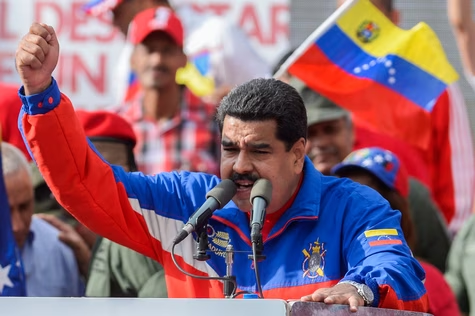
On Saturday, 3rd January, the U.S. carried out a large-scale attack on Venezuela, resulting in the kidnapping of Venezuelan leader Nicolás Maduro. This escalation has set a new precedent for authoritarian powers across the globe.
For more information, visit ➡️ U.S. regime change in Venezuela
The narrative of drug trafficking was quick to fall as Trump declared control of Venezuela's massive oil reserves.
-
This attack was not self-defence.
-
The 'use of force' against the political independence of a state is illegal.
-
The U.S. violated Venezuelan airspace, destroying civilian infrastructure.
-
President Maduro was illegally removed from Venezuela.
Warnings for the World
The global community must stand up for international law and uphold the principles of the UN Charter. Otherwise, who is next? Greenland, Colombia, Cuba, Lebanon, the Democratic Republic of Congo, Taiwan?
Historically, the U.S. has exerted its repressive and damaging control over Haiti, Cuba, Mexico, Nicaragua, Panama, the Dominican Republic, and many others. We cannot let this happen again; the citizens of Venezuela have suffered enough.
The fragmentation of the peace movement has silenced the voices of reason, calls for peace, and respect for human rights. The greedy pursuit of oil, money, power, and retribution only ever serves to exacerbate the suffering of civilians. The Iraq War, the Gulf War, the ongoing war in Sudan, and the conflict over the Niger Delta serve as reminders of the severe human and environmental cost of oil-driven conflicts.
Author: Rachael Mellor, 05.01.25 licensed under CC BY-SA 4.0
For further reading on U.S. Interference in Venezuela see below ⬇️
More Resources
Curated Directory & Deep-Dive Resources on Ongoing U.S. Interference
- Botched Infiltration of Venezuela Leaves Guaidó Tainted Beyond Repair - CD 11.05.20 207727
- 'His head wasn't in the world of reality': how the plot to invade Venezuela fell apart - Guardian 08.05.20 207749
- Not letting Covid-19 crisis go to waste? US ramps up war on drugs… focusing on Venezuela’s Maduro - RT 02.04.20 208903
- Trump: US to deploy anti-drug Navy ships near Venezuela - APNews 02.04.20 208902
- Trump’s Narcoterrorism Indictment of Maduro Already Backfires - CD 28.03.20 208901
- U.S. charges Venezuelan President Nicolas Maduro with drug trafficking - NPR 26.03.20 208900
- Tweet by Benjamin Norton about Imperialism 19.11.19 192180
- Tweet by Benjamin Norton about Bipartisan Imperialism 19.11.19 192181
- Still Meddling in Venezuela - Counterpunch 05.03.18 167607
- No Room for Debate - ZNet 22.02.18 167610
- Say goodbye to $2.30 gas if Trump goes hard after Venezuela - WaPo 31.07.17 167660
- Why Socialism Keeps Winning in Venezuela - Empire Files 27.10.17 167611
- The Economic War Against Venezuela - ZNet 20.10.17 167615
- What Have We Got Here? Looks Like Some U.S. Libertarians Are Supporting Overthrow in Venezuela - Alternet 31.08.17 167619
- Morales acusa EUA de promoverem golpe econômico contra Venezuela - Exame 26.08.17 167621
- Trump's Threats of Military Action in Venezuela Rejected Across Latin America - CD 14.08.17 167626
- Empire Files: Head of Venezuela National Guard on Insurgency & US Threats - TeleSUR 31.07.17 167630
- US Talk of Democracy Is 'Laughable': Tariq Ali on Venezuela - TeleSur 04.07.17 167627
- Empire Files: Abby Martin Meets the Venezuelan Opposition - TeleSUR 03.07.17 167629
- Venezuela Defense of Human Rights and Civil Society Act of 2014 - Wikipedia 167604
- Obama wrong to isolate Venezuela - Boston Globe 22.03.14 167632
- Letter to John Kerry - Venezuela Watch, 18.03.14 167633
- The Washington Post Uses Biased Experts to Promote Propaganda on Venezuela - Intercept 03.03.14 167635
- The Media Is Covering Up What's Really Happening in Venezuela - PolicyMic, 28.02.14 167636
- The US Should Respect Venezuela's Democracy - Al Jazeera, 25.02.14 167639
- Venezuelan Protests: Another Attempt by U.S.-Backed Right-Wing Groups to Oust Elected Government? - DemocracyNow, 20.02.14 167642
- US support for regime change in Venezuela is a mistake - Guardian, 18.02.14 167643
- Venezuela oil 'may double Saudi Arabia' - BBC 1/10 167600