NIWANO Peace Prize
The Niwano Peace Prize was established to promote global endeavours in dialogue, disarmament, human rights, and conflict resolution. The 2025 winner was Musawah.
➡️ NIWANO PEACE PRIZE – Honouring Contributions to World Peace & Interreligious Cooperation
The annual Niwano Peace Prize awards organisations or individuals who have made significant contributions to world peace through inter-religious cooperation. It was founded by Nikkyo Niwano, a Japanese Buddhist leader dedicated to peace, who sadly passed in 1999.
He established the Niwano Peace Foundation in 1978 and, in 1983, began awarding the prize to promote global endeavours in dialogue, disarmament, human rights, and conflict resolution.
The Niwano Prize is unique in that it celebrates diverse projects which cross traditional cultural and religious boundaries. The laureates are announced in February and then commemorated at a ceremony in Tokyo in May.
The Niwano Peace Prize Committee, which selects the recipient each year, includes members from 5 continents, with a mix of male and female members. Formed in 2002, their global and multi-religious makeup ensures that the prize remains unswayed by politics or other influences.
Jump straight to our resources on the ➡️ Niwano Peace Prize
Explore our comprehensive guides on -
- Our Guide to Peace
- Religious Tolerance
- Interfaith Dialogue
- Pacifism in Religion
- Buddhism & the Role of Peace
- Religious Leaders & Peace Activists Inspiring Change
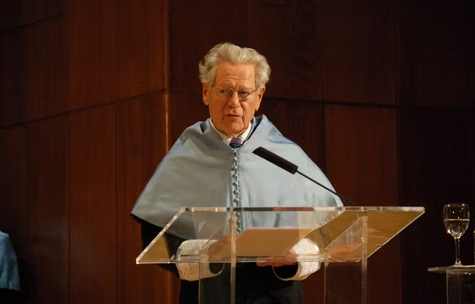
"There cannot be peace in the world without peace among religions" - 2005 laureate Hans Küng.
*****
Niwano Peace Prize 2025 – Musawah
The 42nd Niwano Peace Prize was awarded to Musawah, an international movement for equality and justice for Muslim women. Named after the Arabic word for 'equality', their network includes advocates from more than 40 countries who campaign for changes in attitudes, practices, laws, and policies that protect the rights of women and girls in Muslim countries, in both their public and private lives.
Musawah was founded in 2009 by Malaysian Muslim feminist, NGO leader, and rights activist Zainah Anwar. The prize recognises their tireless work in empowering female leadership, promoting women's rights, and fostering dialogue across faiths to build peaceful communities in Muslim regions.
They work to challenge centuries-old patriarchal interpretations of the Quran and instead promote a modern, progressive, rights-based understanding. They envision Muslim family structures in which all members are treated equally, combining Islamic teachings with universal human rights.
By recognising the importance of equality within the family, this has a direct impact on women's equal access to education, economic justice, health, political participation and all other rights.
Their goal is to create a world where gender equality, justice and non-discrimination are permanently and universally embraced in Islamic societies and reflected in their laws, practices, and traditions.
Notable Niwano Peace Prize Laureates
All recipients of this prestigious prize are worthy however, some stand out for their significant contributions to inter-religious cooperation and world peace.
- Archbishop Hélder P. Câmara (1983, Brazil): The first ever recipient, honoured for his work in human rights, justice, and nonviolence. He was devoted to the liberation of poor Brazilians from oppression and poverty.
- Hildegard Goss-Mayr (1991, Austria): A devoted Roman Catholic who dedicated her life to peace advocacy through the International Fellowship of Reconciliation. During the Cold War, she worked hard to promote East-West dialogue in Europe, and afterwards, on nonviolence movements around the world.
- Maha Ghosananda (1998, Cambodia): Prominent Buddhist leader who devoted himself to bringing lasting peace back to the people of Cambodia in the aftermath of the brutal Pol Pot regime and the subsequent civil war.
- Dr Scilla Elworthy (2003, UK): Committed Quaker and the founder of the Oxford Research Group, which conducts research on increased global security through nuclear disarmament and stricter regulation and reductions of weapons exports.
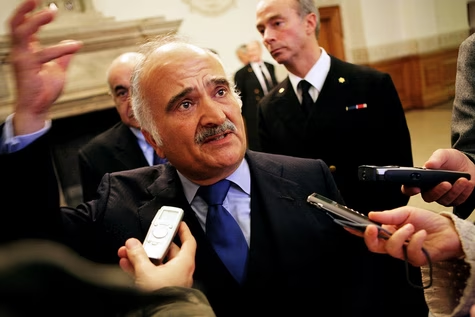
- His Royal Highness Prince El Hassan bin Talal (2008, Jordan): Devoted his life to long-standing efforts in interfaith dialogue and peacebuilding initiatives in the Middle East based on his understanding of human dignity, inspired by his faith.
- Sulak Sivaraksa (2011, Thailand): A prominent Buddhist activist and intellectual known for challenging power structures and promoting social awareness and engaged Buddhism.
- Venerable Pomnyun (2020, South Korea): Zen Master of the Jungto Society, a South Korean Buddhist organisation, awarded for his humanitarian work, environmental activism, and efforts to build trust between different faiths, including work for North and South Korean unification.
- Father Michael Lapsley, SSM (2022, South Africa): An anti-apartheid activist and priest recognised for his work in reconciliation, healing, and ending social discrimination.
- Prof. Mohammed Abu-Nimer (2024, USA/Palestine): Lifelong commitment to peace, interfaith dialogue, and integrating education with conflict resolution and peacebuilding activities, particularly in light of the ongoing atrocities in his homeland, Israel/Palestine.
Author: Rachael Mellor, 24.12.25 licensed under CC BY-SA 4.0
For further reading on the Niwano Peace Prize see below ⬇️
More Resources
Curated Directory & Deep-Dive Resources on NIWANO Peace Prize
- Niwano Peace Foundation 488845
- NIWANO Peace Prize & Laureates 14797
- Niwano Peace Prize - Wikipedia 488844
- Rissho Kosei-kai 488849
- Risshō Kōsei Kai - Wikipedia 488847
- Nikkyo Niwano - Founder 488846
- Nikkyo Niwano (1906-1999), Japan & Buddhist - Wikipedia 14798
- Nichiko Niwano (his son) - Wikipedia 488848
- YouTube Search 488850
- Google News 488851