World Day Against Trafficking in Persons - July 30
Discover campaign resources, advocacy tools, and key actions to support victims and combat modern-day slavery on World Day Against Trafficking in Persons (July 30).
WORLD DAY AGAINST TRAFFICKING IN PERSONS, July 30 - Trapped Behind The Scam
Discover the critical global effort against human trafficking and learn how you can actively support fundamental human rights. Our comprehensive guide offers you in-depth information on the realities of forced labour and sexual exploitation, the central role of organised crime groups behind this crisis, and how the rights of millions are violated every year.
Connect with valuable resources, organisations, and news sources – for effective global action, survivor empowerment, and ending the cycle once and for all.
Please share this valuable resource via Bluesky, Facebook, Instagram, and LinkedIn
Jump straight to our resources on ➡️ Trafficking in Persons
*****
General Information
Established by the United Nations General Assembly in 2013, this day aims to raise awareness of the plight of human trafficking victims and to promote and protect their rights.
Human trafficking is a serious violation of human rights that affects millions of people worldwide. The exact numbers are very difficult to trace given that most do not have identification, victims fear coming forward, and the traffickers very carefully conceal their crimes.
There are numerous forms of human trafficking, including sexual exploitation, forced labour, forced marriage, child soldier recruitment, debt bondage, domestic servitude, organ removal, and forced begging.
In all situations, the victims can not refuse or leave because they face severe control tactics such as physical abuse, manipulation, threats, and isolation.
The UN Office on Drugs and Crime (UNODC) established the Blue Heart campaign to help raise awareness of the victims of trafficking, the impact it has on people and society, and as a reminder of the cold-heartedness of those who exploit human beings for money.
“Human trafficking is an open wound on the body of contemporary society, a scourge upon the body of Christ. It is a crime against humanity.” - Pope Francis.
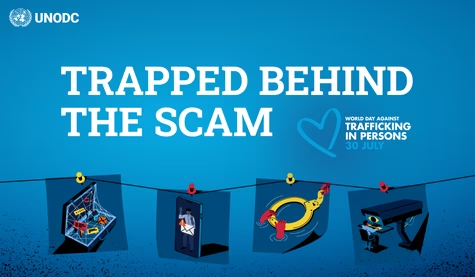
Trapped Behind The Scam - 2026 Theme
The fastest-growing form of human trafficking is forced online scamming.
“Hundreds of thousands of people worldwide have been trafficked by criminal networks and forced to participate in online scams in a multibillion-dollar criminal industry.” - IOM.
Traffickers recruit victims through fake job advertisements and promises of employment opportunities abroad using social media, dating apps, and online jobs boards. They target people in economic desperation and promise excellent salaries with just basic language skills and computer literacy.
The victims are led to believe they have secured genuine work. They then travel to another country and become entrapped in illegal scam compounds that they cannot leave.
They are stripped of their documents, put under constant surveillance, and forced to carry out online scams under the threat of violence. Survivors report torture, sexual abuse, starvation and solitary confinement.
The scams include online fraud, romance scams, fake cryptocurrency investment schemes, gambling and betting fraud, phishing schemes, and identity fraud.
In Asia, the UNODC estimates that these types of scams caused financial losses of between $18 and $37 billion in 2023 alone. The vast majority of this is down to organised crime groups based in the region.
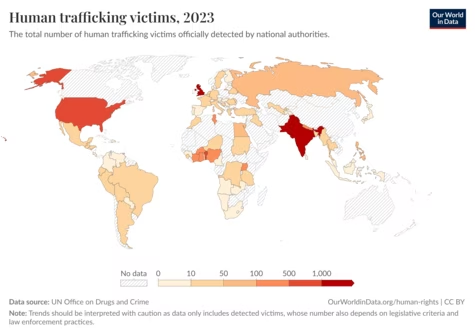
Facts & Figures On Human Trafficking
Every year the UNODC releases a report on the state of human trafficking and migrant smuggling. Below is a summary of their findings from 2025:
- There was an alarming 25% surge in detected trafficking victims globally.
- Organised crime was the driver of 74% of trafficking cases.
- Forced labour became the most common form of trafficking, accounting for 42% of all reported cases.
- Trafficking individuals into forced criminal acts (such as cyber scams or fraud) climbed to 8%, up from 1% in the previous 10 years.
- Instances of child victims increased by 31%, with a notable 38% rise for girls. Children now represent 38% of all detected victims worldwide.
- Women and girls still represent the majority of global victims at 61%. They are predominantly trafficked for sexual exploitation, making up 60% of the total figure.
- Forced labour is heavily embedded into legitimate everyday industries such as agriculture, which accounts for 29% of cases and the fishing sector, which accounts for 28%.
- Around 41% of trafficking cases only came to light because the victim managed to escape and alert the authorities. Police operations account for only 28% of trafficking investigations.
- Sexual exploitation cases are routinely prosecuted, but strong criminal justice frameworks still do not exist to help convict traffickers involved in forced labour and digital scams.
- The organ trade is one of the least documented forms of human trafficking. Only 175 victims were officially recorded worldwide from 2017–2023. Extreme barriers to reporting and detection allow this devastating trade to continue; the real numbers will be significantly higher.
- In 58% of detected cases, trafficking victims remain within their own national borders. In cross-border trafficking, African nations account for 31% of all flows, making it the highest affected continent.
How To Help
- Share our social media posts for the World Day #EndHumanTrafficking to help spread the word about this excellent resource.
- Donate to worthy causes such as the United Nations Voluntary Trust Fund for Victims of Human Trafficking and Better World Info, who work tirelessly to bring attention to the plight of victims and survivors.
- Join the Blue Heart Community or see more ideas on how to support the campaign.
- Contribute your own excellent resources to our toolbox so we can continue expanding and updating our information.
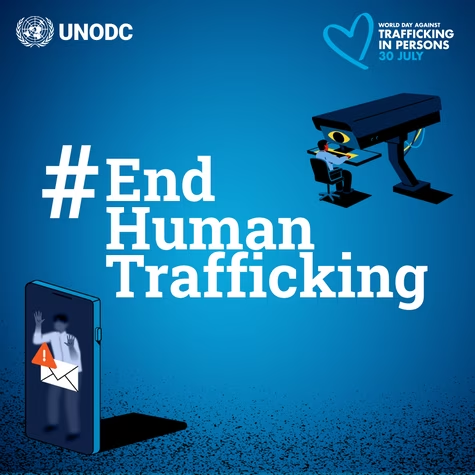
Ending Human Trafficking
The issue of human trafficking is an international issue; therefore, multilateral cooperation is essential.
Legal reforms are desperately needed to firstly prevent organised criminal groups from operating in the first place, to help detect instances of human trafficking, and to be able to prosecute the full range of crimes connected to it.
The UNODC supports countries to improve victim identification, investigations, and prosecutions related to forced criminality, cyber-enabled fraud, money laundering, corruption, and all other aspects of trafficking.
The United Nations Convention against Cybercrime was adopted by the General Assembly in 2024. It is a new global framework to help strengthen cooperation against digital crime, online fraud, and technology-enabled organised crime.
Stronger action to locate and protect victims is a priority. We must disrupt the organised crime groups behind trafficking operations.
Survivors must be given comprehensive ongoing support. By breaking the cycle of exploitation and empowering survivors, they can reclaim their lives with hope, safety, and dignity.
“You may choose to look the other way, but you can never say again that you did not know.” - William Wilberforce, leader of the movement to abolish the Atlantic slave trade.
Author: Rachael Mellor, 29.07.26, licensed under CC BY-SA 4.0
More Resources
Curated Directory & Deep-Dive Resources on World Day Against Trafficking in Persons - July 30
- World Day Against Trafficking in Persons - United Nations 520728
- World Day Against Trafficking in Persons - UNODC 520727
- UN Trust Fund for Victims of Trafficking in Persons 520735
- UN Convention against Transnational Organized Crime 520736
- International Organisation for Migration 520740
- International Justice Mission 520739
- Protocol to Prevent, Suppress and Punish Trafficking in Persons Especially Women and Children - OHCHR 520737
- The Blue Heart Campaign 520733
- World Vision 520738
- Griffith University - Human trafficking scam 520752
- IJM - Forced Scamming 520753
- #WDATIP 520749
- #WorldDayAgainstTraffickingInPersons 520750
- #TrappedBehindTheScam 520748
- #EndHumanTrafficking 520747
- Too Good To Be True: How Fake Job Traps Are Leading Youth into Trafficking - UNODC 520755
- Trafficking and Modern Slavery: Definitions and Global Updates - ICMC 03.08.26 521087
- Council of Europe marks World Day against trafficking in persons with renewed commitment to protecting children of Ukraine - COE 03.08.26 521085
- Statement on World Day against Trafficking in Persons - OHCHR 30.07.26 521086
- The Secretary-General Message on the World Day Against Trafficking in Persons - UN 30.07.26 520742
- 'Trapped Behind the Scam': IOM Warns Trafficking Victims Are Being Forced into Scam Networks - Modern Ghana 28.07.26 520744
- Iran: Women, Children and Migrants at Heightened Risk of Human Trafficking and Exploitation - Iran HRM 27.07.26 520743
- Human Traffickers Move Online, Recruit Youths into Global Scam Networks, NAPTIP, UNODC Warn - This Day 23.07.26 520745
- Over 300,000 people trafficked into Southeast Asia scam hubs yearly, generate $64bn - Vanguard 22.07.26 520746
- UN report details grave abuses against those trafficked into scam centres - OHCHR 20.02.26 520751
- Joint Statement on the World Day against Trafficking in Persons: Human Trafficking and Organized Crime - UN Women 30.07.25 520741
- Slavery, human trafficking and torture in Cambodia’s Scamming Compounds - Amnesty 26.06.25 520756
- Video: Inside Southeast Asia's Notorious Scam Hub For China-Linked Syndicates - CNA Insider 20.06.25 520754
- OC Index - Human trafficking 2025 520757
- UNODC Global Report on Trafficking in Persons - 2024 520734
- YouTube Search 520730