
WSF 2026 in Cotonou
World Social Forum 2026 in Benin: Discover how this major global forum in Cotonou tackled global issues like climate justice, human rights, and economic inequality.
The World Social Forum 2026 in Cotonou, Benin
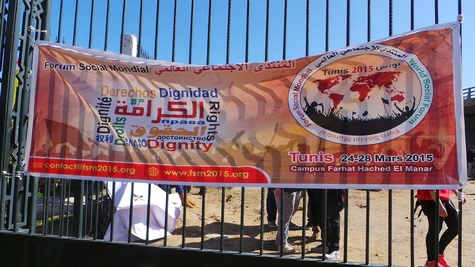
The 17th World Social Forum (WSF) was held in Cotonou, Benin, in August 2026. It was the first time the forum had returned to Africa since Tunis hosted it in 2015. The WSF brought together activists, trade unions, civil-society organisations, human-rights defenders, researchers, faith-based groups, and social movements from different parts of the world. Its guiding motto was “Another World Is Possible.”
Rather than adopting binding resolutions or negotiating agreements between governments, the World Social Forum provides an open space for dialogue, networking, and political organising. It is often described as an alternative to elite economic and political meetings such as the World Economic Forum in Davos.
Originally planned to begin on 4 August, the event was delayed after the Beninese government suddenly withdrew its authorisation. Following negotiations with the organisers, the government reversed its decision, and the forum began two days later.
*****
Jump directly to our Links on the ➡️ WSF 2026 in Cotonou
Core Focus Areas
- Land and natural resources: Participants discussed land grabbing, large-scale land acquisitions, and the protection of community land rights.
- Food sovereignty: Many debates examined whether communities should control their food systems instead of depending on corporations and export-oriented agriculture.
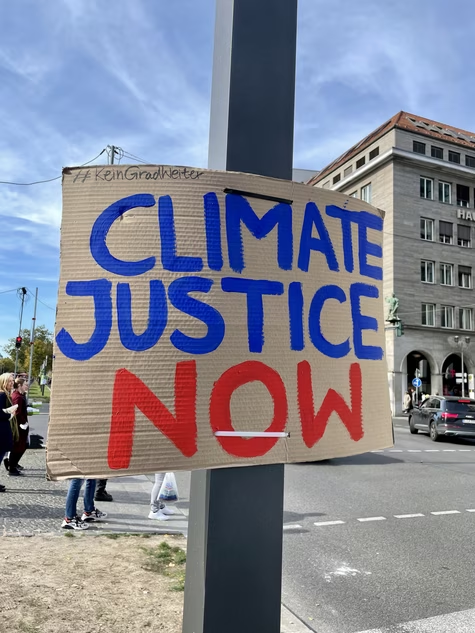
- Climate and environmental justice: Activists connected the climate crisis to the destruction of local ecosystems, displacement, and the unequal distribution of environmental harm.
- Human rights and civic space: The forum highlighted growing restrictions on journalists, activists and non-governmental organisations.
- Global inequality: Poverty, hunger, debt, unemployment, and social exclusion were discussed as structural problems rather than individual failures.
- Peace and international solidarity: Participants addressed militarisation, war, colonial legacies, and the need for stronger cooperation between social movements across regions.
These themes reflect the broader purpose of the WSF: bringing together movements that challenge economic systems and political structures seen as deepening inequality and environmental destruction.
Why was the WSF 2026 in Cotonou, Benin blocked by the government?
The disruption began shortly before the planned opening. Beninese authorities cancelled the opening march, restricted public gatherings, and blocked access to facilities at the University of Abomey-Calavi, where many of the panels and workshops were scheduled to take place. International delegates were reportedly turned back at the airport, while some citizen caravans faced difficulties at the country’s borders.
The government initially referred to “unforeseen circumstances” but did not provide a detailed public explanation. This lack of clarity led to strong criticism from organisers and human-rights groups, including the International Peace Bureau and CETIM. They described the measures as an attack on freedom of assembly, freedom of expression, and the ability of civil-society organisations to work across borders.
Some delegates were also reportedly denied entry or removed from the country. The Haitian delegation, for example, stated that its members had been forcibly removed at Cotonou airport.
Political Context in Benin
The incident took place in a broader context of increasing restrictions on political and civic life in Benin. Although Benin was once widely regarded as one of West Africa’s more open democratic systems, opposition parties, journalists, and civil-society organisations have faced growing pressure in recent years.
The authorities did not publicly claim that the forum represented a security threat. However, the WSF brings together large and diverse networks that often criticise authoritarianism, corporate power, militarisation, colonialism, and international economic institutions. This may have made the gathering politically sensitive, particularly in a country where the government has sought to maintain tight control over large public events.
Civil-society groups have suggested that the decision may have been influenced by fears of mass mobilisation. They have also raised questions about possible diplomatic or geopolitical pressure. These claims remain difficult to verify because the government has not offered a full explanation for its initial decision.
It is important, therefore, to distinguish between documented events and political interpretations. The cancellation of the opening march, restrictions on access, and the obstruction of some delegations were reported by organisers and participating organisations. The precise reasons for the government’s actions, however, remain unclear.
A Reversal After Public Pressure
The attempted cancellation did not permanently prevent the forum from taking place. After urgent negotiations between the organisers, civil-society networks, and Beninese authorities, the government granted permission for the event to proceed. The programme eventually began with a delay, and activities were held at the University of Abomey-Calavi and other locations in Cotonou.
The reversal was welcomed by organisers, but it did not erase the disruption that had already occurred. Delegations had faced travel difficulties, some participants were unable to enter the country, and preparations were interrupted.
For many participants, the episode became part of the political significance of the forum itself. The WSF was not only a space to discuss civic freedoms; it also became an example of the vulnerability of international civil-society gatherings when governments restrict public assembly.
Why the Incident Matters
The events in Cotonou raise important questions about the relationship between governments and transnational civil society.
- First, the episode shows how fragile civic space can be, even in countries with a history of democratic openness. A forum can be legally prepared for years and still be disrupted at short notice if authorities withdraw their support.
- Second, the incident highlights the importance of freedom of assembly. International meetings of activists and social movements are not merely conferences. They allow organisations to exchange strategies, build alliances, and support groups that may be isolated or repressed in their own countries.
-
Third, the controversy demonstrates the limits of hosting large international events without clear legal guarantees. When organisers and participants do not receive transparent information about permits, access, security, and border procedures, governments can effectively control who is able to participate.
- Finally, the attempted ban gave new meaning to the WSF’s central message: “Another World Is Possible.” For participants, this message is connected not only to economic and environmental justice but also to the defence of democratic freedoms and public spaces for collective action.
Author: Janna, 09.08.2026, licensed under CC BY-SA 4.0
More Resources
Curated Directory & Deep-Dive Resources on WSF 2026 in Cotonou
- Forum Social Mondial 2026 521311
- FSM Cotonou 2026 521310
- 15 Thematic Axes of the WSF 521312
- Caravane Ouest-Africaine (fr) 521314
- Communiqué de presse d’annonce de la Caravane 2026 (fr) 11.06.26 521315
- WSF Charter of Principles - Porto Alegre 4/01 521316
- The German language information portal on the global Social Forum movement 521313
- What Happened at World Social Forum (WSF) 2026? - IPB 10.08.26 521503
- Another World Is Built Through Resistance: World Social Forum took place in Cotonou - World March of Women 10.08.26 521504
- Solidarity with the members of the Haitian delegation members forcibly returned at the World Social Forum - Haiti Support Group 07.08.26 521505
- Benin's Government reversed its stance - FSM2026 Cotonou, Bénin fb 06.08.26 521309
- World Social Forum Banned and Suppressed - International Viewpoint 05.08.26 521146
- The ban on the World Social Forum in Benin: an offensive against social movements and popular resistance - CETIM 05.08.26 521145
- IPB Condemns Benin’s Cancellation of the World Social Forum and Repression of International Delegates - International Peace Bureau 05.08.26 521144
- Google News 521317
- Google Images 521318
- Google Videos 521319
- Google Scholar 521320
- YouTube Search 521321
- Benin - Wikipedia 521322
- Politics of Benin - Wikipedia 521323
- Cotonou - Wikipedia 521324
- IPB - What happened at WSF 2026? 521750
- IPB Statement regarding WSF 2026 521751
- IFOR at the WSF 2026 521752
- World March of Women - Another World is possible WSF 2026 521753
- ActionAid Nigeria - Participant in WSF 2026 521754
- Blue Community about WSF 2026 521755
- Official documentation of WSF 2026 521756
- Organising Commiteee of WSF 2026 521757