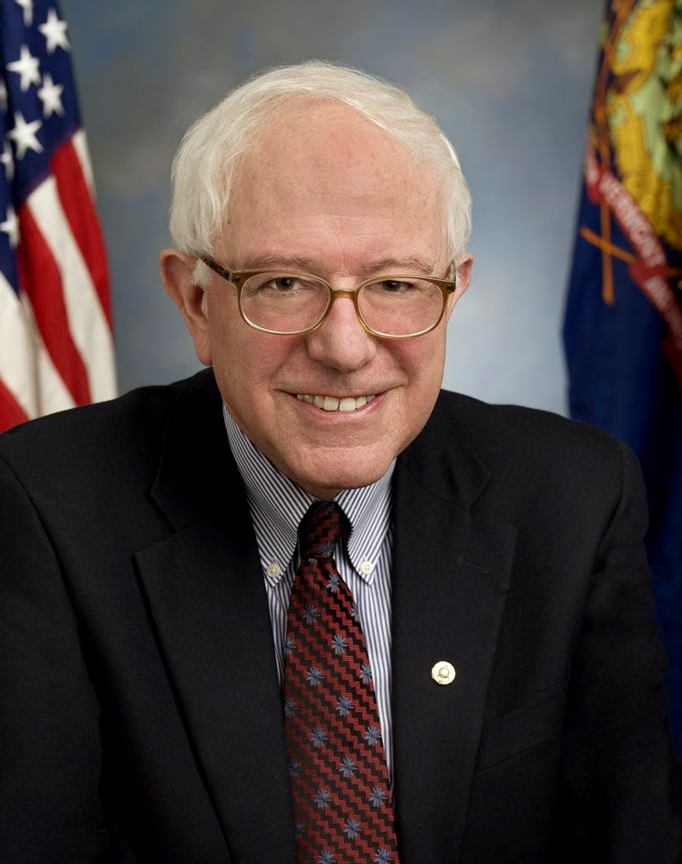
BERNIE SANDERS (independent) - Senator from Vermont
Featuring Bernie Sanders, the forward-thinking political icon | Green New Deal, Universal Healthcare, minimum wage and his presidential campaign

Bernie Sanders - Independent Senator from Vermont
Bernard "Bernie" Sanders (born September 8, 1941) is an American politician who has served as the senior U.S. senator from Vermont since 2007. A self-described democratic socialist, he is the longest-serving independent in U.S. congressional history, though he caucuses with the Democratic Party.
Jump straight to our 1,000 resources on the ➡️ Senator Bernie Sanders
.
Key Information
Current Role: Senior U.S. Senator from Vermont (2007–present)
Political Alignment: Independent (Democratic Socialist, caucuses with Democrats)
Previous Offices: U.S. Representative for Vermont's at-large district (1991–2007); Mayor of Burlington, Vermont (1981–1989)
Presidential Campaigns: Ran in the Democratic presidential primaries in 2016 (runner-up to Hillary Clinton) and 2020 (runner-up to Joe Biden).
Core Political Platform
- Healthcare: Champion of "Medicare for All," advocating for a single-payer, universal healthcare system.
- Economic Policy: Focuses on income and wealth inequality, raising the federal minimum wage,expanding labor unions, taxing corporations and high-net-worth individuals, and advocating for a four-day workweek.
- Education: Advocates for tuition-free public colleges and universities and the cancellation of student loan debt.
- Technology & AI: Focuses on regulating artificial intelligence, warning of job displacement, advocating for public equity in major AI tech platforms, and pushing for limits on Big Tech power.
- Campaign Finance: Supports ending Citizens United and moving toward publicly funded elections.
_____________________________________________________________
Bernie Sanders' key policy positions, focusing on Medicare for All and wealth inequality
Bernie Sanders’ political philosophy revolves around democratic socialism and progressive reform, with Medicare for All and reducing income and wealth inequality serving as the core pillars of his platform.
1. Medicare for All (Single-Payer Healthcare)
Sanders frames healthcare not as a commodity or a privilege, but as a human right. His proposal, outlined in his Medicare for All Act, aims to replace the private health insurance model with a single, federally administered program.
Key Features
- Universal Coverage & Elimination of Out-of-Pocket Expenses: All U.S. residents would be automatically enrolled. The plan eliminates premiums, deductibles, and copays for covered medical care.
- Comprehensive Care: Coverage includes primary care, hospital visits, prescription drugs, mental health services, dental, vision, maternity, and long-term care.
- Elimination of Duplicative Private Insurance: Private health insurance companies would no longer be allowed to sell plans that cover the same services offered under the government program, leaving private insurance restricted only to supplemental, non-covered elective care.
- Cost Controls & Negotiating Power: The single-payer system would cut administrative overhead by bypassing multi-payer insurance billing and allow the federal government to directly negotiate prescription drug prices with pharmaceutical companies.
-
Funding Mechanism: Funded through progressive taxation—including employer payroll taxes,personal income tax surcharges, and taxes targeting high-income earners and corporations.
2. Combating Wealth & Income Inequality
Sanders argues that the concentration of extreme wealth threatens American democracy, asserting that the economic system is "rigged" in favor of the ultra-wealthy at the expense of working families.
Key Pillars
- Wealth Tax ("Tax on Billionaires"): Sanders introduced progressive annual wealth taxes targeting high-net-worth individuals. Under his framework, rates start at low percentages for multi-millionaires and increase up to 8% for multi-billionaires, explicitly aimed at cutting the wealth of billionaires in half over time.
- Corporate Tax & Executive Pay Limits: He proposes raising corporate income tax rates, closing offshore loopholes, and penalizing corporations where the CEO-to-median-worker pay ratio exceeds threshold levels (e.g., 50:1).
- Financial Transaction Tax (Wall Street Tax): Imposes micro-taxes on financial trades (0.5% on stock trades, 0.1% on bonds, and 0.005% on derivatives) to curb high-frequency speculation and generate federal revenue.
- Raising the Minimum Wage & Strengthening Labor Unions: Advocates for increasing the federal minimum wage to a living wage (historically pushing for $15/hour and recently raising that target to $17–$20/hour depending on inflation). He supports the PRO Act to make it easier for workers to join unions and ban anti-union practices.
- Expanding the Social Safety Net: Uses revenue raised from taxing high earners to fund tuition-free public colleges, cancel student debt, expand Social Security benefits, and invest in universal childcare.
_______________________________________________________
Bernie Sanders' key policy positions, focusing on Artificial Intelligence, labour and labour rights
Bernie Sanders approaches labor rights and emerging technology through the lens of economic democracy, viewing both as battlegrounds between corporate interests and working-class power. His platform argues that tech advancement must benefit workers—not just corporate executives and Wall Street—and that workers should hold greater control over the capital and decisions that shape their lives.
1. Artificial Intelligence & Automation
Sanders frames AI and automation as a structural threat to worker livelihoods if left under the exclusive control of major tech conglomerates.
- 32-Hour Workweek with No Loss in Pay: Sanders advocates for reducing the standard workweek to 32 hours (four 8-hour days) without any reduction in wages. He argues that as AI and automation exponentially increase productivity, the economic benefit must take the form of increased leisure and quality of life for workers rather than mass layoffs and higher profit margins for CEOs.
- "Robot Tax" & Automation Offsets: He advocates for imposing taxes on corporations that replace human workers with AI, automated systems, or algorithms. Revenues from these taxes would fund retrainings, income support, and social safety nets for displaced workers.
- Public Ownership & Wealth Funds (The Public Stake): Sanders has proposed legislation—such as the American AI Sovereign Wealth Fund Act proposal—aimed at giving the American public a direct ownership stake in major AI corporations. His argument is that large AI models were trained on publicly generated data, content, and research without consent; thus, the financial benefits should be shared with the public.
-
Strict Guardrails & ASI Limits: In response to safety concerns and job displacement, Sanders has backed stringent regulatory measures, including proposals to pause or ban unregulated artificial superintelligence (ASI) development and establish a dedicated federal Department of AI.
2. Labor Rights & Collective Bargaining
Sanders' labor agenda seeks to drastically expand union density and rebalance power between employers and employees.
- Passing the PRO Act: Sanders is a primary champion of the Protecting the Right to Organize (PRO) Act. The legislation would eliminate state "right-to-work" laws, penalize companies that engage in illegal union-busting practices, restrict employer interference in union elections, and protect striking workers.
- Living Wage & Income Floor: He advocates for significantly raising the federal minimum wage (historically pushing for $15/hour, and more recently targeting $17–$20/hour) and indexing it to inflation.
-
Banning Gig Worker Misclassification: Sanders supports federal rules that classify gig-economy workers (e.g., rideshare drivers, delivery workers) as formal employees rather than independent contractors, granting them full rights to minimum wage, overtime, health benefits, and collective bargaining.
3. Workplace Democracy & Employee Ownership
Beyond standard labor protections, Sanders advocates for restructuring corporate governance to give workers an actual share of ownership and management.
- Worker Representation on Corporate Boards: He proposes requiring large corporations to reserve a significant portion of their board of directors seats (typically 45%) for direct employee representatives,giving labor a voice in executive decisions.
- Corporate Equity Sharing Funds: Sanders supports requiring large corporations to incrementally transfer corporate stock into shared employee-owned funds, ensuring workers receive dividends and voting power as company stock appreciates.
- Employee Ownership Financing Act & Worker Purchase Rights: Through legislation such as the Employee Ownership Financing Act, Sanders promotes worker-owned cooperatives and Employee Stock Ownership Plans (ESOPs) by establishing a U.S. Employee Ownership Bank. This grants workers a "right of first refusal" to purchase facilities or companies facing shutdown or sale.
____________________________________________________
Bernie Sanders' environmental policies and his framework for the Green New Deal
Bernie Sanders views the climate crisis not only as an environmental threat, but as an existential economic and national security emergency. His environmental framework—headlined by his $16.3 trillion Green New Deal proposal introduced during his 2020 presidential campaign—links rapid decarbonization directly with economic justice and labor rights.
1. Core Targets of the Green New Deal
- 100% Renewable Electricity and Transportation by 2030: A goal to transition power generation and the transportation sector entirely to renewable sources like wind, solar, and geothermal within a decade.
- Full Economy-Wide Decarbonization by 2050: Complete elimination of net greenhouse gas emissions across all sectors of the U.S. economy, including manufacturing, agriculture, and housing.
-
Creation of 20 Million Jobs: Treating the climate response as a World War II–style public mobilization to build clean infrastructure, create well-paying union jobs, and guarantee employment for displaced workers.
2. Key Pillars of Sanders' Environmental Framework
A. Rapid Phase-Out of Fossil Fuels & Nuclear Power
- Holding Polluters Accountable: Proposes aggressively taxing fossil fuel industry profits, ending all federal subsidies for oil, gas, and coal, and using legal channels to sue corporate polluters for climate damage.
- Banning Fracking and Fossil Fuel Infrastructure: Calls for an immediate federal ban on hydraulic fracturing (fracking), offshore drilling, and new fossil fuel pipelines or export terminals.
-
No Nuclear Energy or Carbon Capture: Unlike some climate proposals, Sanders explicitly excludes nuclear power (phasing out existing plant license renewals) and unproven carbon capture technologies,focusing strictly on zero-emission renewables like wind, solar, and geothermal.
B. Just Transition for Workers and Communities
- Protecting Energy Workers: Guarantees five years of full wage replacement, healthcare, housing assistance, and job training for workers transitioning out of fossil fuel industries.
-
Environmental Justice: Directs at least 40% of Green New Deal investments to frontline and historically marginalized communities (low-income neighborhoods, communities of color, and indigenous lands) that disproportionately suffer from industrial pollution.
C. Transportation, Buildings, and Infrastructure Overhaul
- Electrifying Transportation: Directs over $2 trillion toward sliding-scale grants for low- and moderate-income families to trade in gas-powered cars for electric vehicles (EVs), alongside massive investments in regional high-speed rail and zero-emission public transit.
- Building Energy Retrofits: Provides grants to weatherize and retrofit homes, small businesses, and public facilities to reduce residential energy consumption by 30%.
-
Regenerative Agriculture: Shifts agricultural subsidies away from factory farming toward small family farms practicing sustainable, carbon-sequestering soil management.
3. Public Ownership and Financing
- Publicly Owned Clean Power: Expands federal Power Marketing Authorities (like the Tennessee Valley Authority) to build and operate renewable power generation directly, selling clean power to municipal utilities and cooperatives at cost.
- How It's Paid For: Financed by penalizing and taxing the fossil fuel sector, cutting defense spending tied to protecting foreign oil infrastructure, income taxes on the 20 million newly created jobs, and long-term revenue generated from federal clean energy production.
_________________________________________________________
Why did the Democratic establishment block his promising campaign for presidency twice?
The claim that the Democratic Party establishment "blocked" Bernie Sanders' presidential campaigns in 2016 and 2020 reflects a central debate in modern American politics. While Sanders amassed massive grass-roots support, his status as an independent outsider pushing a radical policy platform created systemic tension with the Democratic political apparatus.
Whether viewed as institutional "rigging" or the natural mechanics of primary politics, several structural factors, party rules, and strategic maneuvers undercut his bids in both cycles.
1. The 2016 Primary: Structural Advantages & DNC Favoritism
During the 2016 Democratic primary against Hillary Clinton, institutional structures heavily favored the established party frontrunner:
- Superdelegate Dominance: Before voting began, hundreds of unpledged "superdelegates" (party leaders, lawmakers, and DNC members) endorsed Hillary Clinton. Media outlets added these superdelegates to Clinton’s overall delegate tally from day one, creating a public perception that her nomination was inevitable and making Sanders' momentum appear mathematically improbable.
- DNC Leaks & Institutional Bias: In July 2016, leaked emails from the Democratic National Committee revealed that high-ranking party officials had expressed frustration with Sanders' campaign and discussed strategies to undermine his credibility. The revelations led to the immediate resignation of DNC Chairwoman Debbie Wasserman Schultz.
- Joint Fundraising Agreements: The Clinton campaign entered into a joint fundraising agreement with the DNC (the Hillary Victory Fund) early in the election cycle, giving her campaign influence over party finances and strategy before the primary concluded.
-
Debate Scheduling: The early 2016 primary debate schedule was smaller than in previous cycles and frequently placed on weekend evenings, which Sanders' supporters argued was an intentional effort to minimize viewership and protect Clinton's frontrunner status.
2. The 2020 Primary: Strategic Consolidation
Following rules reforms after 2016—which significantly limited the power of superdelegates on the first ballot—Sanders launched a formidable 2020 campaign. He won the popular vote in Iowa, won New Hampshire,and achieved a decisive victory in Nevada, making him the clear national frontrunner by late February 2020.However, the primary dynamic shifted rapidly:
- The Moderates' Super Tuesday Consolidation: Ahead of Super Tuesday, moderate candidate Joe Biden won the South Carolina primary. Immediately following South Carolina, competing moderate candidates Pete Buttigieg and Amy Klobuchar dropped out and endorsed Biden within 24 hours.
- The Progressive Split: While the moderate wing consolidated behind Biden overnight, the progressive vote remained divided. Senator Elizabeth Warren remained in the race through Super Tuesday, splitting progressive primary voters in key states while Biden consolidated moderate and establishment voters.
-
Party Leadership Endorsements: Key establishment figures, such as Representative Jim Clyburn in South Carolina, rallied black voters and moderate Democrats behind Biden, organizing party infrastructure behind a single candidate to halt Sanders' momentum.
3. Electoral Realities Beyond the Establishment
While party maneuvering played a role, political scientists and primary voter data also point to broader electoral realities that limited Sanders' ability to secure the nomination:
- Coalition Limits: Sanders struggled to expand his primary coalition beyond young voters, progressives, and working-class white voters. In both 2016 and 2020, older voters and Black voters—the core demographic backbones of the Democratic primary electorate—voted overwhelmingly for Clinton and Biden.
- Independent Status: Sanders served in Congress for decades as an Independent rather than a registered Democrat. Many long-standing Democratic insiders and loyal voters preferred a candidate with a history of building and supporting the Democratic Party apparatus.
- Electability Concerns: Party leaders and moderate voters feared that Sanders' self-described "democratic socialist" label and proposals like ending private health insurance would make him vulnerable against Donald Trump in a general election.
_________________________________________________________
Wouldn't the USA and the world have been better off if Bernie had won the presidency?
Whether the U.S. and the world would be better off under a Bernie Sanders presidency is one of the most widely debated "what if" scenarios in modern political history. Because political outcomes depend heavily on personal priorities, economic philosophies, and governance realities, there is no single consensus answer.
Instead, historians, economists, and political analysts tend to view a hypothetical Sanders presidency through two distinctly different lenses.
The Argument That the USA and the World Would Be Better Off
Proponents argue that a Sanders presidency would have fundamentally reshaped American society and global governance for the better by tackling structural crises head-on:
- Economic Relief and Inequality: Universal programs like Medicare for All, free public college tuition,and higher minimum wages would have significantly reduced poverty, eliminated medical debt, and reversed decades of growing wealth inequality.
- Aggressive Climate Leadership: By prioritizing a $16.3 trillion Green New Deal, the U.S. could have accelerated global decarbonization, re-established strict international climate commitments, and led a global shift away from fossil fuels.
- Worker Power & Corporate Accountability: Stronger union protections, executive pay caps, and corporate wealth taxes would have rebalanced power between capital and labor, creating a more stable middle class.
-
Foreign Policy Shift: Sanders’ non-interventionist foreign policy would have reduced military spending,curtailed foreign military engagements, emphasized international diplomacy, and reoriented foreign aid toward humanitarian and climate resilience initiatives.
The Argument That the USA and the World Would Be Worse Off (or Unchanged)
Critics and skeptics argue that a Sanders presidency would have faced severe practical limitations and potentially negative economic or geopolitical side effects:
- Legislative Gridlock: Even with Democratic control of Congress, Sanders would have lacked the votes in the Senate to pass landmark proposals like Medicare for All or the Green New Deal. Key moderate Democrats and Republicans would have blocked sweeping structural changes, potentially leading to intense political paralysis and public disillusionment.
- Economic Shock and Capital Flight: Critics argue that rapid tax hikes on corporations, wealth taxes, the elimination of private health insurance, and forced phase-outs of fossil fuels could have disrupted key industries, suppressed market investment, caused job losses in the energy and healthcare sectors, and slowed economic growth.
- Geopolitical Volatility: Critics from the foreign policy establishment argue that reducing U.S. military presence and defense spending might have created power vacuums, potentially emboldening authoritarian rivals like Russia or China and causing friction with traditional NATO allies.
-
Increased Political Polarization: Given Sanders' radical stance relative to the political center, his victory could have intensified ideological division within the U.S., potentially provoking a strong political backlash in subsequent midterm or general elections.
Summary
Ultimately, whether a Sanders presidency would have yielded a "better" world depends on what an individual values most:
- For supporters, the systemic risks and political battles would have been a necessary price to pay to dismantle corporate influence, eliminate health disparities, and fight climate change.
- For critics, the economic risks, potential foreign policy instability, and legislative gridlock make his platform an unrealistic or counterproductive path for governance.
__________________________________________________________
Instead Bernie Sanders played the long game by continuing his work in the Senate making Democratic Socialism popular among Americans and by supporting progressive Democrats and DSA candidates
That perspective captures how many historians and political strategists view Bernie Sanders' broader career trajectory. Rather than seeing his presidential bids in 2016 and 2020 as failed ends in themselves, supporters view them as the launching pad for a sustained political shift.
Instead of stepping back after his campaign losses, Sanders returned to the Senate to leverage his national profile, build institutional influence, and cultivate an enduring movement.
1. Mainstreaming Democratic Socialism
Prior to Sanders' 2016 campaign, "democratic socialism" was largely marginalized in American politics. Sanders demystified the term by tying it directly to Western European social democratic models and popular policies like universal healthcare, tuition-free public college, and strong labor unions.
- Public Opinion: His campaigns shifted political rhetoric around income inequality, corporate power, and billionaire tax wealth from the fringes into mainstream political discourse.
-
Policy Shift in the Democratic Party: Key elements of his 2016 platform—such as a $15 minimum wage, aggressive climate spending, expanding Medicare benefits, and canceling student debt—went from being viewed as "far-left" to forming the core platform of the modern Democratic Party.
2. Institutional Influence in the Senate
Sanders did not retreat into ideological isolation; instead, he used his position in the Senate to shape national policy from within:
- Budget Committee Chair: As Chairman of the Senate Budget Committee, Sanders was instrumental in crafting major legislative packages, including the American Rescue Plan and pushing for ambitious reconciliation spending on climate and social infrastructure.
-
Health, Education, Labor, and Pensions (HELP) Committee Chair: Leading the HELP Committee gave him a direct gavel to target high prescription drug prices, investigate corporate greed, support high-profile unionization efforts (such as Amazon and Starbucks workers), and advocate for labor reforms like the 32-hour workweek.
3. Mentoring the Progressive Pipeline
Sanders recognized that lasting systemic change required building a bench of like-minded lawmakers at federal, state, and local levels:
- Building Political Infrastructure: Through organizations born out of his campaigns (such as Our Revolution) and partnerships with groups like Run for Something, Sanders helped recruit, fund, and endorse young progressives.
- The "Squad" and Congressional Growth: Sanders paved the way for a new generation of high-profile democratic socialist and progressive lawmakers—most notably Representatives Alexandria Ocasio-Cortez, Rashida Tlaib, and Ilhan Omar.
-
Growth of the DSA: The high-visibility campaigns of Sanders and DSA-backed candidates triggered a major surge in membership for the Democratic Socialists of America. DSA members and endorsed candidates expanded their presence significantly in local school boards, city councils (such as the New York City Council), state legislatures across dozens of states, and the U.S. House of Representatives.
4. Changing the Overton Window
By playing the "long game," Sanders fundamentally shifted the Overton window—the range of ideas tolerated in public discourse:
- Small-Dollar Grassroots Fundraising: He proved that national political campaigns could be financed entirely by millions of small-dollar donors, changing how progressive candidates approach fundraising without relying on corporate Super PACs.
-
Normalizing Radical Labor Demands: His ongoing alignment with union strikes, worker ownership proposals, and labor advocacy helped re-energize the American labor movement during a period of historic public support for unions.
The Counter-Perspective
While supporters view this as a successful long-term strategy, critics offer a different take:
- Institutional Limits: Skeptics argue that while he expanded the progressive wing, he did not win the presidency itself, leaving executive and judicial power in the hands of traditional establishment politicians or conservative rivals.
-
Party Polarization: Moderate critics contend that his influence pushed the Democratic Party further left,making it more vulnerable in conservative and swing-state districts.
Ultimately, whether judged as a compromised path or an effective movement strategy, Sanders transformed democratic socialism from an obscure political label into a permanent power center within 21st-century American politics.
________________________________________________________________
What about Zohran Mamdani and Abdul El-Sayed?
Both Zohran Mamdani and Dr. Abdul El-Sayed are prominent figures in the modern progressive movement and clear examples of Bernie Sanders’ political legacy and network, though they occupy slightly different political niches:
1. Zohran Mamdani: The DSA Movement Pipeline
Zohran Mamdani represents the direct intersection between Bernie Sanders' campaign legacy, the Democratic Socialists of America (DSA), and municipal/state-level power:
- DSA Alignment: Mamdani is a explicit card-carrying member of the DSA. His political rise—from a housing counselor to the New York State Assembly and ultimately running high-profile campaigns in New York—was heavily organized and fueled by local DSA chapters.
-
Policy Focus: He built his reputation advocating for tenant rights, public housing funding, housing justice, and fully funded public transit (e.g., the "Fix the MTA" campaign), exemplifying the local focus of socialist governance that Sanders encouraged.
2. Dr. Abdul El-Sayed: The Sanders Policy & Coalition Pipeline
Dr. Abdul El-Sayed represents the policy-driven, Bernie-endorsed progressive wing operating within state and federal politics:
- Sanders Endorsement & Support: During El-Sayed's 2018 Michigan gubernatorial run, Bernie Sanders actively stumped for him. Following that, El-Sayed co-chaired the Biden-Sanders Unity Task Force on Healthcare in 2020, directly co-authoring progressive health policies alongside Sanders' team.
- Ideological Stance: Unlike Mamdani, El-Sayed identifies as a progressive Democrat rather than an explicit socialist. However, his platform—centered on Medicare for All, environmental justice (drawing from his background as an epidemiologist and Detroit health director), and campaign finance reform—mirrors Sanders' core national priorities.
-
Expanding the Bench: El-Sayed went on to found Southpaw Michigan, a PAC dedicated to endorsing and funding down-ballot progressive candidates, continuing the bench-building model Sanders prioritized.
Why They Fit the "Long Game" Narrative
Including figures like Mamdani and El-Sayed demonstrates how Sanders' "long game" split into two effective tracks:
- Inside/Outside Coalition Building: Technocratic progressives and public health advocates (like El-Sayed) who fight for policies like Medicare for All inside mainstream Democratic primary channels.
-
Explicit Socialist Organizing: Grassroots DSA organizers (like Mamdani) who run insurgent campaigns to win local and state executive/legislative seats, shifting local governance leftward.
Both showcase how the bench of candidates fighting for Sanders' policies extended far beyond just "The Squad" in Congress into state houses, city halls, and statewide campaigns across the country.
__________________________________________________________
What about his Fighting Oligarchy campaign with AOC?
The "Fighting Oligarchy" tour (launched in early 2025 by Bernie Sanders alongside Representative Alexandria Ocasio-Cortez) represents one of the clearest operational expressions of his "long game" strategy.
Key Context & Core Goals
Following the 2024 presidential election, Sanders launched the national tour to challenge what he described as the rising power of billionaires, corporate monopolies, and authoritarian trends in American governance.
- Building an Anti-Oligarchy Resistance: Rather than focusing solely on traditional election-year campaigning, the tour acts as a continuous grassroots organizing effort to counter corporate lobbying, tax cuts for the wealthy, and rollbacks to social safety net programs like Medicaid.
- Re-anchoring the Democratic Party: Sanders and AOC have used the rallies to push the Democratic establishment away from corporate donor influence and back toward what Sanders describes as its "FDR-era roots"—a party explicitly centered on working-class economic rights.
-
Organizing Beyond Blue States: A key strategy of the tour has been intentionally visiting red and purple states—including Idaho, Utah, Nebraska, West Virginia, and conservative parts of Texas—to demonstrate that economic populist policies (like universal healthcare, living wages, and wealth taxes) resonate across party lines in working-class communities.
Scale and Cultural Impact
- Massive Turnout: The rallies have drawn tens of thousands of attendees in major hubs (over 30,000 in Denver and 36,000 in Los Angeles) as well as packing auditoriums and college arenas in smaller rural towns.
- Merging Music and Politics: Blending political organizing with pop culture, the tour regularly features musical acts, local labor leaders, and appearances at mainstream cultural events (such as Sanders' high-profile appearance at Coachella 2025) to engage younger voters.
-
Platforming the Next Generation: Beyond AOC, Sanders uses the tour to highlight local progressive leaders and down-ballot candidates—such as NYC's Zohran Mamdani, Representative Greg Casar, and former Michigan Health Director Abdul El-Sayed—directly feeding into his pipeline of progressive power.
Broader Political Significance
The "Fighting Oligarchy" movement underscores how Sanders uses his national stature in tandem with AOC—often viewed as the torchbearer of the movement—to maintain active pressure on both the Republican administration and the Democratic Party apparatus outside of an election year. It bridges parliamentary legislative work in Washington with movement-building on the ground.
*****
Draft: Google Gemini, prompted by Dr. Norbert Stute, Date: 05.11.26
Work in progress. Suggestions, photos and expert input welcome!
More Resources
Curated Directory & Deep-Dive Resources on BERNIE SANDERS (independent) - Senator from Vermont
- FIGHT OLIGARCHY 123
- Bernie ends his presidential campaign 19
- Support ! 43
- News 71
- Videos 116
- General Info 51
- Our Revolution 105
- Endorsements 52
- the Sanders Institute 11
- Our Links on Key Issues
- Corporate Media Blackout ! 20
- Democratic Establishment & DNC Voter Fraud 12
- Superdelegates 10
- Sanders and the Future of the American Left 32
- Sanders Vs. Trump 48
- Sanders & Media 23
- Articles 245