
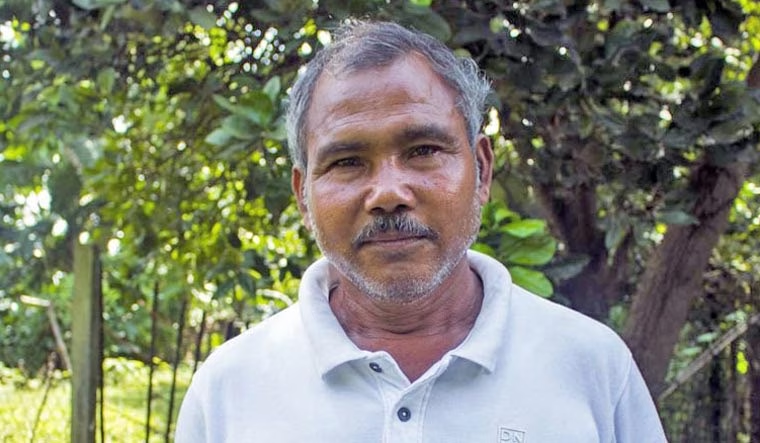
Jadav Payeng (India)
Discover the inspiring story of the Forest Man of India, his reforestation efforts on Majuli Island in Assam, and his impact on local communities, biodiversity, and ecosystem restoration.
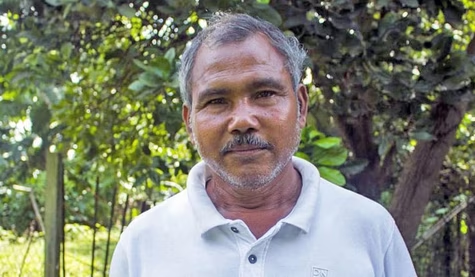
➡️ JADAV PAYENG - The Forest Man of India
Jadav ‘Molai’ Payeng, often hailed as the "Forest Man of India," is a remarkable environmentalist whose dedication to reforestation has transformed a barren sandbar into a thriving forest ecosystem.
Over several decades, Payeng single-handedly planted and nurtured trees on Majuli Island, Assam, a state in northeast India. The result was a lush sanctuary that spans over 1,300 acres.
His efforts have not only combated soil erosion but also provided a habitat for wildlife, including elephants, tigers, and rhinoceroses.
Payeng's story is a testament to the power of individual action in the face of environmental degradation, inspiring countless others to take up the mantle of ecological stewardship. His work underscores the profound impact one person can have on the planet, demonstrating that with unwavering commitment and patience, significant environmental restoration is possible.
A native of the Mishing tribe of the Indian state of Assam, Payeng’s monumental creation, the Molai Forest, bears his name. In recognition of his extraordinary efforts, he was awarded India’s fourth-highest civilian honour, the Padma Shri, in 2015.
Starting with just twenty bamboo seedlings on a sandbar of the river Brahmaputra, he has continued to nurture the plants persistently to this day. Despite the odds against him, he stood firm with limited resources and determination to keep planting, never giving up on his mission.
This article traces the evolution of his extraordinary journey, examining not only the scale of his environmental contribution but also the quiet determination that sustained it.
Key Takeaways:
- This former barren sandbar of the Brahmaputra River is now the world's largest man-made forest.
- His work began in 1979 after witnessing ecological damage and wildlife loss, notably the death of wildlife due to extreme heat on the treeless sandbar.
- His efforts created the Molai Forest, spanning 1360 acres.
- The forest contains over 100 species of plants, including bamboo and medicinal flora.
- He used low-cost, innovative techniques like drip irrigation and soil regeneration.
- The ecosystem sustains around 250 local families.
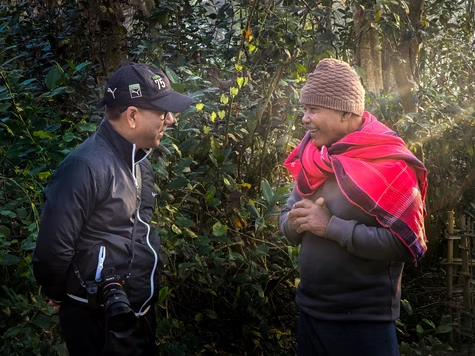
The Origin of the Molai Forest
In 1979, Jadav Payeng was employed as a labourer on a development project of the social forestry division. He was assigned the stewardship of a 200-hectare patch of land in Arunachapori (also part of the Brahmaputra river ecosystem). The project was intended to last five years, but ended in three.
Payeng had nowhere else to go, so he decided to keep planting trees and caring for the flora he had already planted. In the same year, he found a large number of dead snakes that had died from excessive heat after floods washed them onto the treeless sandbar. It was then that he planted the first 20 bamboo saplings.
Marked by the recurring floods that devastated the island of Majuli, Payeng’s childhood was profoundly shaped by the disaster that forced his parents to abandon their native village. Reflecting on his childhood, he recalls that his village provided everything from thatch to cane, everything that was needed to sustain a comfortable life in their elevated dwellings, colloquially known as “Chang Ghar.”
Molai Kathoni Today (Molai Forest)
Today, this remarkable forest is home to over 100 species of indigenous trees and plants, including hydrophytes, medicinal and aromatic plants, orchids, fruit trees, and valuable timber species.
The story of Molai Kathoni gained widespread attention in 2008, when a herd of elephants migrated into the forest reserve from the north bank of the Brahmaputra River, moving further south. This unique and flourishing patch of greenery soon caught the eye of the media, who aptly dubbed it “Molai Kathoni”, meaning “Molai’s woods.”
A herd of around 100 elephants now regularly visits the forest each year, staying for about 6 months. Additionally, the forest supports 250 families, who live in several clusters of 10 to 12 huts within the area, relying on the ecosystem for their sustainable livelihoods.
Notable flora species from his forest include Arjun (Terminalia arjuna), Pride of India (Lagerstroemia speciosa), Silk trees (Albizia procera), and Cotton trees (Bombax ceiba). Bamboo alone spans over 300 hectares.
Initially, to irrigate the large stretch of saplings, Payeng constructed bamboo structures above the saplings and placed earthen pots with very small holes for drip irrigation. Water seeped out gradually over several days, nourishing the delicate saplings as he worked on other chores.
To transform the infertile sandbar into nutrient-rich soil, Payeng physically transported red ants, earthworms, and organic biomass from his village to the island. The insects worked as biological ploughs, altering the soil composition and preparing the ground for deciduous trees.
In the words of Jadav Payeng, “I grew up loving nature: clear blue skies, tall trees, birds and animals. I tell everyone: It is not human beings who changed my life. It’s the trees that have put clothes on my back, birds who have taken me across seven seas, from the land where the sun rises first, to where the sun sets last.”

Recognitions
For over three decades, his creation largely remained in the dark, away from public recognition. But, when his story finally emerged, the world stood in awe of a man who, despite not having completed his secondary education, had ignited a quiet revolution painted in countless shades of green.
In 2012, Payeng was named the ‘Forest Man of India’ by Jawaharlal Nehru University. He then went on to win the fourth-highest civilian award of India, ‘The Padma Shri’, in 2015.
In 2020 was also awarded the ‘Commonwealth Point of Light’ by the Government of the United Kingdom. Most recently, in 2025, the Jyoti Prasad Trust established the ‘Jadav Payeng International Award’ in his honour.
The innovative solutions he developed, utilising coconut tree planting to combat soil erosion in Majuli, have garnered international recognition for their role in the fight against climate change. His inspirational story has transcended borders, even inspiring a children’s book, "Jadav and the Tree Place.”
Moreover, his story has been integrated into school curricula across the United States and beyond as a compelling lesson in ecology. His awe-inspiring journey has found a place in the pages of the schoolbooks around the world.
Despite international acclaim, numerous awards, and being the subject of award-winning documentaries (such as William D. McMaster's Forest Man), Payeng lives a remarkably simple life. He continues to wake up before dawn, taking a boat across the river to tend his forest and earn his living by selling milk from his livestock.
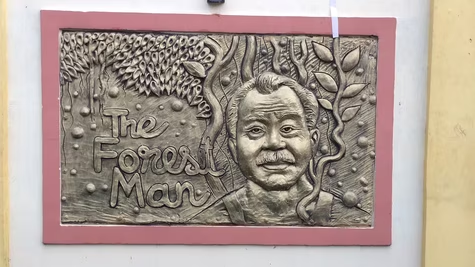
Individual Action Creating a Better World For Everyone
Payeng's contribution is not just about creating a green forest. The trees that Payeng planted act as massive carbon sinks, absorbing carbon dioxide while enhancing ecosystem health by supporting biodiversity, regulating water cycles, and sustaining diverse habitats.
In an interview with ‘The Better India’, he said the education system should mandate that every child plant two trees. He reiterated the need to integrate tree planting into school curricula during a TED Talk that he was invited to deliver in 2015.
Today, his focus is to expand the forest onto another sandbar of the Brahmaputra and turn Majuli Island into a tropical paradise.
The story of Jadav Payeng teaches us that environmental transformation does not always start with grand policy changes or massive funding. In some cases, it begins with just one person planting a seed and nurturing a dream that never dies.
For those seeking inspiration amid the mayhem of climate change, the Molai island forest is a living testimony to what one dedicated soul can achieve.
"Teach your children to love nature and the rest will happen on its own". - Jadav Payeng
*****
Recommended Reading:
- Jadav Payeng: The Forest Man of India - Assam Times 1/17
- Save tree, save world - TED Talk 4/22
- Jadav Payeng’s Molaikathoni - Equator Initiative
- Jadav Payeng: The visionary who turned barren land into a lush forest - India Today 9/24
- Jadav Molai Payeng – the ‘Forest Man of India’ - ResearchGate 2/14
- Meet Jadav Payeng, India's Forest Man, who created 550 hectares of forest single-handedly - The Hindu 3/19
Author: Tanuj Samaddar, Date: 24.04.26, licensed under CC BY-SA 4.0.
For more information on the Forest Man of India see below ⬇️
More Resources
Curated Directory & Deep-Dive Resources on Jadav Payeng (India)
- Jadav Payeng - Wikipedia 486276
- Google News 486285
- YouTube Search - Forest Man of India 486279
- Google Scholar 486283
- Majuli Island - Wikipedia 486278
- Google Book: The Boy Who Grew a Forest: The True Story of Jadav Payeng - Sophia Gholz (2019) 486284
- Jadav Payeng : The Forest Man of India Who Created a 1360 Acre Forest in Assam 2/26 516627
- Extraordinary Indians | Jadav Payeng - Reader's Digest 9/25 516568
- Jadav Payeng: The Forest Man's Legacy of Cultivating a Greener Future - Grow Billion Trees 8/25 516626
- "We are all connected," The wisdom of Jadav Payeng, India's Forest Man - one earth 5/24 486286
- Video: Meet ‘The Forest Man of India’ | In Collaboration with ThumsUp - Brut India 9/22 486280
- Video: Save tree, save world | Jadav Payeng | TEDxPraxisBusinessSchool 4/22 516632
- Never believe that you're too small to make a difference. This farmer planted one tree every day for 37 years and transformed a chopped down barren land in Majuli Island, In… 241568
- Video: Why Students are Important for Greener Future? | Jadav Payeng | TEDxIIMKashipur 5/19 516631
- Video: Man Who Planted the Jungle | Jadav Payeng | Inspiring Documentary | Forest Man 5/15 486281
- The Lone Green Warrior - Earth Island Institute 12/14 516571
- One Man Plants Forest Larger Than Central Park - Mongabay 11/14 516573
- Video: Why I planted a 1400 acre forest alone | Jadav Payeng | TEDxBangalore 10/14 516630
- Jadav Payeng created his own forest in Assam, one tree at a time - Scroll 9/14 516575
- Video: Forest Man - William D McMaster 6/14 (must watch) 486277
- India's Forest Man - Al Jazeera 1/14 516570
- Jadav Payeng Builds His Forest - Cercle Magazine 9/13 516572
- Video Interview: Jadav Payeng - Bijit Dutta 11/12 (must watch) 516622
- The Man Who Made A Forest - The Times Of India 4/12 516574
- Jadav Payeng - Sanctuary Nature Foundation (2012) 516569
- Padma Shri - Wikipedia 486282
- Google Images 486287