
PFAS - Forever Chemicals
These non-biodegradable, harmful chemicals are now everywhere, even in our bodies. Explore how strict regulation, accountability of manufacturers, and litigation are helping to reduce the risks.
➡️ PFAS - Global Contamination Of The Environment With Toxic, Forever Chemicals
PFAS refers to the chemical substances Perfluoroalkyl and Polyfluoroalkyl. There are over 10,000 different man-made variations which are extremely resistant to biodegradation.
They were invented in the 1930s and 40s for military and industrial use due to their high durability. Their heat resistance, strength, and ability to repel grease and water meant that they found their way into everyday household items.
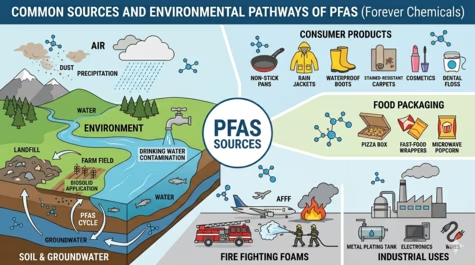
PFAS chemicals are found in non-stick cookware, stain-resistant fabrics, carpet treatments, food packaging, waterproof clothing, makeup and personal care products, and paints and cleaning products. PFAS chemicals are so prevalent in our environment that they have been found everywhere from Mount Everest to the deepest oceans.
The global market value for PFAS in 2023 was $14.3 billion; it is projected to reach $20 billion by 2029.
Companies became aware of the serious risks of PFAS in the 1960s but it was hidden from the public until the late 1990s. Various lawsuits helped uncover the truth, but by then the damage was already done.
Almost 100% of the U.S. population is exposed to at least one type of PFAS. It has been found to cause immune dysfunction, increased risk of cancer, various reproductive implications, and developmental issues in children.
The annual health costs associated with PFAS exposure in Europe range from €52 to €84 billion.
*****
Jump straight to our resources on ➡️ PFAS
Explore our comprehensive guides on -
- Toxic Substances
- Waste & Toxins
- Soil & Drinking Water
- The Biodiversity & Climate Crisis
- The Circular Economy
- Sustainability
Why Are PFAS Chemicals So Prevalent?
The widespread use of these toxic chemicals in everyday items and their inability to break down mean they are quite literally everywhere. Their resistance to water and just about everything else means they have found their way into our water sources, soils, air, and food.
As they take decades to break down in the environment, there has been a significant accumulation, posing a disastrous risk to ecosystems and public health. Companies ignored the warning signs, kept the dangers secret, and misled the public about their safety.
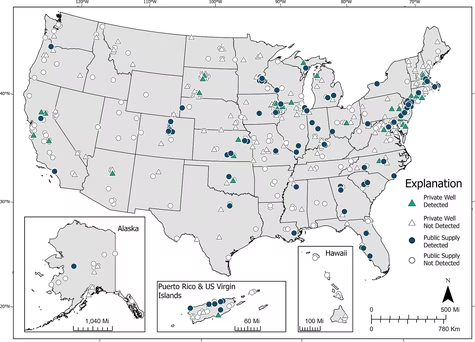
An estimated 99% of humans now have measurable levels of PFAS in their blood. Contamination has been found on all 7 continents, even in the most remote of places. Recent global studies found that 69% of groundwater samples contain the chemicals, and even more worryingly, with no known contamination sources.
In Europe, there are over 17,000 contaminated sites and about 2,300 hotspots which have extremely hazardous concentrations. In the U.S., PFAS are present in about 75% of urban tap water samples and 25% of rural samples.
The effects are most severe for those living in close proximity to manufacturing plants, military bases, airports, and landfills. In these areas, the water, soil, and air are more highly contaminated.
Environmental & Health Issues
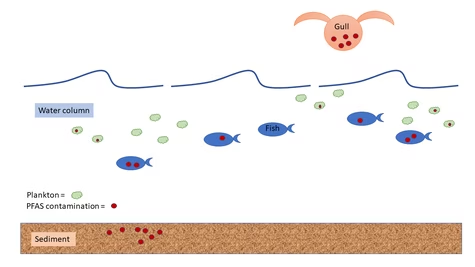
- PFAS chemicals are fuelling the biodiversity crisis as they accumulate in living organisms and move up the food chain.
- Around 600 species are already affected by reproductive failures, immune system suppression, and metabolic disruptions.
- During the production of PFAS chemicals, manufacturing plants release huge quantities of greenhouse gases, contributing to the climate crisis. Some plants emit HCFC-22, which is roughly 5,000 times more potent than carbon dioxide. There is much debate about their use in renewable energy technology, as we attempt to solve one problem, we create another.
- PFAS is highly mobile in soil and leaches into groundwater from landfill waste and firefighting foams. From here, it flows into rivers, lakes, and drinking water.
- Biomagnification means that concentrations of PFAS increase as they move up the food chain, affecting aquatic ecosystems and the safety of food for human consumption.
- PFAS chemicals travel long distances by air, meaning no place on Earth is spared from their impacts.
- The presence of PFAS chemicals in humans is linked to reduced ability to fight infections and a decreased response to vaccines.
- There is evidence that exposure causes increased risk of kidney, testicular, thyroid, and liver cancers.
- PFAS causes higher cholesterol levels and an increased risk of obesity or type 2 diabetes.
- There is a clear link between high levels of PFAS and lower infant birth weights and accelerated puberty.
- The highest risk groups are infants and young children, communities relying on contaminated water sources, and workers in the manufacturing industry.
Legal Challenges Against PFAS
In the U.S., Europe, and Australia, tens of thousands of lawsuits have been filed against PFAS manufacturers and users. The main challenges are centred around environmental damage, health implications, and consumer deception.
The first major lawsuit was filed in 1999 in West Virginia on behalf of farmer Wilbur Tennant. The events inspired the movie ‘Dark Waters’. The suit alleged that DuPont knowingly contaminated the water supply after Tennant saw his cattle suffering from numerous health issues.
DuPont was found to have dumped 7,100 tons of PFOA sludge during the late 1980s, despite knowing that PFAS was toxic and had serious harmful effects on humans and animals. The large settlement figure was used to fund the C8 Science Panel, which works to connect PFOA to diseases.
This lawsuit laid the foundations for thousands of other cases in the years that followed.
As of early 2026, U.S. chemical companies, including 3M, DuPont, Chemours, and Corteva, have paid approximately $14 billion in total settlements to resolve litigation over PFAS contamination.
Regulations Around The World
As the toxic legacy of PFAS was kept hidden for decades, progress on regulating its use has been significantly delayed. In general, there is a shift towards regulation and bans; however, progress is slow, and under the Trump administration, several environmental rollbacks have stalled it further.
In the EU, governments are working to restrict PFAS as a group, covering all 10,000 substances with a goal of a near-total ban. In 2026, PFAS were banned in food packaging, and a new limit was placed on drinking water.
In 2026, the UK government in 2026 launched a plan to map, restrict, and manage PFAS. It involves phased restrictions, which will begin in 2027 on all non-essential products. They plan to introduce a drinking water limit in the near future, ban firefighting foams, and impose stricter regulations on industrial emissions.
U.S. regulation, driven by the scale of contamination, the slow pace of federal action, and the thousands of chemical variations that remain unregulated, is insufficient. Historically, the EPA has taken steps to improve drinking water standards, but rollbacks under Trump have actually loosened these limits and permitted the use of certain PFAS in pesticides.
To reduce the regulatory burden on industries, the U.S. are compromising public health and water safety. While the EU has taken a proactive approach, in the face of industry resistance, the global response overall is slow and wholly inadequate.
Addressing The Pollution Burden
Not only must we stop adding to the PFAS pollution burden, but we must also tackle the existing accumulation of it in our environment. Cleaning up legacy pollution is no easy feat in the face of such a widespread, stubborn issue.
We must enforce accountability through the polluter-pays principle.
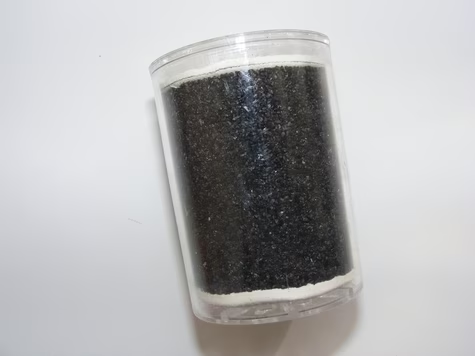
Advanced technologies which utilise activated carbon can remove PFAS from drinking water and wastewater. We must move away from landfills and incineration and towards destruction technologies that can break down the carbon-fluorine bond.
Contaminated sewage sludge, when spread onto agricultural land, must be treated first to prevent further soil contamination.
By reducing human and animal exposure to PFAS, we can begin to slowly reduce the impacts, but this approach only works if we prevent further contamination and stop the influx of new PFAS at the source.
As individuals, we can reduce our exposure by:
- Installing a water filter which uses activated carbon or reverse osmosis.
- Contact your local water supplier to find out when their last testing was and for a copy of the results.
- Replace traditional non-stick cookware with cast iron, stainless steel, glass, or ceramic.
- Avoid eating anything that came in grease-resistant packaging, such as fast-food wrappers, pizza boxes, and microwave popcorn.
- Store leftovers in glass or metal containers, not plastic ones.
- Avoid carpets, furniture, and clothes treated with stain-resistant sprays.
- Check for labels which say PFAS-free or PFC-free.
- Steer clear of cosmetics, toiletries, and dental floss that list PTFE or perfluoro in their ingredients.
- Support organisations and local action groups which are pushing for stricter regulations on PFAS.
- Contact your local politicians to demand stronger restrictions on PFAS in products and on industrial pollution.
*****
Chemical pollution has officially passed the safe limit for humanity. Strict universal regulation and demanding accountability from polluters are the only paths forward to protect current and future generations.
Chemical-by-chemical regulation of a group which contains over 10,000 substances is futile. All PFAS must be banned through blanket legislation to achieve a prompt, effective solution to this dangerous problem. Any other response will take decades and leave one harmful chemical to be replaced by another.
The multi-billion-dollar PFAS industry has orchestrated a well-funded, intense lobbying campaign to prevent further regulation and avoid a trillion-dollar cleanup bill.
"We’re facing a ‘forever chemicals’ crisis... at the cost of our health, our environment, and the lives of our loved ones." - Mark Ruffalo.
We must not delay action any further.
Author: Rachael Mellor, 01.05.26 licensed under CC BY-SA 4.0
For further reading on PFAS see below ⬇️
More Resources
Curated Directory & Deep-Dive Resources on PFAS - Forever Chemicals
- What are PFAS? Everything you need to know about the ‘forever chemicals’ surrounding us every day - Guardian 25.05.24 515167
- Estimated scale of costs to remove PFAS from the environment at current emission rates - Science Direct 25.03.24 515247
- Toxic Gaslighting: How 3M Executives Convinced a Scientist the Forever Chemicals She Found in Human Blood Were Safe - ProPublica 20.05.24 515229
- 'Important Step': EPA Finalizes Rule to Clean Up Forever Chemical Contamination - CD 19.04.24 409847
- US imposes first-ever limits on levels of toxic PFAS in drinking water - Guardian 10.04.24 406750
- Warning as scientists reveal the fruit and vegetables with the most forever chemicals - Independent 09.04.24 515203
- Harmful ‘Forever Chemicals’ Removed from Water with New Electrocatalysis Method - ENN 06.03.24 402758
- Forever Chemicals: PFAS Contamination of Freshwater Fish - Rivers Trust 20.12.23 515179
- Discussion. Has the human population become a sentinel for the adverse effects of PFAS contamination on wildlife health and endangered species? - Science Direct 25.11.23 515242
- PFAS ‘forever chemicals’ harming wildlife the world over: Study - Mongabay 26.09.23 515241
- Study Finds 'Forever Chemical' Exposure Increases Risk of Certain Cancers in Women - CD 18.09.23 373296
- The Cost of Treating PFAS: Alleviating the Taxpayer Burden - SL Law Group 10.09.23 515249
- Why the market for mopping up ‘forever' chemicals is exploding - GreenBiz 26.07.23 366352
- 'Forever Chemical' Lawsuits Could Ultimately Eclipse the Big Tobacco Settlement - Time 12.07.23 515214
- You probably have “forever chemicals” in your body. Here’s what that means - Vox 23.06.23 515183
- Chemical firms kept data on PFAS health hazards secret - Chemistry World 02.06.23 515228
- Industry Documents Show Corporate Ghouls Knew About Forever Chemicals for Decades - Gizmodo 01.06.23 349889
- The Devil they Knew: Chemical Documents Analysis of Industry Influence on PFAS Science - NIH 06/23 515226
- Scientists Identify Bacteria That Can Break Down ‘Forever Chemicals’ - ENN 31.05.23 349765
- ChemSec identifies the top 12 PFAS producers in the world and reveals shocking societal costs - Chem Sec 22.05.23 515206
- Societal Cost of 'Forever Chemicals' Estimated at Over $17,000,000,000,000 - CD 12.05.23 347331
- Chemical romance: how politicians fell for BASF - Corporate Europe 15.03.23 515234
- Over 100 organisations call on the European Commission to fully ban PFAS by 2030 - HEAL 14.03.23 515200
- Toxic ‘forever chemicals’ found in toilet paper around the world - Guardian 13.03.23 334933
- Revealed: scale of ‘forever chemical’ pollution across UK and Europe - Guardian 23.02.23 331295
- How Widespread Are These Toxic Chemicals? They’re Everywhere - NY Times 22.02.23 515243
- Alarming levels of PFAS in Norwegian Arctic ice pose new risk to wildlife - Guardian 11.02.23 328792
- Investors pressure top firms to halt production of toxic ‘forever chemicals’ - Guardian 06.01.23 515208
- Groups Sue to Stop Company's 'Forever Chemical' Contamination of Plastic Containers - CD 28.12.22 323398
- EU lobby profile: Syngenta - Corporate Europe 20.10.22 515236
- New Study Maps Over 50,000 Sites In the U.S. That Are Likely Contaminated With 'Forever Chemicals' - Gizmodo 12.10.22 313376
- Video: Forever Chemicals PFAS, PFOA, PFOS, BPA, Explained Clearly - MedCram 6/22 416257
- ‘Forever chemicals’ may have polluted 20m acres of US cropland, study says - Guardian 08.05.22 288942
- Study Shows Even 'Green' and 'Nontoxic' Products for Kids Contain Forever Chemicals - CD 04.05.22 287112
- ‘A worldwide public health threat’: Rob Bilott on his 20-year fight against forever chemicals - Guardian 01.05.22 285161
- From Raincoats to Napkins, Toxic 'Forever Chemicals' Found in Everyday Products - CD 26.01.22 272096
- PFAS ‘forever chemicals’ constantly cycle through ground, air and water, study finds - Guardian 18.12.21 265746
- Video: PFAS: Last Week Tonight with John Oliver (HBO) 10/21 416258
- Production of forever chemicals emits potent greenhouse gases, analysis finds - Guardian 16.09.21 515245
- The True Cost of PFAS and the Benefits of Acting Now - NIH 07/21 515248
- Teflon and 'forever chemicals:' The hidden toxins in your body - DW 11.06.21 256807
- Study finds alarming levels of ‘forever chemicals’ in US mothers’ breast milk - Guardian 13.05.21 244000
- Chemical giants hid dangers of ‘forever chemicals’ in food packaging - Guardian 12.05.21 243621
- Video: PFAS: The secret toxins in your body - Planet A 3/21 256815
- Cosmetics, cellphones, guitar strings: where we found 'forever chemicals' - Guardian 14.12.20 228144
- Toxic PFAs chemicals discovered in hundreds of products - Intercept 02.12.20 228558
- Breaking Down Toxic PFAS - Earth Justice 09.10.20 228560
- PFAS ‘forever chemicals’ are widespread and threaten human health - Conversation 09.10.20 228564
- PFAS present throughout the Yadkin-Pee Dee river food chain - ENN 05.06.20 209169
- Study: winds spread PFAS pollution far from a manufacturing facility - American Chemical Society 27.05.20 208426
- Toxic ‘forever chemicals’ more common in tap water than thought, report says - National Geographic 24.01.20 228554
- Why you need to know about PFAS, the chemicals in pizza boxes and rainwear - Guardian 23.05.19 228555
- DuPont, 3M Concealed Evidence of PFAS Risks - UCS 22.03.19 515227
- What are PFAS chemicals, and what are they doing to our health? - CNN 14.02.19 228561
- Dark Waters - IMDb, 2019 515215
- Teflon Is Forever - Mother Jones 5/07 256805