
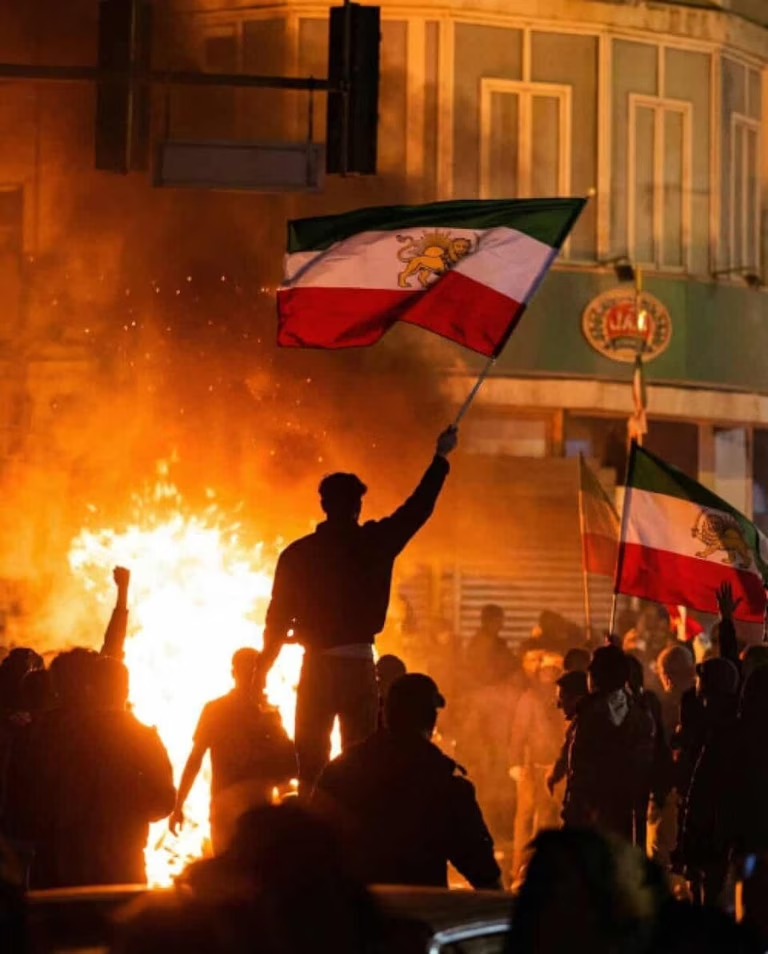
Iranian protests 2025-2026
Widespread unrest erupted in December 2025 as thousands demand the removal of Iran’s supreme leader, Ayatollah Ali Khamenei. Brutal response by security forces and human rights abuses.
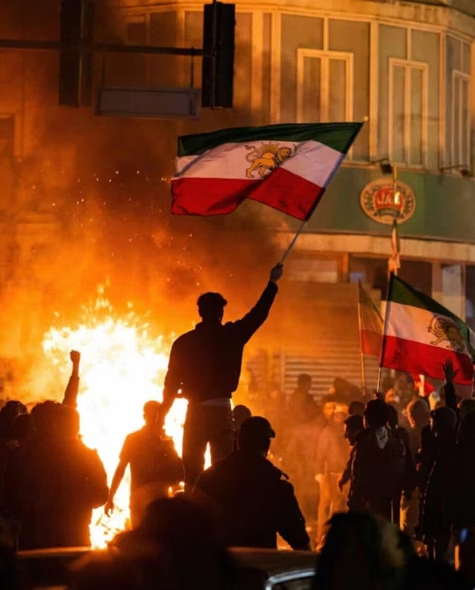
➡️ DEADLY ANTI-REGIME PROTESTS IN IRAN 2025/26 - Under a Strangled Economy, Iranians Have Had Enough
Nationwide unrest erupted in Iran on December 28, 2025. Although the demonstrations have since eased, widespread discontent with the Islamic Republic government, its mishandling of the ongoing economic crisis, and its brutal stronghold on the country have continued to worsen.
These protests amount to the largest uprising since the 1979 Islamic Revolution. Demonstrations have taken place in all 31 provinces across 186 cities. The Iranian government responded with deadly force, killing more than 6,000, injuring thousands more, and arresting more than 24,000. Instilling fear in Iranian civilians, many have now chosen to stay at home as the country reels from a 20-day government-enforced internet blackout.
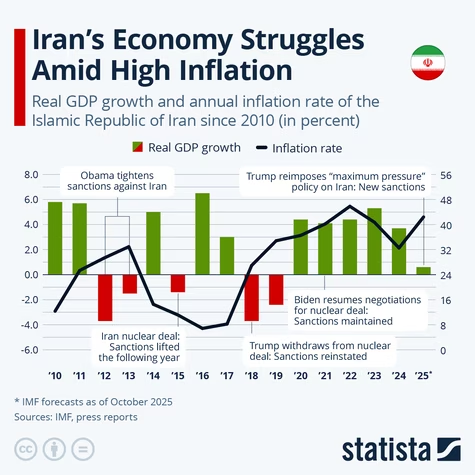
The latest protests began after shopkeepers and merchants in Tehran closed their shops following the Rial's plummet to an all-time low. Soaring prices, the collapse of the currency, and economic growth of just 0.6% has made business and life in the country near impossible.
The situation escalated after U.S. President Donald Trump threatened to take military action. For years, Iran has struggled under brutal repression, critical water shortages, power outages, unchecked air pollution, chronic corruption, and economic mismanagement.
Jump straight to our resources on the deadly ➡️ Protests in Iran
Explore our comprehensive guides on -
-
Iran & Past Conflicts
-
Israeli Attacks on Iran
-
The Iranian Nuclear Programme & the Nuclear Deal
-
U.S. & UN Sanctions
-
Women's Rights (Or Lack Of) in Iran
-
The Death Penalty
-
Human Rights in Iran
-
The Political Situation in Iran
-
Information for Protesters in Iran
*****
Iran's Economic Meltdown
Iran is suffering its deepest and most prolonged economic crisis in modern times. In the last 8 years, the Iranian currency has fallen by 90%. In December 2025, one U.S. dollar was priced at 1.36 million Rial. Food prices have risen by 72% compared to the previous year. This dire situation is not new; it is a consequence of years of inaction, and the Iranian people are angry.
How can people survive if a tray of eggs is £9 and five kilos of cooking oil is £25?
Iran's economy is unrecognisable as war and sanctions have brought the country to a standstill. Iran is now one of the most heavily sanctioned countries in the world.
Timeline of significant sanctions on Iran:
-
1979 – The first U.S. imposed sanctions after the seizure of the U.S. Embassy in Tehran. Iranian imports are banned, and $12 billion in assets are frozen.
-
1995 - President Bill Clinton prevents U.S. companies from investing in Iranian oil and gas, and from engaging in all forms of trade. In 1996, Congress passed a law requiring sanctions on foreign firms investing more than $20m a year in Iran's oil and gas sector. European protests postponed its implementation until 2010.
-
2006 - The United Nations imposes sanctions on Iran's trade in nuclear energy-related goods. Individuals and companies with connections to it have their assets frozen. Over the following years, the U.S., the EU, and the UN continue to expand and tighten their sanctions.
-
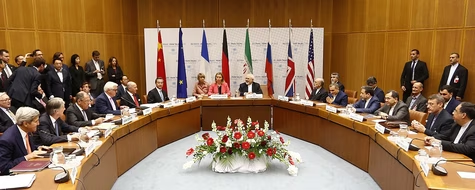
2015 - The U.S., the UK, China, France, Germany, Russia, and Iran sign the Joint Comprehensive Plan of Action. The agreement entails Iran curbing its nuclear program in exchange for a significant easing of sanctions.
-
2018 – President Trump withdraws the U.S. from the nuclear treaty and reimposes all sanctions on Iran.
-
2019 - Trump imposes new sanctions targeting petrochemicals and metals, as well as 12 Iranian officials.
-
2020 - The U.S. assassinates Qassem Soleimani and imposes more sanctions on Iran.
-
2025 – The U.S. launches strikes on Iranian nuclear sites in a 12-day war. UN sanctions were reimposed over Iran's nuclear programme.
-
2026 – Almost all of Iran's oil revenue and overseas assets remain frozen.
When the Rial reached a new record low in December 2025, and at the height of the protests, the head of Iran's Central Bank resigned. He had been critical of the government's handling of the economic situation.
President Masoud Pezeshikian has appointed Abdolnasser Hemmati as the new bank governor. Hemmati previously held this position from 2018 to 2021. This is a questionable move, as during his brief stint as the country's Economy Minister, he was impeached in a no-confidence vote. The reason, for failing to tackle inflation and improve the value of the Rial, the very job expected of the Central Bank.
Deadly Crackdown by Authorities
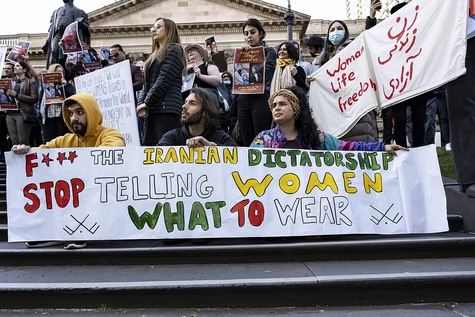
On the recent protests, Ali Hosseini Khamenei, Iran's supreme leader, said, "rioters must be put in their place." This gave the Islamic Revolutionary Guard Corps (IRGC) the green light to put an end to the protests by any means necessary.
Most international news organisations are barred from reporting inside Iran, but accounts from people who attended the protests reveal that protesters were shot at with live rounds indiscriminately. They even targeted those running away and even onlookers who were not involved. An alarming detail is that the IRGC specifically aimed at the protesters' faces and eyes.
In an attempt to crush dissent, shotguns, assault rifles, and handguns were used on the largely peaceful protests. Many of those injured did not seek medical attention for fear of being detained. The authorities have been refusing to hand over bodies to their families. Iranian security forces have a history of confiscating their victims' bodies and even forcing families to pay for the bullets used.
Donald Trump has threatened military action if the attacks on protesters continue, but has so far failed to intervene. Iran responded that it is open to negotiations. A few days later, however, Trump announced a 25% tariff on Iran's trade partners.
Iran is a theocratic republic which gives ultimate authority to their supreme religious leader. Exerting massive control over the country, the supreme leader also serves as commander-in-chief of the armed forces, sets general policy, controls the state media, appoints heads of the justice system, and leads key religious foundations. They hold a lifetime tenure.
The state is built on Shia Islamism, and the current regime has consolidated a mass of power. It is defended by a series of paramilitary forces, government-controlled courts, and death sentences against political dissidents.
The morality police enforce compulsory hijab laws, women's rights have been stripped back, the persecution of minorities, such as the Kurds, Baluchis, and Arabs, is commonplace, the internet is censored and restricted, social media platforms are blocked, and schools are strictly controlled by the state to promote ideological indoctrination.
"The violent repression of the Iranian people does not solve any of the country's problems. On the contrary, it creates conditions for further human rights violations, instability and bloodshed." - Volker Türk, UN High Commissioner for Human Rights
Is a Peaceful, Prosperous Iran Possible?
The widespread demonstrations in Iran, although started as an economic protest, are part of much broader political issues and anti-government sentiment. Protests saw university students marching alongside shopkeepers and merchants.
Iran now faces an unknown future.
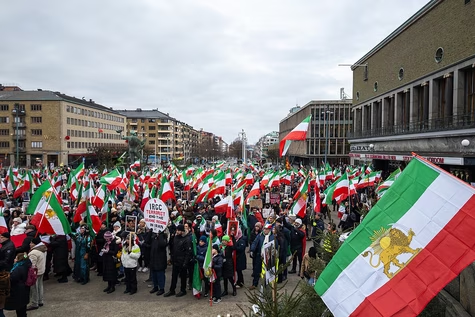
International protests have now spread around the world as people unite and speakup for the people in Iran and the desperate need for reason, justice, and peace.
Iran is suffering from severe water scarcity, forcing internal migration and devastating rural communities. Decades of sanctions have left Iran crippled and isolated from the international community. Despite its wealth in oil and gas, due to failing infrastructure, civilians endure frequent energy shortages, leaving homes without heating in the winter months.
Change will come, but in what direction we can not be sure. Weak attempts at diplomacy have failed. The U.S. and Iran are both stubbornly uncompromising and looking to military action as a first option.
Iranian people dream of freedom and democracy whilst endlessly criticising the regime's authoritarian rule, even under the threat of death. The global community must step up to support the Iranian people and help them reclaim their future. Endless sanctions are not working and continue to punish innocent civilians.
Regime change in Iran would shake up the entire Middle East. Diplomacy would begin to stand a chance, Iranian influence would wane, conflicts would stabilise, and regional cooperation might even become the norm.
We must work to eliminate the nuclear threat in Iran and in all nuclear states.
"In the face of oppression, the courage to speak out becomes the beacon of hope." – Nasrin Sotoudeh, Iranian lawyer and human rights activist
Author: Rachael Mellor, 29.01.25 licensed under CC BY-SA 4.0
For further reading on the 2025/26 Protests in Iran see below ⬇️
More Resources
Curated Directory & Deep-Dive Resources on Iranian protests 2025-2026
- Iran’s protests: the regional and international responses - IISS 16.01.26 509117
- So much for a ‘final battle’ – once again the Iranian people’s peaceful and democratic demands have been silenced - Guardian 16.01.26 505107
- Video: Reza Pahlavi, is the last shah's son a viable opposition leader for Iran? - Guardian 16.01.26 505282
- Video: Who is Reza Pahlavi, the son of Iran's last shah? - BBC 16.01.26 505109
- Iran crisis explained: what we know so far - Guardian 15.01.26 504879
- You Might Not Like What Comes Next in Iran - Politico 15.01.26 506174
- One uprising, two stories: how each side is trying to frame the uprising in Iran - Conversation 15.01.26 506979
- How the Islamic Republic uses internet shutdowns as a tool of repression - Conversation 15.01.26 505946
- Iran’s Protesters Are Caught Between State Repression and Foreign Intervention - Truthout 15.01.26 505682
- 'Pahlavi will return': Nearly 50 years after the Shah fled, Iranians want his son back - JPOST 15.01.26 505110
- Rift at top of the Taliban: BBC reveals clash of wills behind internet shutdown - BBC 15.01.26 504898
- “This Regime Will Fall”: Director Jafar Panahi on Deadly Iran Protests & Filmmaking Under Censorship - DN! 15.01.26 505542
- The Saga of an Iranian Jewish Kurdish Labor Activist - Iran Wire 15.01.26 504917
- What is HRANA, the US-based group behind Iran’s death toll figures? - Al Jazeera 15.01.26 504875
- How ‘day zero’ water shortages in Iran are fuelling protests - Guardian 15.01.26 505762
- How ‘day zero’ water shortages in Iran are fuelling protests - Guardian 15.01.26 504877
- Trump says Iran has told him ‘killing has stopped’ as he pulls back from strike threats - Guardian 15.01.26 504876
- Iran's regime crushing protests in bloody crackdown - DW 15.01.26 504922
- ‘The world needs to know what’s happening’: families of protesters killed in Iran tell of heartbreak - Guardian 15.01.26 504886
- I know the terrible cost of speaking out in Iran – and I beg the world to stand with those speaking out now - Guardian 15.01.26 505765
- Video: Reza Pahlavi vows to recognise Israel, end nuclear programme if he led Iran - Al Jazeera 15.01.26 505111
- Is Starlink helping Iranians break internet blackout, and how does it work? - Al Jazeera 14.01.26 505493
- Will the Islamic Republic of Iran be able to celebrate its 47th anniversary? - TFF 14.01.26 507246
- Execution of condemned Iranian protester postponed, family told - Guardian 14.01.26 504880
- Fact check: AI fakes and old videos mislead on Iran protests - DW 14.01.26 504790
- Are Iran’s protests different this time around? - Al Jazeera 14.01.26 504874
- Only the Iranian People Should Determine Their Nation’s Future - CD 14.01.26 504753
- Trump’s neo-con turn on Iran - Al Jazeera 14.01.26 504869
- Qatar warns U.S.–Iran escalation would be “catastrophic” for the region - Iran Wire 14.01.26 504910
- Attacking Iran Is No Way to Support Iranian Protests - In These Times 14.01.26 505687
- What are Trump’s military options for an attack on Iran? - Al Jazeera 14.01.26 504867
- Iran signals fast trials and executions for protesters, despite Trump's warning - NPR 14.01.26 504835
- Why western diplomats are wary of predicting end days for Iran’s regime - Guardian 14.01.26 504795
- Anti-regime protests in Iran and around the world – in pictures - Guardian 14.01.26 504646
- US military action in Iran appears increasingly likely, report says - Guardian 14.01.26 504759
- UN 'very concerned' over rising 'military-like rhetoric' on situation in Iran - AA 14.01.26 504699
- No word on fate of Iran protester due to be put to death, says relative - Guardian 14.01.26 504760
- Trump Urges Protesters in Iran to “Take Over Your Institutions” As Death Toll Reaches Thousands - Mother Jones 14.01.26 504658
- The death toll from a crackdown on protests in Iran jumps to over 2,500, activists say - NPR 14.01.26 504651
- Podcast: Massacres and executions: what are we hearing from inside Iran? - The Latest 14.01.26 504799
- Iran’s Regime Is Unsustainable - New Yorker 13.01.26 504858
- Why the US Must Absolutely Not Force Regime Change in Iran - CD 13.01.26 505286
- As Trump Threatens to Intervene, Iranian Protesters Warn US, Israel ‘Want Entire Region in Chaos’ - CD 13.01.26 505285
- Iran’s protesters need our support – not another western-intervention disaster - Guardian 13.01.26 504527
- Why Trump’s options are limited when it comes to using force against Iran - Guardian 13.01.26 504549
- President Trump Urges Iran Protests To Continue, Says ‘Help Is on Its Way’ - AntiWar 13.01.26 504670
- Trump says no 'accurate number' yet on Iran protester deaths - AA 13.01.26 504698
- World reacts to Iran protests, US military threats against Tehran - Al Jazeera 13.01.26 505457
- World reacts to Iran protests, US military threats against Tehran - Al Jazeera 13.01.26 504697
- How US sanctions crippled lives of Iranians Trump says he wants to ‘help’ - Al Jazeera 13.01.26 505456
- Trump promises ‘help is on its way’ and tells Iranians to ‘keep protesting’ - Guardian 13.01.26 504552
- Video: How the U.S. and Israel Are Trying to Co-opt Iran's Protests - Dropsite 13.01.26 505723
- What Russia Will—and Won’t—Do for Its Embattled Ally Iran - Carnegie Endowment 12.01.26 505944
- Iran’s Protests Are Following a Familiar Pattern - Carnegie Endowment 12.01.26 505727
- How Will the Trump Administration Respond to Violent Protests in Iran? - CSIS 12.01.26 504932
- Son of Last Iranian Shah Asks Trump to Back Military Coup as Protests Rage - CD 12.01.26 504528
- Iran Escalates Deadly Crackdown on Mass Protests as Trump Threatens to Launch Military Attack - DN! 12.01.26 504640
- Iran protests 2026: our surveys show Iranians agree more on regime change than what might come next - Conversation 12.01.26 505473
- Would Trump’s threatened strikes help Iran’s protestors or boost the regime? - Chatham House 12.01.26 504478
- How Iran’s protest movement has gained increasing momentum – a visual guide - Guardian 12.01.26 504464
- Trump Again Threatens to Bomb Iran as Protest Deaths Near 600 - CD 12.01.26 505760
- Iran says communications open with US, Trump weighs response to crackdown on protests - Al Arabiya 12.01.26 504444
- Lighting cigarette with burning Khamenei portrait becomes protest symbol - Iran International 11.01.26 504446
- New protests rock Iran as NGOs raise the alarm over crackdown 'massacre' - Le Monde 11.01.26 504447
- ‘The streets are full of blood’: Iranian protests gather momentum as regime cracks down - Guardian 11.01.26 504445
- Iran warns US troops and Israel will be targets if America strikes over protests as death toll rises - NPR 11.01.26 504477
- Two Nights Iran Didn’t Sleep: What Happened on January 8 and 9? - IranWire 10.01.26 504574
- 'There wasn't even time for CPR': Iran medics describe hospitals overwhelmed with dead and injured protesters - BBC 10.01.26 504553
- Iran authorities signal intensified crackdown as unrest grows - Reuters 10.01.26 504227
- Iran protesters tell of brutal police response as regime lashes out - Guardian 10.01.26 504219
- Iran’s army pledges to defend national interests after US backs protesters - Al Jazeera 10.01.26 504223
- Video: Watch: Iran protesters breach London embassy and RIP down Islamic regime flag - GBNews 10.01.26 504207
- Video: Son of last Iranian shah urges protesters to shutdown cities | DW News 10.01.26 504208
- Video: Iranians Continue Protests Despite Khamenei's Waring, Death Penalty Threats | WION News 10.01.26 504209
- The Guardian view on Iran’s protests: old tactics of repression face new pressures - Guardian 09.01.26 504221
- Silent fault lines - IPS 09.01.26 504600
- Doctor Says More Than 200 Reported Dead in Tehran as Regime Opens Fire on Protests - Time 09.01.26 504228
- Growing protests in Iran do not necessarily herald a return to monarchy - Guardian 09.01.26 504222
- Video: Is Iran Finally on the Brink of Revolution? - Free Press 09.01.26 504206
- Video: Could Iran be the next Venezuela? | The Take - Al Jazeera 09.01.26 504217
- Video: Iran Protest Live: Street protests Grow in Iran as the Country Faces an Internet Blackout | Khamenei - Mint 09.01.26 504213
- Video: This is the Berlin Wall moment in Iran": Masih Alinejad on the nationwide protests - CNN 09.01.26 504211
- Video: Iran unrest widens as government shuts off internet - Global National 09.01.26 504214
- Video: How far will Iran's protests go? Defiance grows despite crackdown - France24 08.01.26 504212
- Video: Iran’s mass protests: Is the regime’s survival in question? - Newsmakers 08.01.26 504210
- What to know about the intensifying protests shaking Iran and putting pressure on its theocracy - PBS 08.01.26 504241
- Video: Iran Revolution Live with Iranian Host: Day 12 - Goldie Ghamari (?) 08.01.26 504215
- Iran’s Protesters Are Caught Between State Repression and Foreign Intervention - Truthout 08.01.26 505198
- Iran: An Uprising Besieged from Within and Without - CrimethInc. 07.01.26 504647
- Video: Live: Deadly Iran Protests Spread To Hinterland as Trump Threatens US Action | Iran Protests - Firstpost 07.01.26 504218
- Video: Why the Iranian regime is on the brink of collapse - Channel 4 News 06.01.26 504240
- Iran’s Massacres Will Haunt the Regime - Journal of Democracy 02.01.26 509010
- Explainer: Five things you need to know about protests in Iran - Al Jazeera 02.01.26 504224
- Video: How far will the latest protests go in Iran? | Inside Story - Al Jazeera 01.01.26 504216
- Video: Iran Protest LIVE: Iran Shuts Down As Protesters Storm Governor's Office Amid Economic Woes - Firstpost 01.01.26 504239
- Reza Pahlavi - Britannica 504242
- Reza Pahlavi - Grokipedia 504244
- Reza Pahlavi, Crown Prince of Iran - Wikipedia 504243