
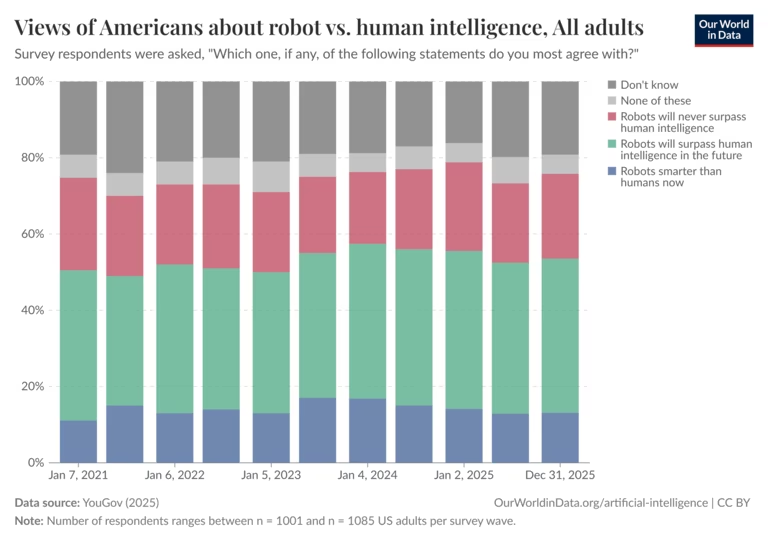
Human Intelligence - HI
Explore the key differences between Human Intelligence (HI) and AI. Discover why human adaptability, empathy, and unique origins matter in a world of machines.
HUMAN INTELLIGENCE vs ARTIFICIAL INTELLIGENCE - Strengths & Limitations
Discover the fascinating world of human intelligence (HI) versus artificial intelligence (AI) and learn how you can actively protect our democratic future. Our HI vs AI guide offers you in-depth information on the critical implications for democracy, the dangers of big tech dominance, and Audrey Tang’s visionary concept of assistive AI.
Connect with valuable resources, initiatives, and organisations – for genuine technological empowerment, improved digital rights, and a sustainable future.
Jump straight to our resources on ➡️ Human Intelligence
With nearly 4 in 10 employees saying their organisation has adopted AI in some form, many are already taking advantage of its benefits.
The use of AI has sped up processes, increased efficiency, cut costs, and helped to sort through mountains of data. AI models, however, can miss context and can also display biases. Worryingly, they can project confidence with very little information.
The benefits of AI are best seen when used in collaboration with human intelligence. People bring diverse logical decision-making, opinions based on evidence, and the unreplicable human imagination. They also bring essential perspectives with empathy and accountability.
*****
General Information on Human Intelligence
While AI continues to advance at an astonishing pace, the core differences between how humans and machines think remain profound. The methods of processing information, adapting, and finding meaning differ in distinct ways.
Origin:
- Humans are conscious. It is shaped by millions of years of evolution, sensory experiences, emotions, and social interactions.
- AI is algorithmic and mathematical. It is designed by humans and runs on code, data, and statistical probabilities.
Adaptability:
- Humans can learn a new skill with just a few or even one example. We can then adapt this knowledge to different areas of our lives.
- AI functions with very specific tasks. They require vast datasets to learn patterns and struggle with transferring this to out-of-context situations.
Intent:
- Humans are sentient, self-aware, and emotionally deep. Our intent is guided by moral agency, ethics, and the capacity to feel empathy.
- AI has no feelings, consciousness, or intent. It merely processes data to predict the next most logical output. It can only mimic empathy.
_________________________________________________________
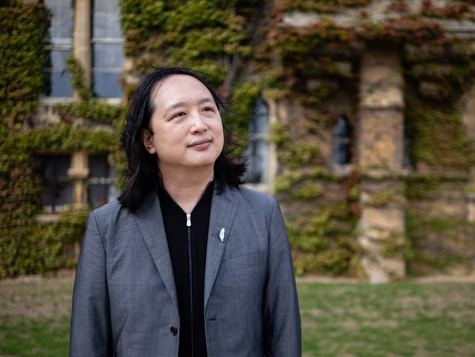
Audrey Tang’s Vision
Audrey Tang is a Taiwanese civic hacker and software programmer who has earned a reputation as one of the biggest names in computing. She has used her skills and influence to bring civic tech into the mainstream and promote internet freedom and civic participation in Taiwan and beyond.
In 2024, she became Taiwan’s Cyber Ambassador, a high-level diplomatic role specialising in digital policy, cybersecurity, and technology governance.
Her goal is to turn digital tools into a force for good. She provides one of the most democratic and human perspectives on the relationship between HI and AI. Rather than viewing AI as a threat, she champions collaboration and community.
Assistive Intelligence -
Tang defines the acronym AI as "Assistive Intelligence," rather than "Artificial." She argues that AI should never take a ‘top-down’ approach that forces humans out of the loop.
Tang’s approach views AI as a supportive tool that amplifies human agency, helps communities connect, and makes life easier.
Singularity vs Plurality -
Singularity in AI is the point at which AI surpasses human capabilities and can improve itself without human intervention. Silicon Valley has been relentlessly pursuing reaching this point.
Driven by greed, tech billionaires seek exponential profits and total market control. Escaping the limits of human cognition, if used for good, could help us to solve some of the planet's most pressing global issues, such as hunger, poverty, disease, and climate change, but many experts have labelled this concept a mere fig leaf.
AI is well documented to have exacerbated inequalities. The massive concentration of wealth in tech monopolies, the automation of jobs, and the biases in AI decision-making are already creating divides.
Co-author of the project and book 'Plurality', Tang argues that the true power of human intelligence lies in collective, horizontal intelligence.
"We the people, are already the superintelligence we are looking for" - Audrey Tang.
She argues that the goal should not be to build a supreme machine to save us, but to use technology to connect our existing individual minds.
She highlights how AI biases can amplify polarisation and function almost like parasites feeding on societal division.
Tang’s solution of plurality advocates for using civic AI and tools like "Alignment Assemblies" to find consensus among populations and solve complex societal issues collaboratively.
Tang has proven that technology can help deepen trust and give millions a chance to help shape policies. With a mission to fight polarisation and uphold democratic values, her ideas on digital democracy and civic participation are being rolled out worldwide to promote open, inclusive, and transparent governance.
Her 'Taiwan Model' of democracy has already been adopted across various levels of government, civic organisations, and international initiatives, as well as in governments abroad.
Digital technology is transforming our democratic processes and reshaping how we engage with political processes. When used for good, digital tools can support campaigning, how we communicate with politicians, how we share our opinions, how we obtain information, how we vote, and how elections are run.
These new tools have opened up new avenues for participation, transparency, and accountability. Social media and government forums facilitate public discourse, make it easier for our voices to be heard, and allow voters to hold leaders accountable.
On intelligence, Tang sees the ultimate measure of intelligence as relational health - how well a community cares for its members and collaborates. Her belief is that AI should be designed locally and collaboratively to support community relationships rather than isolating individuals.
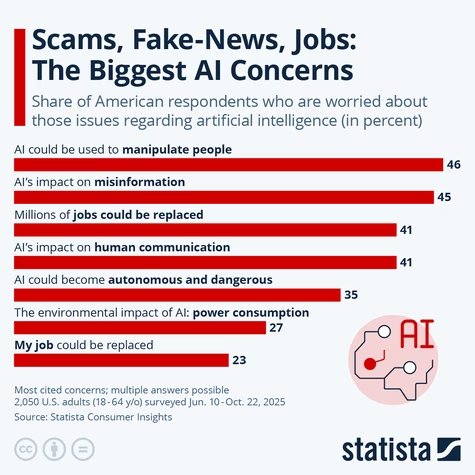
The Dangers of AI
The Digital Revolution and the rapid rise of Big Tech companies and AI over the last 2 decades have led to vast market dominance, massive concentrations of power and money, and an unexpected and dangerous role in politics.
The world's five largest tech giants are all American companies – Alphabet (Google), Amazon, Apple, Meta (Facebook), and Microsoft. They all have their headquarters in the San Francisco Bay Area of Northern California, also known as Silicon Valley.
These companies exert massive control over the internet through operating systems, search engines, social media, e-commerce, and streaming services. This unprecedented influence allows them to set their own rules for competition, data privacy, information access, marketing, and audience engagement.
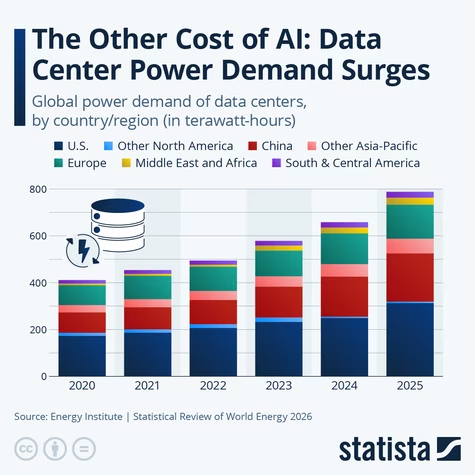
Major areas of concern include:
- The risk of overdependency
- The spread of misinformation, ease of manipulation, and content control
- Algorithmic bias
- Monopoly and antitrust concerns
- Security, data, and privacy
- The risk of international interference
- Labour exploitation
- Use of AI in warfare
- Extreme energy and water consumption caused by data centres
AI Plurality & Assistive AI For A Better World
Better World Info supports Audrey Tang’s approach to AI, focusing on plurality, community, and collaboration, in which AI assists human activities rather than overtaking or dominating them.
We must prioritise diverse perspectives, the decentralisation of power, and the implementation of regulations. Resilience, inclusion, sovereignty, and a commitment to democratic values are of utmost importance.
The human intelligence versus artificial intelligence debate is best resolved not as a competition but through a collaborative framework in which AI serves as a powerful supplement that enhances, rather than replaces, human critical thinking and creativity.
Author: Rachael Mellor, 17.07.26, licensed under CC BY-SA 4.0
More Resources
Curated Directory & Deep-Dive Resources on Human Intelligence - HI
- Why I *do not* use GenAI in any aspect of my work. The five big reasons - Andrew Godfrey-Collins 20.08.26 523362
- AI job worries grow. But some human skills can’t be replaced by machines - Guardian 20.07.26 520508
- Design AI Systems That Actually Strengthen Human Reasoning - HBR 20.07.26 520513
- From artificial to actual intelligence – reclaiming the human university - Wonkhe 14.07.26 520519
- Video: The 3 Human Skills AI Can’t Replace - Mike Bechtel - The IJK Podcast 13.07.26 520509
- Safe from AI: which jobs will help you thrive in the future? - Guardian 11.07.26 522998
- How AI is reshaping human skills and thinking - APA 01.07.26 520515
- Why human intelligence still matters in the age of AI - Washington Post 07.06.26 520497
- AI Isn’t Replacing Creativity. It’s Moving It Upstream - Forbes 26.05.26 520502
- Why AI will never replace human creativity? - Tieto 20.05.26 520499
- Video: The Cognitive Partnership: How AI is Reshaping Human Intelligence - The Exchange 07.05.26 520517
- AI Won’t Replace Human Creativity. It Will Unleash It - Tech Policy 06.05.26 520500
- AI vs. Human Intelligence: Comparing Strengths and Limits - Intuit 06.04.26 520493
- Guarding human agency: What AI means for project professionals, clients and the institutions that support them - APM 12.03.26 520522
- The big AI job swap: why white-collar workers are ditching their careers - Guardian 11.02.26 522992
- Why comparisons between AI and human intelligence miss the point - Conversation 05.02.26 520495
- Human-AI collaboration: What is it and why is it important? - IBM, 2026 520520
- AI limitations: Why AI Still Cannot Replace Human Judgment - Medium 29.12.25 520505
- Why Artificial Intelligence Will Not Replace Human Psychologists: Legal, Ethical, and Clinical Limitations - Society For Psychotherapy 29.12.25 520507
- Artificial intelligence is not a substitute for human intelligence - Nature 05.12.25 520524
- Researchers Explore How AI Can Strengthen, Not Replace, Human Collaboration - CMU 30.10.25 520511
- AI Won’t Replace Humans. It Will Give Them Superpowers - Forbes 30.09.25 520512
- AI won't make the call: Why human judgment still drives innovation - HBS 29.09.25 520503
- Why AI transformation needs human intelligence - Digital Futures 31.07.25 520516
- AI Can Free Human Intelligence for Discovery and Exploration - ADB 14.02.25 520521
- The Human Touch: Why AI Will Never Fully Replace Human Creativity - Medium 13.02.25 520501
- When humans and AI work best together — and when each is better alone - MIT 03.02.25 520518
- AI is revolutionising decision-making, but it can’t replace human leaders - LSE 03.01.25 520506
- Human brain vs AI: what makes better decisions? - University of Cambridge, 2025 520498
- Artificial intelligence can perform your tasks, but it can't take moral responsibility for them - Zach Mercurio, 2025 520504
- How AI Can Improve Human Performance - Insead 03.07.23 520523
- Human- versus Artificial Intelligence - Frontiers 25.03.21 520496
- Artificial intelligence must not be allowed to replace the imperfection of human empathy - Conversation 01.02.21 520510
- Artificial intelligence: How is it different from human intelligence? - University of Hull 520494
- Harnessing the Power of Human Intelligence in the Age of AI: A Winning Strategy - Cognni 520514
- Audrey Tang - Taiwan
- Better World Info
- Wikipedia - Info
- (Good) Governance & Democratic Development
- eDemocracy, eGovernance & eParticipation
- Freedom of Information & Open Government
- Linux / GNU - Open Source
- Internet Governance
- Open Data
- Digital Independence Day - DI Day
- Dangers of Big Tech & Silicon Valley