
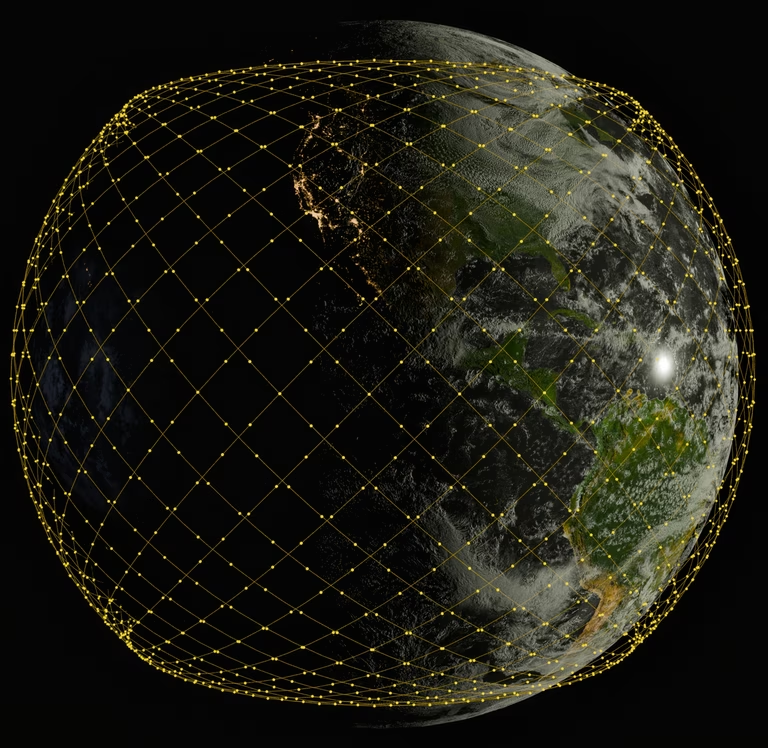
Golden Dome
Is the U.S. Golden Dome missile defense system true security or a trigger for a new arms race? Explore the costs, risks, and impact on global stability.
THE GOLDEN DOME - The U.S. Global Missile Defence System. More Trump Folly Or Essential Security?
Discover the controversial U.S. Golden Dome missile defence proposal and learn about the pros and cons of its development. Our guide offers you in-depth information on military spending, space-based defense, and strategic feasibility.
Connect with valuable resources on genuine risk assessment, improved fiscal accountability, and hopes for a safer future for everyone.
Jump straight to our resources on the ➡️ Golden Dome
*****
General Information
On January 27, 2026, U.S. President Donald Trump signed an executive order directing the Secretary of Defence to submit a plan for an Iron Dome for America. His plans were revealed to Congress in March, stating that "Israel has it, other places have it, and the United States should have it too".
The ‘dome’ would be a multi-layer missile defence shield intended to safeguard the nation against advanced ballistic, hypersonic, and cruise missiles. It will come at a total cost of $1.2 trillion over two decades.
The program is being managed by the Office of Golden Dome for America, led by Gen. Michael Guetlein.
The feasibility of this grossly expensive project (paid for by taxpayers) has been widely criticised by both defence experts and anti-war organisations.
Trump is peddling the vague statement that “the success rate is very close to 100%.”
“Why should the United States spend billions, if not trillions, of dollars on a missile defence apparatus that is more than likely to fail? The federal government could put this money to far better use than to waste it on a defence system with minimal strategic benefit for the United States.” - Cato Institute.
Russia and China have also publicly condemned the Golden Dome, labelling it provocative, a threat to global stability, and highlight the risks of weaponising outer space.
Work on the project has not yet commenced, but Trump has set a deadline for the system to be fully operational before the end of his term in 2029. A prospect which is currently looking unlikely.
Explore our comprehensive guides to the U.S. military, U.S. foreign policy, the U.S. arms industry, the global arms trade, and the Military-Industrial-Congressional-Media Complex.
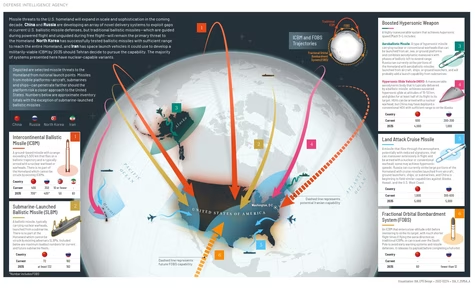
What Does A Golden Dome For America Look Like?
It will be made up of 4 layers, one of which will be spaced-based. Upon completion, the defence shield will consist of a constellation of 7,800 new satellites, tasked with sensing, tracking, and targeting incoming missiles.
The ground layers will consist of radar networks, lasers, and missile interceptors designed to destroy enemy missiles.
The space-based warning system will detect heat signatures and map out real-time tracking of missiles. The land and sea interceptors on the ground will be deployed across the United States and will upgrade current systems such as the Aegis and Ground-Based Midcourse Defence (GMD).
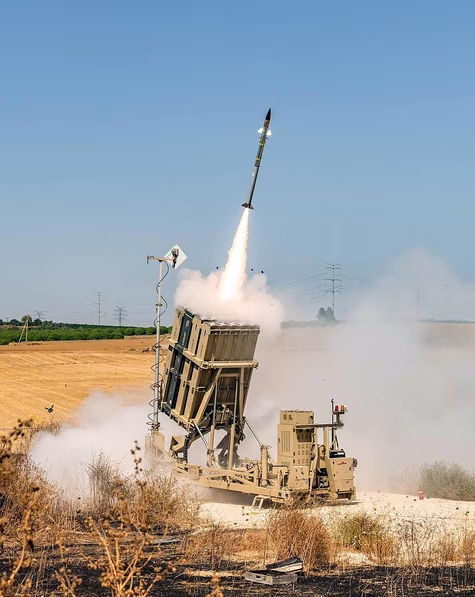
There will also be a Regional Sector layer, which will form the broad surface layer designed to intercept immediate and lower-tier threats to high-value targets, major cities, and military bases. This part was modelled after Israel's Iron Dome.
The contracts for developing the revolutionary space-based interceptors are reportedly worth up to $3.2 billion in total. The 12 companies named include General Dynamics Mission Systems, Lockheed Martin, Northrop Grumman, Raytheon, Sci-Tec, SpaceX, and Turion Space Corp.
Military contractors are positioned to profit immensely.
For official background and legislative details, you can read the Defence Primer on the Golden Dome for America.
To explore how Lockheed Martin is mobilising, review their Capability Overview.
Why Is The Golden Dome So Controversial?
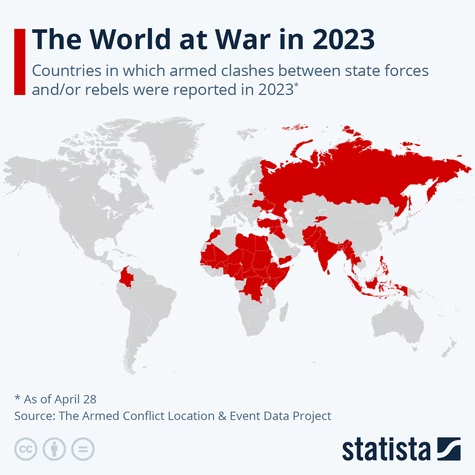
Since its introduction, the program has divided national security experts, fiscal watchdogs, and governments around the world. One of the main points of contention is the significant gap between the government's budgeting and the stark reality of the astronomical long-term costs.
FUNDING -
It's hard to ignore a trillion-dollar discrepancy between the official White House announcement of $175 billion over three years and the Congressional Budget Office's estimate of $1.2 trillion for a full 20-year deployment.
The funding for the project was also fast-tracked from an unaccountable military-industrial "slush fund". The aggressive timeline and vague proposals had led critics to label the project a blank check for defence contractors.
“With the war in Iran already costing over $30 billion, and the Pentagon’s 2027 budget slated to be $1.5 trillion, the last thing Americans need is their tax dollars going towards another wasteful defence project.”- CATO Institute.
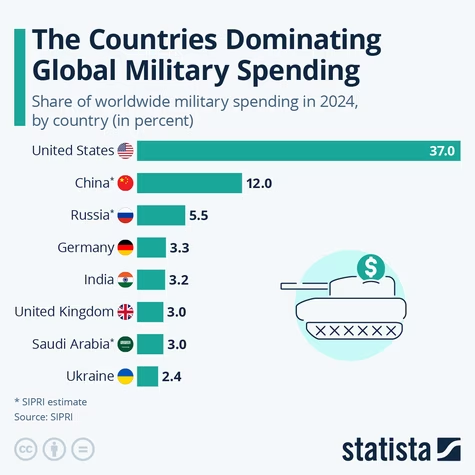
Heavy secrecy has left taxpayers in the dark. In January 2026, the Trump administration proposed a record-breaking $1.5 trillion US military and defence budget for 2027. If passed by Congress, this would be a 42% to 50% increase from the previous year.
The U.S. already has by far the largest military expenditure in the world. At the same time, citizens of the U.S. are grappling with spiralling poverty and inequality, an education system in crisis, and the nation still holds the unenviable title of being the only major developed country without a system of universal healthcare.
“It will make us poorer, less secure, and more isolated. It’s a gold-plated boondoggle that will enrich defence contractors and ignite a new nuclear arms race. Let’s be clear: Golden Dome is a trillion-dollar mistake in the making.” - Sen. Edward J. Markey.
TECHNICAL CRITICISMS -
Prominent aerospace engineers and physicists have questioned Trump’s claims that the defence system will be impenetrable and capable of intercepting all aerial threats from anywhere in the world.
The fact is that no defence system is flawless.
Chair of the American Physical Society’s missile defence study group estimates that “the number of space-based interceptors needed to theoretically counter a salvo of 10 solid-propellant ICBMs launched by North Korea has increased to 40,000 - making the cost of space-based defence prohibitive.”
The question of whether this type of technology can reliably intercept hyper-velocity, hypersonic missiles in real time remains to be seen.
Another factor is that enemies can easily disable the entire system by saturating it with cheap decoys and debris, exhausting the interceptors.

In a 2022 report by the American Physical Society, the concept of a Golden Dome was deemed “technically infeasible” and likely to “waste hundreds of billions of dollars on inherently ineffective systems.”
The Golden Dome was in part inspired by Israel's Iron Dome, which has recently suffered high-profile failures and penetrations. In March 2026, Iranian missiles struck the towns of Dimona and Arad after Israeli defences failed to intercept them due to a series of ‘malfunctions’.
The Iron Dome is designed to intercept short-range rockets and missiles, protecting specific population centres and critical infrastructure of roughly 30% to 40% of Israel’s total land area.
Trump intends to cover the entire United States, which has a land area 423 times that of Israel. This would be an unprecedented scale of defence. Israel has likely spent several billion dollars on the Iron Dome over its lifespan, yet has deployed only 10 batteries.
LONG-TERM COSTLY MAINTENANCE -
Low-orbiting satellites experience natural orbital decay during their lifecycle. This would result in the replacement of an estimated 1,600 space interceptors every single year, creating a huge strain on the defence budget to maintain operations. Over 20 years, the total number of satellites needing replacement would reach 30,000.
GEOPOLITICAL ESCALATION -
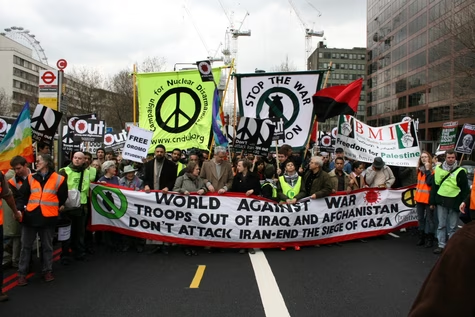
Both Russia and China have publicly opposed the Golden Dome, claiming that it undermines mutual vulnerability and global strategic stability. They view the operation as an offensive measure, allowing the U.S. to carry out acts of war with little repercussions.
Concerns that it could trigger a new global arms race are warranted. Believing that their current arsenals would not penetrate the shield, countries may preemptively expand their weapons stockpiles to overwhelm it. Nations will likely intensify production of hypersonic missiles and invest in new technologies to evade U.S. defences.
The pursuit of such a defence system will also derail negotiations on arms control. Some countries have already spoken out about nuclear arms proliferation and how heightened war narratives make arms control talks impossible.
BREAKING MUTUAL ASSURED DESTRUCTION (MAD) -
Organisations like Chatham House state that the Golden Dome threatens the concept of nuclear deterrence. Its existence will make fundamental and irreversible changes to the security elements of international order.
Under MAD, there is no advantage to being first to strike an adversary, since any strike will result in retaliation. MAD simply can not exist whilst a Golden Dome protects the entire U.S. territory. Mutual vulnerability is erased.
Adversaries of the U.S. could perceive this move as an attempt to gain an advantage in a potential nuclear conflict, thus creating instability in the nuclear arms race. It could even incentivise nations to strike preemptively before the Golden Dome is in place. Another reason why the Golden Dome is promoting military escalation.
The Golden Dome is by no means a solution to the nuclear threat, and if anything, it will make the world a more dangerous place.
LACK OF TRANSPARENCY -
The entire initiative has been accused of lacking transparency. Even on the inside, lawmakers and defence contractors are becoming frustrated by classified meetings, a lack of comprehensive spending plans, and unreleased details.
The information released to the public is of a similar nature. Trump's announcement was sparse on details and featured many of the typical sweeping statements we have grown accustomed to.
The silence on defence companies, spending plans, exploding costs, and yet-to-be-developed technologies is likely intentional, meant to prevent criticism.
WEAPONISATION OF SPACE -
The Golden Dome could catalyse the militarisation of space. Placing interceptors and sensors directly into orbit blurs the line between a defensive shield and offensive orbital strike capabilities.
The U.S. Space Force has already begun issuing multibillion-dollar contracts to aerospace companies, including a multibillion-dollar deal with Elon Musk's SpaceX.
The move also pushes the boundaries of the 1967 Outer Space Treaty, which restricts placing weapons of mass destruction in space. Many countries have spoken out about the risk of space becoming a battlefield.
CONFLICTS OF INTEREST & CORPORATE INFLUENCE -
A formal coalition of lawmakers petitioned the Department of Defence Inspector General to investigate the unprecedented influence of commercial aerospace executives over the system's design. Critics allege that standard federal acquisition protocols were bypassed to favour specific private space conglomerates.
Big Tech already exerts an unprecedented amount of market dominance, hoarding massive swaths of money and increasingly controlling politics. Corporate interests in national safety have unlocked a new level of fear.
Senator Elizabeth Warren has been an outspoken critic of the involvement of private companies, especially those like Palantir and Anduril, which have well-known financial and political ties to the Trump administration. The spiralling costs of the Golden Dome will prove mutually beneficial for those closely involved.
Both of these organisations have drawn intense criticism for their privacy and surveillance records, prompting unlawful use of force and enabling human rights violations.
How To Shift From Confrontation To Collaboration
Independent think tanks, rights organisations, arms control analysts, and scientists agree that the enormous cost of the Golden Dome brings little benefit to the general public.
It has been marketed to U.S. citizens as practically flawless, with very little detail on how taxpayers' money will be spent.
Unfavourable parallels to Ronald Reagan's unfulfilled 1980s Strategic Defence Initiative have been drawn. Although they differ in approach and technological advancements, the vision of impenetrable defence is the same.
Both have raised serious concerns about technological feasibility, the risk of escalating global arms races, and the massive allocation of resources for military purposes.
The unprecedented 2027 U.S. military budget request compounds the upward trend of militarisation at the expense of social welfare.
We must continue to expose the recklessness of such initiatives and fight instead for common-sense values such as international cooperation and shared responsibility for mutual safety. Common security is the answer, not more weapons, more hostility, and more nationalism.
In the words of SIPRI, "no country can obtain security, in the long run, simply by taking unilateral decisions about its own military deployment."
Security is about building a future where security is collective, not competitive. Common security creates a safer and more stable world, where resources are directed towards development rather than defence.
“Instead of chasing an impossible dream that risks bankrupting us and destabilising the world, we should be investing in what actually works: diplomacy, arms control, and smart defence.” - Sen. Edward J. Markey.
Author: Rachael Mellor, 08.06.26, latest update 31.08.26, licensed under CC BY-SA 4.0
More Resources
Curated Directory & Deep-Dive Resources on Golden Dome
- Arms Control Center - Fact Sheet: “Golden Dome” 516445
- Lockheed Martin - Golden Dome for America 516444
- Golden Dome (missile defense system) - Wikipedia 516360
- US space weapons deployment will spark international arms race in space - CND UK 21.09.26 524382
- The Return of Great-Power Spheres of Influence - Modern Diplomacy 04.07.26 519551
- Nuclear Weapons and the Future of American Power - Carnegie Endowment for International Peace 02.07.26 519550
- US claims first successful test of ‘Golden Dome for America’ system - Al Mayadeen 24.06.26 519200
- ‘Trillion-Dollar Scam’: Lawmakers Demand Halt to Trump’s Golden Dome Boondoggle - CD 18.06.26 518830
- Golden Dome: Defense and Space Stocks Positioned to Win - Globe and Mail 16.06.26 518685
- New Report Cites Surge In Global Nuclear Weapons Spending - Forbes 15.06.26 518684
- US lawmakers seek $750 million for Ukraine, move to adopt 'Department of War' rebrand - Reuters 11.06.26 518686
- White House to meet defense firms to talk about ramping up production, sources say - Reuters 10.06.26 518130
- Golden Dome Marks A Moment Of Truth For Military Tech Firms - Forbes 25.05.26 518129
- Golden Dome needs a price tag and a clear objective to succeed - Atlantic Council 22.05.26 518128
- Golden Dome or Golden Scam? - IPPNW 19.05.26 516449
- Scientific report on 'Golden Dome' program counters Trump's claims - UPI 19.05.26 516451
- Golden Dome: From Bad to Worse - CATO Institute 14.05.26 516447
- Trump's 'Golden Dome' will cost $1.2tn and might not stop all-out missile attack - BBC 13.05.26 516446
- Rep. Garamendi Statement on “Astronomical” $1.2 Trillion Golden Dome CBO Score - John Garamendi 13.05.26 516458
- Trump’s ‘Golden Dome’ Missile Defense Plan Could Cost $1.2 Trillion - NY Times 12.05.26 516456
- Trump's Golden Dome Projected to Cost $1.2 Trillion and May Not Work as Advertised - Time 12.05.26 516452
- Trump wants denuclearization but pursues a ‘Golden Dome’ of missile defense. Here’s why he can’t have both - Bulletin 29.04.26 519549
- Space-based missile defense: Golden Dome or gold brick? - The Bulletin 22.04.26 516464
- Missing the Mark: Why Golden Dome is Bad for American Taxpayers - Taxpayers for Common Sense 04.02.26 516457
- Trump doesn’t need the Golden Dome in Greenland. He needs a stronger NATO - The Bulletin 03.02.26 516473
- Golden Dome forces a rethink of space warfare and allied defense strategy - Tech Journal 31.01.26 516465
- Greenland key to Trump’s ‘Golden Dome’ plans - ECCi 26.01.26 516475
- Trump says Canada opposes his 'Golden Dome' being built in Greenland - AA 24.01.26 516470
- Why Greenland is less Golden Dome and more gold rush for rare earths - Robeco 23.01.26 516472
- Video: Trump’s Golden Dome Plan Puts Greenland On The Brink, Europe Warns Of 'Unprecedented Fallout' - Hindustan Times 14.01.26 516463
- Trump’s Golden Dome excuse for Greenland grab is ‘detached from reality,’ experts say - Defense One 14.01.26 516466
- Why Trump doesn’t need to own Greenland to build Golden Dome - Politico 14.01.26 516474
- Golden Dome changes both NATO and the EU - Space4Peace 22.12.25 516462
- ‘Golden Dome’ and the Illusory Promise of Invulnerability - SWP 05.12.25 516448
- We Might Regret Golden Dome’s Greatest Ambition - War On The Rocks 11.12.25 516469
- The Dangers of the Golden Dome Program: Critical Historical Perspectives - Peace Policy 02.12.25 516459
- Golden Dome for America: Assessing Chinese and Russian Reactions - CSIS 20.11.25 516460
- Does the Golden Dome Create Strategic Instability or an Opportunity with China and Russia? - CSIS 23.10.25 516467
- What's the Plan for 'Golden Dome'? Even Experts Aren't Sure - Scientific American 09.09.25 516455
- Can Trump's golden dome stop a nuke? Probably not - Supercluster 02.09.25 516477
- Golden Dome dangers: An arms control expert explains how Trump’s missile defense threatens to make the US less safe - Conversation 06.06.25 516454
- Golden Dome: Doubling Down on a Strategic Blunder - Arms Control 06/25 516471
- Trump’s Golden Dome plan threatens to fuel a new arms race - Chatham House 28.05.25 516450
- China, North Korea, and Russia’s Response to Trump’s ‘Golden Dome’ Proposal - Time 27.05.25 516461
- Golden Dome: what Trump should learn from Reagan’s ‘Star Wars’ missile defence system plan - University of Portsmouth 22.05.25 516476
- What Will the U.S. Golden Dome Missile Defense Mean for Russia? - Carnegie 19.05.25 516453
- Saying the quiet part out loud: All that glitters is not 'Golden Dome' - Responsible Statecraft 28.03.25 516468