

SIPRI Reports
Global military spending has hit a record $2.89 trillion. Read our analysis of the 2026 SIPRI report, NATO rearmament, key spenders, and calls for budget reallocation.

SIPRI REPORT 2025 - World Military Expenditure Reaches An Unprecedented $2.9 Trillion
Discover the critical research of SIPRI reports and learn how transparent data can empower global disarmament efforts. Our guide offers you in-depth insights into rising global military expenditure, the arms trade, and international security trends.
Connect with hundreds of valuable resources, initiatives, and organisations – helping to promote the reallocation of military budgets toward vital social needs, human security, and a peaceful, sustainable future.
Jump straight to our resources on ➡️ SIPRI
*****
General Information
The Stockholm International Peace Research Institute (SIPRI) is an independent think tank that specialises in research on conflict, the arms trade, arms control, militarisation, and disarmament. SIPRI was established in 1966 and has its headquarters in Sweden.
Their full SIPRI Yearbook is released every year in June, but throughout the year, other smaller reports are published, such as the Arms Industry report in December and the Arms Transfers report in March.
The annual Military Expenditure report is released in April, coinciding with the Global Days of Military Action (GDAMs) campaign, organised by GCOMS (Global Campaign on Military Spending) and the International Peace Bureau (IPB).
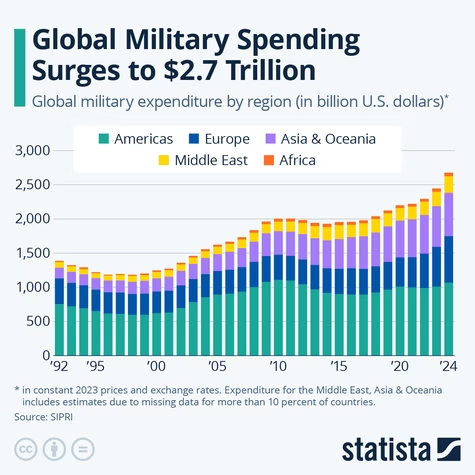
The April 2026 report revealed a 2.9% increase from the year before, marking 11 consecutive years of growth. The U.S. once again is by far the biggest spender.
This trend of rampant military spending shows no signs of slowing. It is no coincidence that the world is experiencing the highest number of conflicts since 1945, the end of WW II.
As healthcare, education, and social budgets shrink, it is high time the world seriously reassessed its priorities.
"The world is over-armed and peace is under-funded" - Ban Ki-moon
Explore our comprehensive guides on NATO and their new 5% GDP Goal, AUKUS, nuclear weapons, the military and climate change, the arms industry, weapons systems and drones, and the importance of nonviolence.
Please share this important resource via ➡️ Twitter, Bluesky, Facebook, Instagram, and LinkedIn !
Key Findings In The April 2026 Report
- $2.88 trillion amounts to $350 in military spending per person on the planet.
- In 2025, the four biggest military spenders accounted for more than half of global military spending.
- The top five spenders were the U.S ($954bn), China ($336bn), Russia ($190bn), Germany ($114bn) and India ($92bn).
- The U.S. spends more than the next six countries combined. They have been the biggest spender every year since WW II.
- Spending rose by 14% in Europe and by 8.1% in Asia and Oceania.
- Global military expenditure as a share of gross domestic product (GDP) is now 2.5%.
- US spending actually shrank as no new military aid for Ukraine was approved during the year. U.S. military spending was 7.5% lower in 2025 than in 2024.
- Rearmament efforts by European NATO members led to the sharpest annual growth in European spending since the end of the Cold War.
- The 29 European NATO members spent a combined total of $559 billion; of these, 22 of them had military spending of at least 2% of GDP.
- Germany’s military burden exceeded the 2% threshold for the first time since 1990, reaching 2.3% of GDP.
- Israel’s military spending remained 97% higher than in 2022.
- China, the world’s second-largest military spender, increased its military spending by 7.4% to $336 billion.
- In response to increasing pressure from China, Taiwan’s military spending rose by 14% to $18.2 billion, the largest annual increase since at least 1988.
- Nigeria’s military expenditure grew by 55% to $2.1 billion, as insurgencies and extremist violence contributed to worsening insecurity.
*****
This trend of year-on-year increases in military expenditure is deeply concerning in an increasingly volatile world. Citizens do not need more weapons, more destruction, and more suffering. They need social security, quality healthcare, free education, and a renewed commitment to human rights.
As states continue to prioritise armament and military strength, this constant state of posturing creates a domino effect. Investments into military capabilities and arms proliferation as a form of ‘defence’ merely lead to an unnecessary arms race and a dangerous security dilemma.
Relations between states are no longer built upon common security but are shrouded in uncertainty and fear. The risk of war is infinitely higher as states compete to build the largest and most advanced militaries.
A worldwide rethink of military budgets is critical as we continue to spiral down this tragic, anarchic path.
From a human rights, social justice, and common sense perspective, military expenditures must be reallocated to vital social needs, environmental protection, and peace initiatives.
The world does not become safer the more we build up armies to ‘protect’ ourselves; the result is quite the opposite.
“A nation that continues year after year to spend more money on military defence than on programs of social uplift is approaching spiritual doom” - Martin Luther King Jr.
Author: Rachael Mellor, 04.05.26, latest update 22.07.26, licensed under CC BY-SA 4.0
More Resources
Curated Directory & Deep-Dive Resources on SIPRI Reports
- SIPRI 514838
- SIPRI Yearbook 2026 - Armaments, Disarmament and International Security 521242
- SIPRI Yearbook 2025 514826
- SIPRI Map of World Military Expenditure 2025 514830
- SIPRI on X 514842
- Instagram 514841
- Stockholm International Peace Research Institute - Wikipedia 514839
- Five charts that show the rise of global militarisation - Al Jazeera 29.04.26 515094
- Global military spending rise continues as European and Asian expenditures surge - SIPRI 27.04.26 514827
- Military spending splurge needs to be resisted by the left - Canary 27.04.26 514833
- SIPRI: Record arms spending, again - DW 27.04.26 514829
- Buoyed by European rearmament boost, global military spending jumps to $2.89 trillion - Breaking Defense 27.04.26 514832
- SIPRI: World Defense Budgets Rise for 11th Straight Year - Politics Today 27.04.26 514835
- Europe, Asia driving surge in global military spending: report - RFI 27.04.26 514837
- SIPRI challenges claim all NATO allies reached 2%, warns of 'creative accounting' - Euractiv 27.04.26 514840
- Global military spending rises 2.9% despite US decline over Ukraine freeze - Reuters 26.04.26 514834
- Mapping the military AI industry - SIPRI 23.04.26 514831
- Trends in World Military Expenditure, 2025, SIPRI 04/26 514828
- SIPRI Report 2026: The global arms market is growing, while in Africa it remains a mystery - Agenzia Fides 16.03.26 514836