
PFAS - Forever Chemicals
These non-biodegradable, harmful chemicals are now everywhere, even in our bodies. Explore how strict regulation, accountability of manufacturers, and litigation are helping to reduce the risks.
➡️ PFAS - Global Contamination Of The Environment With Toxic, Forever Chemicals
PFAS refers to the chemical substances Perfluoroalkyl and Polyfluoroalkyl. There are over 10,000 different man-made variations which are extremely resistant to biodegradation.
They were invented in the 1930s and 40s for military and industrial use due to their high durability. Their heat resistance, strength, and ability to repel grease and water meant that they found their way into everyday household items.
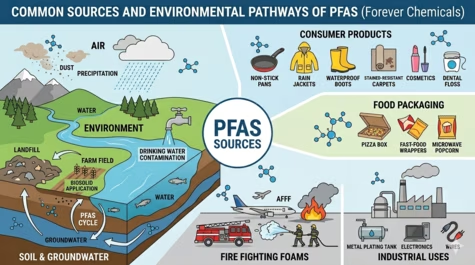
PFAS chemicals are found in non-stick cookware, stain-resistant fabrics, carpet treatments, food packaging, waterproof clothing, makeup and personal care products, and paints and cleaning products. PFAS chemicals are so prevalent in our environment that they have been found everywhere from Mount Everest to the deepest oceans.
The global market value for PFAS in 2023 was $14.3 billion; it is projected to reach $20 billion by 2029.
Companies became aware of the serious risks of PFAS in the 1960s but it was hidden from the public until the late 1990s. Various lawsuits helped uncover the truth, but by then the damage was already done.
Almost 100% of the U.S. population is exposed to at least one type of PFAS. It has been found to cause immune dysfunction, increased risk of cancer, various reproductive implications, and developmental issues in children.
The annual health costs associated with PFAS exposure in Europe range from €52 to €84 billion.
*****
Jump straight to our resources on ➡️ PFAS
Explore our comprehensive guides on -
- Toxic Substances
- Waste & Toxins
- Soil & Drinking Water
- The Biodiversity & Climate Crisis
- The Circular Economy
- Sustainability
Why Are PFAS Chemicals So Prevalent?
The widespread use of these toxic chemicals in everyday items and their inability to break down mean they are quite literally everywhere. Their resistance to water and just about everything else means they have found their way into our water sources, soils, air, and food.
As they take decades to break down in the environment, there has been a significant accumulation, posing a disastrous risk to ecosystems and public health. Companies ignored the warning signs, kept the dangers secret, and misled the public about their safety.
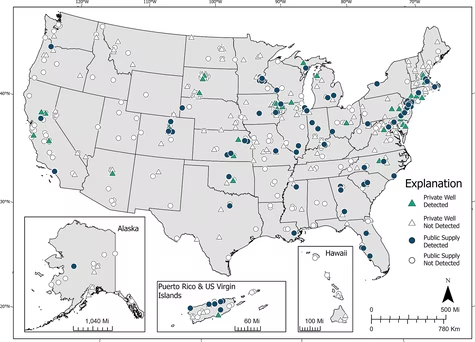
An estimated 99% of humans now have measurable levels of PFAS in their blood. Contamination has been found on all 7 continents, even in the most remote of places. Recent global studies found that 69% of groundwater samples contain the chemicals, and even more worryingly, with no known contamination sources.
In Europe, there are over 17,000 contaminated sites and about 2,300 hotspots which have extremely hazardous concentrations. In the U.S., PFAS are present in about 75% of urban tap water samples and 25% of rural samples.
The effects are most severe for those living in close proximity to manufacturing plants, military bases, airports, and landfills. In these areas, the water, soil, and air are more highly contaminated.
Environmental & Health Issues
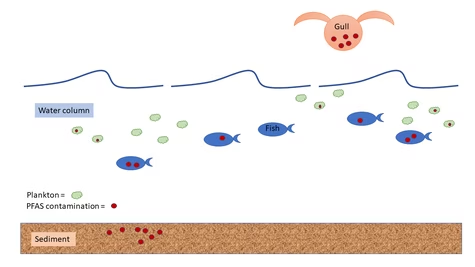
- PFAS chemicals are fuelling the biodiversity crisis as they accumulate in living organisms and move up the food chain.
- Around 600 species are already affected by reproductive failures, immune system suppression, and metabolic disruptions.
- During the production of PFAS chemicals, manufacturing plants release huge quantities of greenhouse gases, contributing to the climate crisis. Some plants emit HCFC-22, which is roughly 5,000 times more potent than carbon dioxide. There is much debate about their use in renewable energy technology, as we attempt to solve one problem, we create another.
- PFAS is highly mobile in soil and leaches into groundwater from landfill waste and firefighting foams. From here, it flows into rivers, lakes, and drinking water.
- Biomagnification means that concentrations of PFAS increase as they move up the food chain, affecting aquatic ecosystems and the safety of food for human consumption.
- PFAS chemicals travel long distances by air, meaning no place on Earth is spared from their impacts.
- The presence of PFAS chemicals in humans is linked to reduced ability to fight infections and a decreased response to vaccines.
- There is evidence that exposure causes increased risk of kidney, testicular, thyroid, and liver cancers.
- PFAS causes higher cholesterol levels and an increased risk of obesity or type 2 diabetes.
- There is a clear link between high levels of PFAS and lower infant birth weights and accelerated puberty.
- The highest risk groups are infants and young children, communities relying on contaminated water sources, and workers in the manufacturing industry.
Legal Challenges Against PFAS
In the U.S., Europe, and Australia, tens of thousands of lawsuits have been filed against PFAS manufacturers and users. The main challenges are centred around environmental damage, health implications, and consumer deception.
The first major lawsuit was filed in 1999 in West Virginia on behalf of farmer Wilbur Tennant. The events inspired the movie ‘Dark Waters’. The suit alleged that DuPont knowingly contaminated the water supply after Tennant saw his cattle suffering from numerous health issues.
DuPont was found to have dumped 7,100 tons of PFOA sludge during the late 1980s, despite knowing that PFAS was toxic and had serious harmful effects on humans and animals. The large settlement figure was used to fund the C8 Science Panel, which works to connect PFOA to diseases.
This lawsuit laid the foundations for thousands of other cases in the years that followed.
As of early 2026, U.S. chemical companies, including 3M, DuPont, Chemours, and Corteva, have paid approximately $14 billion in total settlements to resolve litigation over PFAS contamination.
Regulations Around The World
As the toxic legacy of PFAS was kept hidden for decades, progress on regulating its use has been significantly delayed. In general, there is a shift towards regulation and bans; however, progress is slow, and under the Trump administration, several environmental rollbacks have stalled it further.
In the EU, governments are working to restrict PFAS as a group, covering all 10,000 substances with a goal of a near-total ban. In 2026, PFAS were banned in food packaging, and a new limit was placed on drinking water.
In 2026, the UK government in 2026 launched a plan to map, restrict, and manage PFAS. It involves phased restrictions, which will begin in 2027 on all non-essential products. They plan to introduce a drinking water limit in the near future, ban firefighting foams, and impose stricter regulations on industrial emissions.
U.S. regulation, driven by the scale of contamination, the slow pace of federal action, and the thousands of chemical variations that remain unregulated, is insufficient. Historically, the EPA has taken steps to improve drinking water standards, but rollbacks under Trump have actually loosened these limits and permitted the use of certain PFAS in pesticides.
To reduce the regulatory burden on industries, the U.S. are compromising public health and water safety. While the EU has taken a proactive approach, in the face of industry resistance, the global response overall is slow and wholly inadequate.
Addressing The Pollution Burden
Not only must we stop adding to the PFAS pollution burden, but we must also tackle the existing accumulation of it in our environment. Cleaning up legacy pollution is no easy feat in the face of such a widespread, stubborn issue.
We must enforce accountability through the polluter-pays principle.
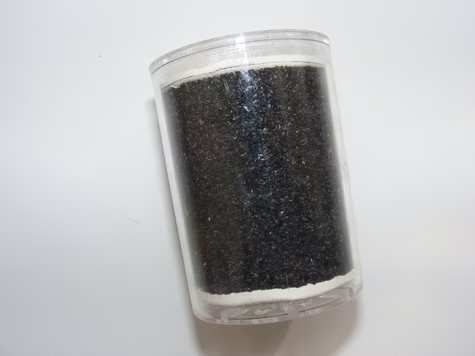
Advanced technologies which utilise activated carbon can remove PFAS from drinking water and wastewater. We must move away from landfills and incineration and towards destruction technologies that can break down the carbon-fluorine bond.
Contaminated sewage sludge, when spread onto agricultural land, must be treated first to prevent further soil contamination.
By reducing human and animal exposure to PFAS, we can begin to slowly reduce the impacts, but this approach only works if we prevent further contamination and stop the influx of new PFAS at the source.
As individuals, we can reduce our exposure by:
- Installing a water filter which uses activated carbon or reverse osmosis.
- Contact your local water supplier to find out when their last testing was and for a copy of the results.
- Replace traditional non-stick cookware with cast iron, stainless steel, glass, or ceramic.
- Avoid eating anything that came in grease-resistant packaging, such as fast-food wrappers, pizza boxes, and microwave popcorn.
- Store leftovers in glass or metal containers, not plastic ones.
- Avoid carpets, furniture, and clothes treated with stain-resistant sprays.
- Check for labels which say PFAS-free or PFC-free.
- Steer clear of cosmetics, toiletries, and dental floss that list PTFE or perfluoro in their ingredients.
- Support organisations and local action groups which are pushing for stricter regulations on PFAS.
- Contact your local politicians to demand stronger restrictions on PFAS in products and on industrial pollution.
*****
Chemical pollution has officially passed the safe limit for humanity. Strict universal regulation and demanding accountability from polluters are the only paths forward to protect current and future generations.
Chemical-by-chemical regulation of a group which contains over 10,000 substances is futile. All PFAS must be banned through blanket legislation to achieve a prompt, effective solution to this dangerous problem. Any other response will take decades and leave one harmful chemical to be replaced by another.
The multi-billion-dollar PFAS industry has orchestrated a well-funded, intense lobbying campaign to prevent further regulation and avoid a trillion-dollar cleanup bill.
"We’re facing a ‘forever chemicals’ crisis... at the cost of our health, our environment, and the lives of our loved ones." - Mark Ruffalo.
We must not delay action any further.
Author: Rachael Mellor, 01.05.26 licensed under CC BY-SA 4.0
For further reading on PFAS see below ⬇️
More Resources
Curated Directory & Deep-Dive Resources on PFAS - Forever Chemicals
- National Institute of Environmental Health Sciences 515165
- ChemTrust 515166
- OECD 515171
- What are PFAS Chemicals? - EWG 228556
- Basic Information on PFAS - EPA 228557
- PFAs Free (UK) 228562
- Environment Agency UK 515169
- The Forever Lobbying Project 515185
- Nature - PFAS and forever chemicals in the environment 515181
- Ban PFAS Manifesto 515199
- PAN Europe - Ban PFAS pesticides and TFA 515230
- Chem Sec - PFAS Guide 515233
- UNEP 515178
- The Forever Pollution Project 515221
- Per- and polyfluoroalkyl substances (PFAS) - Wikipedia 416250
- PFOS - Wikipedia 416255
- PFOA - Wikipedia 416256
- TFA - Wikipedia 482176
- PFAS litigation and regulations by country - Wikipedia 515209
- YouTube Search - PFAS 482177
- #PFAS 416251
- Dark Waters (2019 film) - Wikipedia 416252
- The Devil We Know (2018 Documentary) - Wikipedia 416253
- 10 Things You Can Do About Toxic PFAS Chemicals - Clean Water Action 228559
- What are forever chemicals and why are they a problem? - Marine Conservation Society 515170
- EPA - Identifying Drinking Water Filters Certified to Reduce PFAS 515225
- FIDRA - PFAS Free 515232
- How growing up in ‘Chemical Valley’ inspired lawyer to sue industry she used to work for - Guardian 24.08.26 523760
- ‘Telling the Public to Drink Poison’: Trump EPA Targets Drinking Water Limits for ‘Forever Chemicals’ - CD 18.05.26 516554
- European Commission shelves plan to tighten regulation of chemical products - Le Monde 05.05.26 515188
- McDonald’s and Coca-Cola caught trying to gut Europe’s landmark plastics law months before it takes effect - Greenpeace 01.05.26 515197
- Video: Toxic ‘forever chemicals’ linked to childhood leukemia, research suggests - Independent 28.04.26 515180
- Government must go further on PFAS - Water.Org 28.04.26 515223
- 13 ways to avoid PFAS (forever chemicals) in your home - The Times 27.04.26 515176
- Forever chemicals: MPs call for ban on controversial substances - BMJ 27.04.26 515174
- Use of toxic Pfas in consumer goods must be urgently restricted, MPs say - Guardian 23.04.26 514418
- 10 PFAS-Free Apparel Brands For Nontoxic Clothing - The Good Trade 15.04.26 515218
- Lobbying in PFAS: Big Money is Poisoning our Water - Clean Water Action 03.04.26 515195
- The European Chemical Sector's Influence on Biodiversity Policy - Influence Map 04/26 515238
- EU chemicals agency backs ban on PFAS 'forever chemicals' - Reuters 26.03.26 515202
- The 8 companies paying 99% of PFAS legal penalties in the U.S. - Chem Sec 16.03.26 515211
- Some top US lobbying firms are working both sides of the Pfas issue at the same time - Guardian 14.03.26 515186
- New Way to Trap Toxic PFAS in Water - PFAS 04.03.26 510822
- Waterproof Gear Relied on PFAS. Not Anymore. Here's What to Know - NY Times 18.02.26 515219
- PFAS: Inaction will cost the EU €440 billion by 2025 - Renewable Matter 16.02.26 515244
- The EU is working on a blanket ban of ‘forever chemicals’. Why isn’t Britain? - Guardian 10.02.26 515201
- Policy Paper: PFAS Plan: building a safer future together - Gov.uk 03.02.26 515222
- New EU-wide protections against PFAS in drinking water come into effect - European Commission 12.01.26 515220
- High levels of ‘forever chemical’ found in cereal products across Europe – study - Guardian 04.12.25 515231
- Video: BBC Panorama: The Truth About Forever Chemicals - Children of the 90s 03.12.25 515224
- I have high levels of forever chemicals in my blood - what can I do about it? - BBC 01.12.25 515184
- The Trump Administration Is Deregulating Forever Chemicals - Jacobin 28.11.25 499713
- Firms ordered to reduce forever chemicals in drinking water sources for 6 million people - BBC 03.11.25 515173
- The hidden sources of forever chemicals leaking into rivers – and what to do about them - Conversation 16.10.25 494272
- Video: We’re all contaminated: The toxin inside us — PFAS - Al Jazeera 14.10.25 515205
- Lobbyists Are Playing Both Sides of the PFAS Debate - Jacobin 12.09.25 515194
- I used to work with Pfas, but they do need to be banned - Guardian 02.09.25 515240
- Chemical companies lobbying MPs not to ban Pfas - Guardian 28.08.25 515192
- Revised PFAS restriction proposal ‘reflects industry lobbying’, NGOs say - ENDS Europe 22.08.25 515198
- How to destroy harmful 'forever chemicals' - BBC 19.08.25 515207
- Exposure to some common Pfas changes gene activity, new study finds - Guardian 15.08.25 485401
- Waste from agricultural plant poisoned US town’s water with Pfas, lawsuits allege - Guardian 11.08.25 515210
- “They Poisoned the World”: The Corporate Cover-Up & Fightback Against PFAS, “Forever Chemicals” - DN! 08.08.25 483613
- Three major chemical companies agree to pay $875m to New Jersey over Pfas claims - Guardian 05.08.25 515212
- PFAS and Your Health - ATSDR 22.07.25 515175
- ‘Poisoning the Well’ Authors Sharon Udasin and Rachel Frazin on PFAS Contamination and Why It ‘Has Not Received the Attention It Deserves’ - EcoWatch 08.07.25 490543
- Yale Experts Explain PFAS ‘Forever Chemicals’ - Yale Sustainability 20.05.25 515168
- Video: How One Company Secretly Poisoned The Planet - Veritasium 14.05.25 515172
- Video: PFAS 'forever chemicals': Citizens take on industrial giants in quest for justice - France24 02.05.25 515204
- Why the French PFAS ban isn’t the victory it seems - Chem Sec 03.03.25 515239
- Regulation of PFAS in the EU: Tackling health risks and protecting communities - Borgen Project 27.02.25 460512
- Lobbying in ‘forever chemicals’ industry is rife across Europe – the inside story of our investigation - Conversation 21.01.25 452647
- Industry lobbying and eye-watering costs of PFAS pollution revealed - Chem Trust 16.01.25 515193
- Why are PFAS so bad for people and planet? - Client Earth 14.01.25 515177
- PFAS: How the chemical industry is derailing a ban on 'forever chemicals' - Le Monde 24.01.25 452646
- Coordinated lobbying campaign targeted European PFAS regulation: reports - Food Packing Forum 20.01.25 515190
- Toxic industry lobby tries to block PFAS restrictions - PAN Europe 16.01.25 515187
- How the chemical industry is derailing a ban on 'forever chemicals' - Le Monde 15.01.25 515235
- Intense lobbying over EU plans to limit 'forever chemicals' - Euractiv 14.01.25 515196
- Environmental lawyers denounce obstructive lobbying on PFAS and warn of legal risks - Client Earth 14.01.25 515189
- Chemical reaction: Inside the corporate fight against the EU’s PFAS restriction - Corporate Europe 14.01.25 515191
- Cost to clean up toxic PFAS pollution could top £1.6tn in UK and Europe - Guardian 14.01.25 515246
- Beware the Toxic Chemicals at Dollar Stores - CD 03.12.24 445077
- Nature Paper Discusses New Approach to Breakdown PFAS, Forever Chemicals - ENN 20.11.24 442082
- New PFAS Removal Process Aims to Stamp Out Pollution Ahead of Semiconductor Industry Growth - ENN 07.11.24 439494
- Forever chemicals are in our drinking water – here’s how to reduce them - Conversation 30.10.24 437966
- PFAS in textiles in Europe’s circular economy - EEA 17.09.24 515217
- WHO Drops Weak PFAS Guidelines and Starts Anew After Criticism Over Industry Influence - CD 14.08.24 428419
- Forever Chemical Pollution Can Now Be Tracked - ENN 12.08.24 427906
- What are PFAS and how are they dangerous for my health? - EEA 30.07.24 515182
- Outdoor clothing brands still using ‘forever chemicals’ despite health risk - Guardian 15.06.24 515216
- UN FAO ends ‘partnership’ with pesticide industry lobby group - PAN UK 12.06.24 515237
- Many PFAS forever chemicals are toxic—here's how to avoid them - Medical Xpress 03.06.24 417415
- How to Reduce Your Exposure to Potentially Toxic 'Forever Chemicals' - Science Alert 03.06.24 417416
- Many PFAS forever chemicals are toxic – here’s how to avoid them - Conversation 31.05.24 450329
- PFAS Cover-Up: How 3M Hid Risks of Forever Chemicals & “Gaslit” Scientist Who Tried to Sound Alarm - DN! 30.05.24 417414
- Study highlights PFAS risk from Bangladesh textile sector - Ecotextile 30.05.24 417417
- Industry Braces for PFAS Lawsuits That Could 'Dwarf' Those of Asbestos, Tobacco - CD 29.05.24 416249
- Watchdog Group Accuses EPA of Misconduct in PFAS Testing of Pesticides - Truthout 28.05.24 417418
- Lawyers to Plastics Makers: Prepare for ‘Astronomical’ PFAS Lawsuits - NY Times 28.05.24 515213