
International Court of Justice (ICJ) @ UN
Discover how the ICJ shapes international law. Explore UN World Court rulings, advisory opinions, and cases like South Africa v. Israel & climate change.
INTERNATIONAL COURT OF JUSTICE (ICJ) - The World Court Of The United Nations
Discover the vital work of the ICJ and how the court actively protects the rule of law. Our guide offers you in-depth information on past cases, important judgements, and advisory opinions.
Connect with hundreds of valuable resources, reports, and news sources – for accountability, diplomacy, and global justice.
Jump straight to our resources on the ➡️ International Court of Justice (ICJ)
*****
General Information
The ICJ is the only international court that hears disputes between nations. It was established in June 1945, and all 193 UN members are automatically parties to the court's statute.
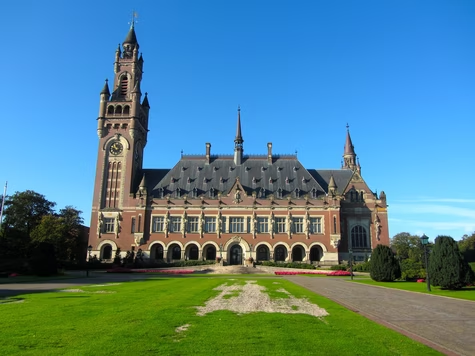
The court is the principal judicial organ of the United Nations and is located in The Hague, Netherlands. They deal with cases which have been brought by nations, and they play an essential role in maintaining international peace using international law and providing advisory opinions on legal questions.
Although its decisions are binding, the court lacks enforcement power, which can limit their practical impact. Despite this, their judgments carry significant global weight and have historically contributed to fostering diplomatic solutions and adherence to international law.
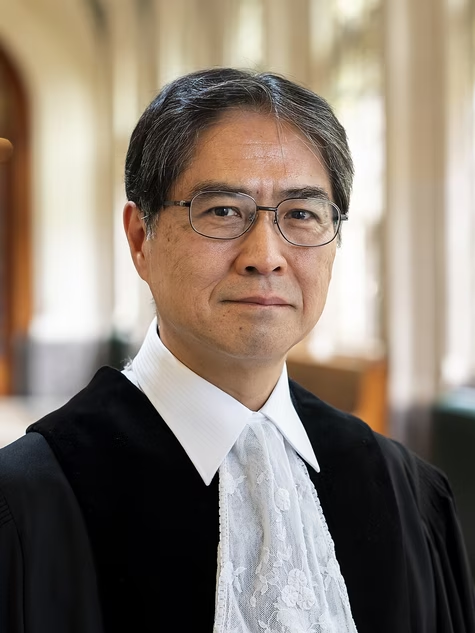
The ICJ is comprised of 15 judges elected by the UN General Assembly and the Security Council, who serve a nine-year term. The current President is Yuji Iwasawa, a former professor of international law at the University of Tokyo and a longstanding member of the ICJ. One-third of the seats go up for election every three years, and retiring judges may be re-elected. The judges act as independent magistrates and do not represent their governments. Only one judge of any nationality can be on the court at any time.
Recent Significant Cases Of The ICJ
As of September 2025, the ICJ has seen 201 cases and issued 28 Advisory Opinions. Their caseload has increased significantly in recent years, with 39 cases filed in the last decade alone.
The court deals with pivotal and complex international issues such as territorial and boundary disputes, state sovereignty, allegations of genocide and war crimes, violations of international treaties and obligations, violations of international law, racial discrimination, and unlawful detention.
The ICJ also provides non-binding but highly authoritative legal opinions to UN organs concerning issues such as nuclear weapons and climate change obligations. Below we list some recent major cases and opinions:
-
The Gambia v. Myanmar 2019, Allegations of Genocide - Gambia made a case against Myanmar alleging that they violated the 1948 Genocide Convention against the Rohingya population with its clearance operations in 2016. Preliminary measures in 2020 ordered Myanmar to prevent acts of genocide and submit compliance reports. The court rejected Myanmar's objections and began conducting public hearings in January 2026. This case marks a historic use of international law to protect a minority group. Final judgment is pending.
-
Ukraine v. Russian Federation 2022, Allegations of Genocide - Ukraine made a case against Russia claiming that they falsely accused them of genocide in Donbas and then used it as a justification for their 2022 invasion. They cited that this was a violation of the 1948 Genocide Convention. As preliminary measures, the court ordered Russia to suspend its military operations (which it ignored) as it found no evidence for Russia's claims of genocide. The case is still ongoing, as the court faces jurisdictional issues and various counterclaims from Russia.
-
ICJ Advisory Opinion on Israel's Unlawful Occupation of Palestine, 2022 - Initiated by a 2022 UN General Assembly request and with 52 states submitting evidence, this is the largest ever ICJ case. In July 2024, the ICJ issued an advisory opinion declaring Israel's decades-long occupation of Palestinian territories illegal. It ruled Israel's settlement expansion, annexation, and exploitation of natural resources as violations of international law, in particular, the right to self-determination. Israel also must provide full reparations for damage, and all states are under an obligation not to recognise the occupation as legal.
-
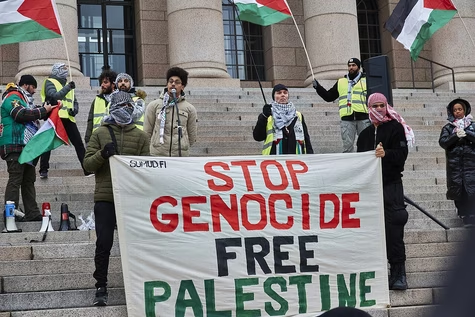
South Africa v. Israel 2023, Allegations of Genocide - South Africa made a case against Israel, alleging that Israel's military actions in Gaza violate the 1948 Genocide Convention. Two rulings in 2024 stated that it is plausible that some of Israel's actions fall under the Genocide Convention. Preliminary measures ordered Israel to take all steps to prevent genocide and ensure access to humanitarian aid. Israel maintains it is acting in self-defence against Hamas. The case is still ongoing and will likely take many more years before a final ruling is made.
-
ICJ Advisory Opinion on Climate Change, The Vanuatu Initiative 2023 - A group of law students from the University of the South Pacific came up with the idea to approach the UN General Assembly and won the support of Vanuatu and, later, a coalition of 132 nations. They sought clarification of countries' legal obligations under international law to address the climate crisis. In 2025, the ICJ issued its advisory opinion, which all 15 judges unanimously adopted: Nations have a legal duty to combat the planetary crisis.
Limitations Of The ICJ
One major challenge for the ICJ is that it relies on state consent for jurisdiction, meaning that it cannot force a state to appear before the court. The ICJ also lacks its own enforcement mechanism, so states can simply fail to comply with a judgment with no repercussions. Permanent member states of the UN Security Council are also able to exercise their veto power to avoid rulings against them.
Given the court's weight however, the vast majority of states are likely to comply with its rulings rather than risk the disapproval of their international allies.
Member States of the UN are automatically parties to court statutes but that doesn't necessarily mean that the ICJ has jurisdiction over them. The U.S., for example, withdrew from compulsory jurisdiction in 1986 following the Nicaragua v. United States case. Other countries who have not signed the declaration recognising jurisdiction of the court include China, Russia, Iraq, Israel, Libya, Qatar and Yemen. Some countries accept jurisdiction but with major exceptions, such as India and Pakistan.
The court is also restricted to hearing cases solely between states, and so it cannot directly try individuals or hear cases brought by individuals, corporations, NGOs, or other non-state entities.
The ICJ has also been criticised for its inefficiency, as cases often take years to resolve. This makes the court unsuitable for immediate crisis management. Cases can also fall victim to the heavy influence of powerful states, which can leverage their power to bypass, ignore, or obstruct the court's proceedings.
After more than eight decades, the Court's influence is declining. Calls for reforms such as the election process for judges, addressing permanent member conflicts of interest, and ensuring consent-based jurisdiction are growing louder.
Conclusion
The ICJ is an excellent example of diplomacy and justice, and even after 80 years, it remains a central institution in international law. In a time when the rule of law is being threatened at every turn, we rely on the stoic independence and global stature of the world's court to clarify international law and enforce state responsibility to uphold it.
In a time where 2 billion people - a quarter of humanity - are living in areas affected by violent conflict, the ICJ plays an increasingly important role in the pursuit of accountability and the preservation of the global legal order.
"The ICJ stands as a testament to the international community's commitment to justice and the peaceful resolution of conflicts." – Former Secretary-General of the UN Boutros Boutros-Ghali
Author: Rachael Mellor, Date: 09.03.26, latest update 31.08.26, licensed under CC BY-SA 4.0
More Resources