Islam
Explore a comprehensive guide to Islam. Learn about Muslim culture, the Holy Quran, the Prophet Muhammad, the role of peace, Ramadan, and women in Islam.
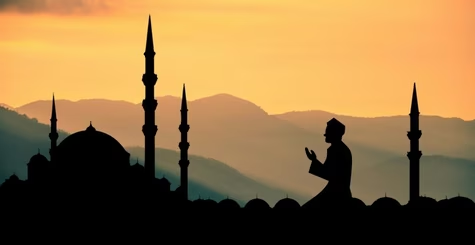
THE FAITH OF ISLAM – The World's Second Largest Religious Population
Discover the world of Islam, a faith with a rich cultural and historical legacy and a rapidly growing global community of over 1.9 billion followers. Our guide offers you in-depth information on Muslim history, arts, philosophy, Muslim women, green Islam, and the crucial fight against rising Islamophobia.
Connect with hundreds of valuable resources, portals, charities, and organisations – for genuine religious tolerance, combatting anti-Muslim discrimination, and building a peaceful, inclusive future for everyone.
Jump straight to our resources on ➡️ Islam
*****
General Information
Islam is a monotheistic religion based on the revelation of the Quran by the Prophet Muhammad in the 7th century. Followers of Islam are called Muslims, the "one who submits to God".
With over 1.9 billion followers, Muslims make up 24% of the global population with significant populations across the Middle East, North Africa, and Asia. The religion has a rich cultural and historical legacy, influencing art, science, food, politics, and philosophy.
The Quran is the holy book of Islam and is considered the unchanging word of Allah (God). It contains moral and ethical instructions intended to guide the lives of believers. It also calls on believers to live peacefully with other religions.
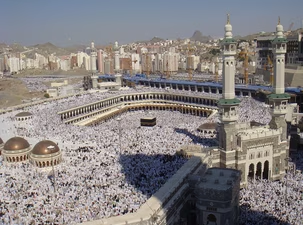
Central to Islam are the Five Pillars, which include the declaration of faith (Shahada), prayer (Salah), almsgiving (Zakat), fasting during Ramadan (Sawm), and the pilgrimage to Mecca (Hajj).
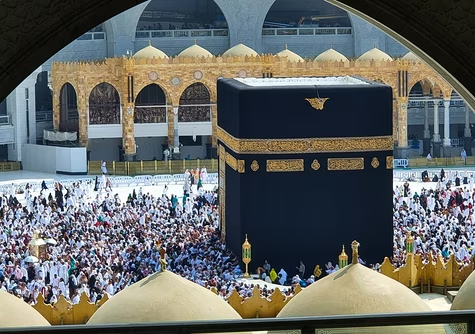
Denominations of Islam
Sunnis are the largest denomination within Islam, accounting for approximately 85% of all Muslims. Sunni Muslim populations are concentrated in Saudi Arabia, Egypt, and most of the Middle East. They follow the Prophet Muhammad and the first four caliphs who succeeded him. Sunnis emphasise the importance of community and unity among Muslims.
Shia Islam (or Shiism) is the second-largest branch of Islam. Shiites are a minority group comprising approximately 15% of the Muslim population.
They believe that Ali, the Prophet Muhammad's cousin and son-in-law, was the Prophet's first legitimate successor. Shiites emphasise the importance of religious leadership and view their Imams as spiritual guides.
The Ismailis are a Shiite subgroup that places particular emphasis on spiritual guidance and knowledge. They believe that their Imamate (spiritual leadership) has been passed down through a specific line of Imams, beginning with Ali and his son, Hassan. The Ismailis also emphasise the importance of harmony between religion and secular life.
Despite some differences, Sunnis, Shiites, and Ismailis share many common beliefs and practices. All three groups pray five times a day and consider the Quran the holy book of Islam.
Furthermore, they all emphasise the importance of justice, compassion, and charity as fundamental values of Islam. Islam and peace are also closely intertwined. Islam emphasises the importance of peace and harmony in society.
The Quran states that there should be no coercion in religion and that all people are equal. The Prophet Muhammad also said that there is no benefit in disturbing one's neighbour. Peace and respect for other religions and cultures are essential components of Islam.
Unfortunately, extremist ideologies and actions adopted by a small minority of Muslims have tarnished the peaceful reputation of Islam. Misguided extremists interpret Islamic texts to justify violence, hate, or political supremacy.
Extremists tend to focus on a rigid, political interpretation of Sharia law and the desire to create an Islamic state. These beliefs pit non-Muslims as the enemy, in direct contrast with traditional Islamic teachings.
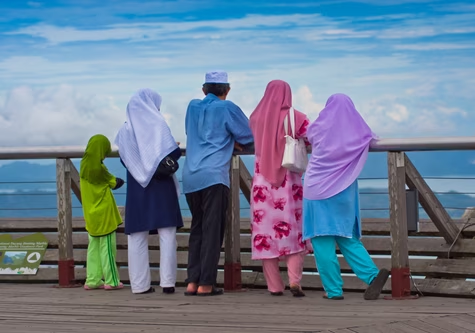
Women in Islam
The role of women in Islam is a controversial topic. Many people have the impression that women are oppressed in Islam, but this is not the reality. Islam emphasises gender equality and the dignity and respect that women should receive.
The Quran calls on men to treat their wives with respect and to see them as equal partners. In Islam, women have the right to education, work, and marriage.
The Islamic dress code calls on believers to dress modestly and respectfully. Women are required to cover their bodies, but there is no specific dress code for men.
The headscarf (hijab) and full veil (niqab) are important aspects of Islamic dress. The Quran encourages women to protect their beauty and dress appropriately. Many Muslim women see the headscarf as a sign of their devotion to Allah.
The burka is more controversial as it covers the entire body, whilst the face is hidden with a mesh screen. It is not considered obligatory by the majority of Muslims.
Since the takeover by the Taliban in Afghanistan, women have faced extreme systematic denial of their rights. They have misused religion as a way to impose gender apartheid on women and effectively remove them from public life.
Girls are now banned from attending school beyond the sixth grade. Women are banned from most workplaces. They must be completely covered and are forbidden from entering public spaces without a male chaperone, including healthcare facilities.
One in three girls is married before the age of 18. There is no protection for women experiencing violence. The new Afghan government has no female ministers, and it is forbidden for women to participate in the judicial system.
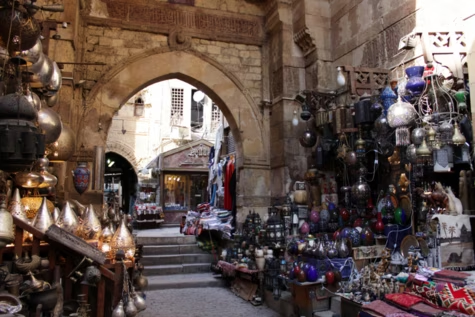
Arabian Culture & History
Muslim and Arabian cultures are deeply entwined. The Prophet Muhammad was an Arab, which means that Arab culture heavily influenced early Islamic practices.
The Quran is also written in Arabic, making the language central to Muslim worship and culture. Approximately 93% of Arabs are Muslims, meaning that for the vast majority, the two identities are inseparable.
Islamic culture varies significantly across the globe; for example, Indonesia, Nigeria and Turkey have very different traditions and customs. Arab culture is specific to the Arab world, including the Middle East and North Africa.
Arab culture has a long and rich history dating back to the dawn of civilisation. The region has experienced many conquests and changes of rule, resulting in a blend of diverse cultural influences and a rich heritage.
The Arabic language has a long tradition of poetry and prose. One of the most famous works is "One Thousand and One Nights," a collection of stories and tales from the Arab world. Arabic literature has also produced many important poets and writers, including Rumi, Ibn Arabi, and Khalil Gibran.
Arabic is one of the oldest and most important languages in the world. It is spoken by over 420 million people worldwide and is one of the six official languages of the United Nations.
Arabic music has a long history and is known for its unique aesthetic and expressiveness. The region's musical traditions are diverse, ranging from classical music to pop and hip-hop.
Arabic cuisine is known for its diversity and flavour influenced by the region's various cultural traditions. It is renowned for its use of spices and herbs such as cinnamon, coriander, and saffron.
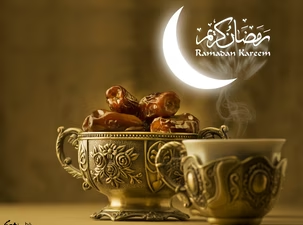
Ramadan is the most important month in the Islamic year, observed by Muslims around the world as a time of fasting, prayer, self-discipline, spiritual advancement, and community. Ramadan is observed in the ninth month of the Islamic calendar, the dates of which change every year.
It commemorates the month the Quran was first revealed to the Prophet Muhammad. Fasting in Ramadan is a spiritual practice that encourages believers to reflect on their thoughts, actions, and relationships. Ramadan ends with the festival of Eid al-Fitr, which is celebrated for three days and is one of the most important holidays in the Islamic calendar.
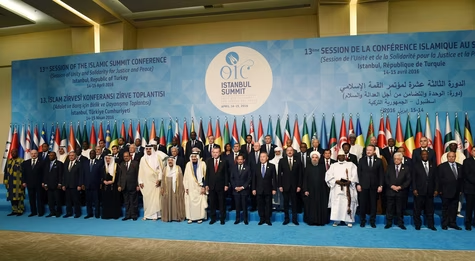
Organisation of Islamic Cooperation (OIC)
The OIC is the second-largest intergovernmental body after the United Nations. It represents 57 member states and was founded in 1969 under its former name, the Organisation of the Islamic Conference.
The organisation works to "safeguard and protect the interests of the Muslim world in the spirit of promoting international peace and harmony". They have permanent delegations to the United Nations and the European Union.
The Council of Foreign Ministers is the OIC's primary decision-making body. They meet annually to discuss issues concerning Muslim nations. Recent discussions have focused on the situation in Gaza, the Kashmir issue and the protection of Muslim minorities around the world.
The OIC also work to help reduce prejudice and misunderstandings and facilitate better integration of Muslims into society. Stereotypes are often the cause of discrimination and exclusion of Muslims in society. Public education contributes to reducing widespread Islamophobia.
Another important aspect of the OIC is the promotion of women's rights and the strengthening of women's roles in the Muslim community.
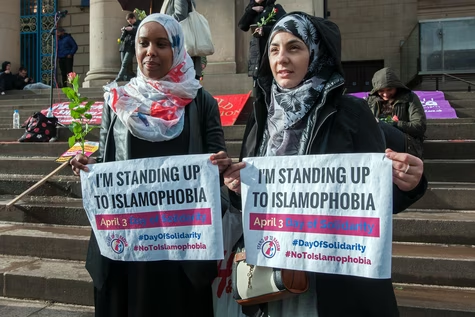
Discrimination of Muslims & Islamophobia
Islamophobia is hostility, discrimination or violence towards Muslims. It is a form of racism directed at Muslims or those who appear to be Muslim. Islamophobia refers to verbal and physical abuse, but also hate crimes, media bias, and institutional discrimination.
Anti-Muslim sentiments developed in Medieval times and became more prevalent with the rise of multiculturalism. Islamophobia is increasingly manifesting through politics and state-sanctioned anti-Muslim policies.
The systematic oppression of Muslims is taking place around the world:
- China – Over a million Uyghur Muslims in China have been sent to "reeducation" camps in Xinjiang, where detainees experience forced labour and religious restrictions.
- Myanmar - State-sanctioned violence and discrimination against Rohingya Muslims have left them stateless, without the right to vote, with severe restrictions on their movements, and with limited access to employment, education, and healthcare. The situation has been described as genocide.
- India - Home to approximately 204 million Muslims, India has the world's largest Muslim-minority population. Domestic policies are becoming increasingly Hindu nationalist and hostile towards Muslims. Anti-Muslim legislation, socio-economic disparities, and targeted violence are intentionally marginalising Muslims and violating religious freedoms.
- The United States – In 2017, under Executive Order 13769, Trump placed immediate travel restrictions on citizens from seven Muslim-majority nations. It was dubbed the "Muslim ban" and faced intense legal challenges and widespread protests. Systemic discrimination, hate crimes, and prejudice increased significantly after 9/11 and have continued to rise. In 2024, record complaints of anti-Muslim and anti-Arab incidents were made.
- Europe - Almost 1 in 2 Muslims living in Europe in 2024 reported racial discrimination in their daily lives. This is attributed to increasing geopolitical tensions, anti-immigration sentiments, and institutionalised policies. Several European countries in recent years have introduced bans on face-covering veils in public, which disproportionately target Muslim women.
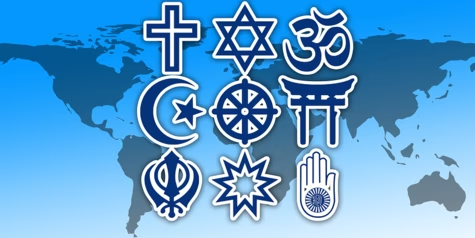
Fostering a Culture of Religious Tolerance
In a world marked by conflict and prejudice, the peaceful coexistence of people of different religions is an important goal that we should strive for.
Humanity has a responsibility to uphold the fundamental human right of religious freedom. We must build a world where individuals are able to practice their beliefs without discrimination or state interference.
Dialogue and cooperation among different religious communities are essential to addressing the challenges of our time. The focus should be on common ground, not our differences.
Accepting and respecting diverse religious practices and traditions promotes peace, cultural progress, and unity.
As-salamu alaykum is a widely used greeting within Muslim populations. It means 'Peace be upon you' and is a sign of respect and goodwill. If there is one thing that we should all agree on, it is that everyone deserves to live in peace.
Author: Jasmin, 14.04.23, translated and edited by Rachael Mellor 07.04.26, latest update 16.07.26, licensed under CC BY-SA 4.0
More Resources
Curated Directory & Deep-Dive Resources on Islam
- General Info 67
- The Holy QUR'AN 49
- Islamic Video & Audio 36
- Islamic Magazines 17
- Islamic Books 25
- Peaceful Islam 82
- Arab Language 19
- Muslim News 14
- Islamic Portals 37
- Prophet Muhammad 6
- Muslim Women 116
- Role of Women in Islam 94
- Muslim Organizations 21
- Organizations in the West 43
- Muslim Charities 12
- Mecca & Medina 20
- Holy Sites 10
- Hadith 2
- Five Pillars 9
- Prayer 18
- Sharia 7
- RAMADAN 290
- The HAJJ 113
- Other High Days 17
- Islamic Studies 32
- Islamic Philosophy 33
- Islamic Finance 19
- Arab League 2
- Arabic Culture 25
- Sunnis 9
- Shia 20
- Ismailies 11
- Ahmadiyya 15
- Sufism 17
- Other Groups 5
- Islamic Dress Code 23
- Islamophobia 153
- Islamic Extremism 25
- Other Texts 13
- Links 10
- Green Islam 63
- Wahhabism
- Selected Articles 23