
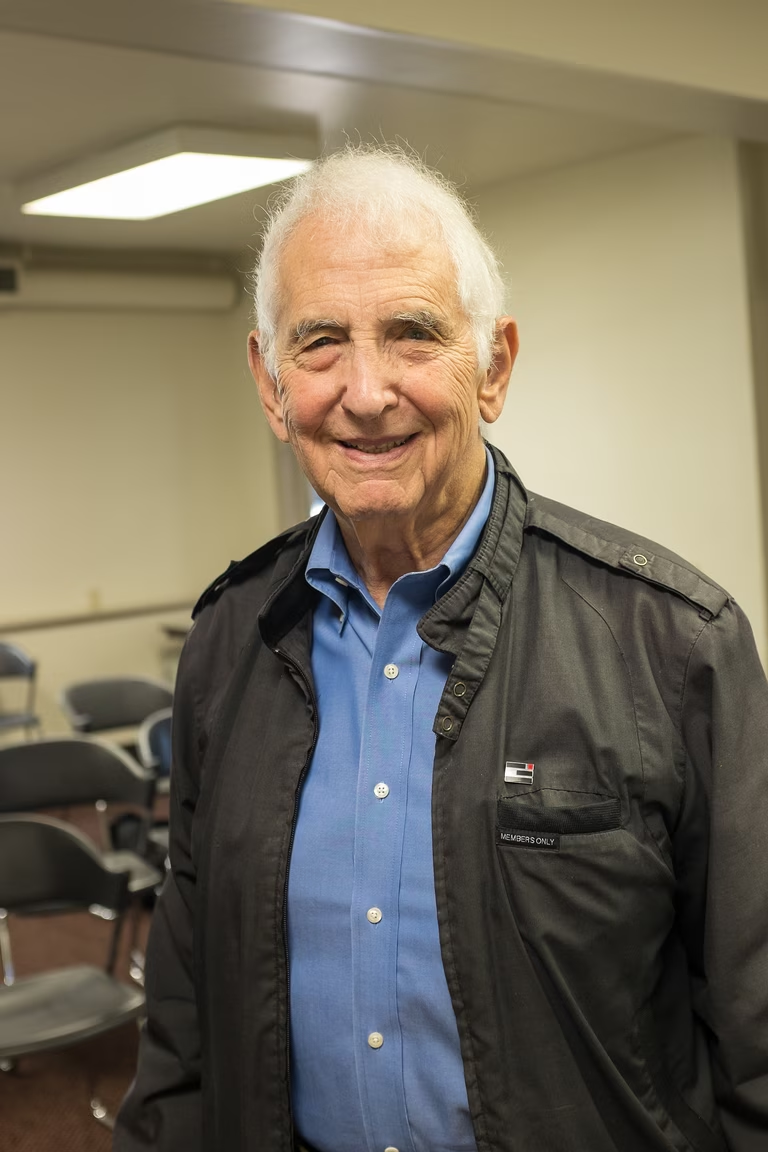
Daniel Ellsberg (USA)
Explore the life and legacy of Daniel Ellsberg, Pentagon Papers whistleblower, Right Livelihood laureate, peace advocate, and defender of press freedom.
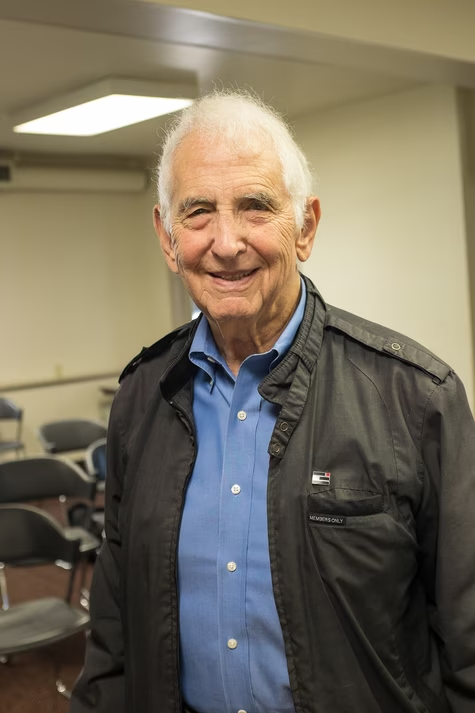
DANIEL ELLSBERG (1931 - 2023) - Whistleblower, Military Analyst, Anti-War & Peace Activist
Discover the inspiring legacy of antiwar activist Daniel Ellsberg and his fearless commitment to truth. Our guide offers essential insight into the inspiring work of whistleblowers, our right to governmental transparency, and the ongoing battle for nuclear disarmament.
Connect with valuable resources, historical archives, and moving obituaries for a man who fought for genuine democratic accountability, press freedom, and a safer future.
Jump straight to our resources on ➡️ Daniel Ellsberg
*****
General Information
“There are two types of courage involved with what I did. When it comes to picking up a rifle, millions of people are capable of doing that, as we see in Iraq or Vietnam. But when it comes to risking their careers, or risking being invited to lunch by the establishment, it turns out that’s remarkably rare.” – Daniel Ellsberg.
In his earlier career, Ellsberg was a firm supporter of U.S. foreign policy. His close exposure to the harsh realities of the Vietnam War, however, was an integral turning point in his life.
His work with the Pentagon Papers set a new precedent in the U.S. for press freedom and the protection of whistleblowers. He soon after dedicated his life to advocating for nuclear disarmament, raising awareness of the catastrophic risks posed by nuclear policy, and promoting transparency in U.S. governance.
Ellsberg has received numerous awards for his commitment to peace, human rights, and literacy.
Some of his most notable prizes include the Gandhi Peace Award (1978), the Right Livelihood Award (2006), the Olof Palme Prize (2018), and the Blueprint for Free Speech Lifetime Achievement Award (2021).
Just before his passing, he approved the creation of the Ellsberg Whistleblower Award. It was established in 2024 to continue his mission for peace and democratic and political empowerment. The award is backed by international journalism and transparency organisations.
It “honours whistleblowers whose efforts have revealed information that significantly enhances public or scientific debate, strengthens the public’s right to know, and thus supports democracy.”
Early Career & The Vietnam War
With a PhD in economics from Harvard University, Ellberg started his career as a U.S. Marine Corps officer. He then went on to become a strategic analyst for the RAND Corporation and the U.S. Department of Defence.
He worked as a government consultant and was involved in strategic planning initiatives, including nuclear war policies. In the mid-1960s, Ellsberg began working as an advisor in South Vietnam, where, on a special assignment, he travelled more than 10,000 miles throughout the country. He witnessed firsthand the cruel realities of the conflict.
The Vietnam War took place between 1955 and 1975; it was fought between communist North Vietnam (allied with the Soviet Union and China) and South Vietnam (allied with the United States). The goal of the U.S. was to prevent communist expansion.
U.S. containment policies were unrelenting, devastating, and dehumanising. They used brutal methods such as carpet bombing, Agent Orange, and free-fire zones, ultimately leading to the deaths of over two million civilians. The atrocities of the Mỹ Lai massacre left a deep scar in Vietnam and are now a historical symbol of systemic moral failure.
Ellsberg quickly concluded that the war was unwinnable and that the U.S. government had been deliberately misleading the public.
“By two years in Vietnam, I was reporting very strongly that there was no prospect of progress of any kind, so the war should not be continued." - Daniel Ellsberg
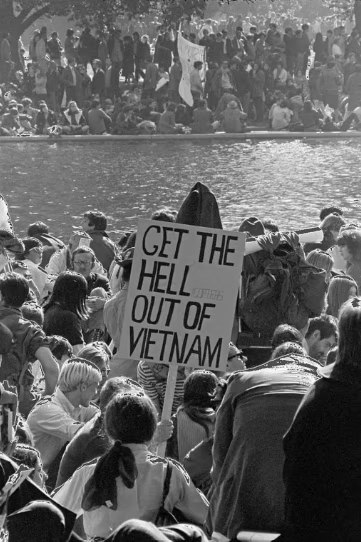
By the late 1960s, the public began to strongly question the morality of the war. Public sentiment shifted dramatically, and there was widespread opposition to the rising number of casualties, the military draft, and government policy. This had no effect on President Nixon, who believed that withdrawal would damage his credibility.
When Ellsberg was granted access to the top-secret Pentagon Papers, he realised the full scale of government deception and had hopes of putting a swift end to the war.
The Pentagon Papers Leak
“Government officials should not be allowed to indiscriminately classify information to cover up their own mistakes” - Daniel Ellsberg.
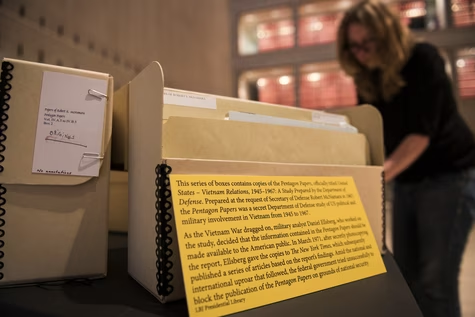
In 1967, Ellsberg made contributions to a huge top-secret Pentagon study which was officially titled ‘United States–Vietnam Relations, 1945–1967: A Study Prepared by the Department of Defence’. It was a detailed history of U.S. decision-making in Vietnam.
Ellsberg first attempted to persuade members of Congress to put the papers in the public domain; this failed. With the help of a friend's photocopier, his 13-year-old son, 10-year-old daughter, and Anthony Russo, a colleague from RAND, he spent 8 months making duplicates of the 7,000-page report.
In 1971, he sent it to the New York Times, the Washington Post, and 16 other major newspapers. The Nixon administration obtained a court order to prevent the Times from releasing further documents. The battle went up to the Supreme Court, which ruled 6-3 in favour of press freedom and permitted further publications.
The main findings of the Pentagon Papers were:
- Four successive governments had lied to the public and Congress about the scale and true intentions of American involvement in the Vietnam War.
- The U.S. covertly expanded military operations into Laos and Cambodia, and escalated troops long before informing the public.
- The U.S. used and manipulated events such as the 1964 Gulf of Tonkin naval confrontations to secure Congressional authorisation for full-scale war.
- U.S. officials realised early in the war that it was very likely unwinnable, motivations for continuing the war were primarily to avoid a humiliating U.S. defeat. Helping the people of South Vietnam was a very low priority.
- The U.S. were directly involved in political engineering in South Vietnam, including promoting the rise of South Vietnamese President Ngo Dinh Diem and then later sanctioning the 1963 military coup.
Initially, the newspapers were disappointed in the lack of attention that the release received. However, the incredibly high-profile Supreme Court trial ensured that the findings stayed firmly in the headlines.
This was one of the most significant leaks in American history. It completely shattered public trust in the government, had far-reaching implications, and ultimately helped end the war.
Ellsberg says that at the time, “The effect on Nixon’s policy was zero. The war went on: a year later, the biggest bombing of the war and then, at the end of that year, 18 months later, the heaviest bombing in human history."
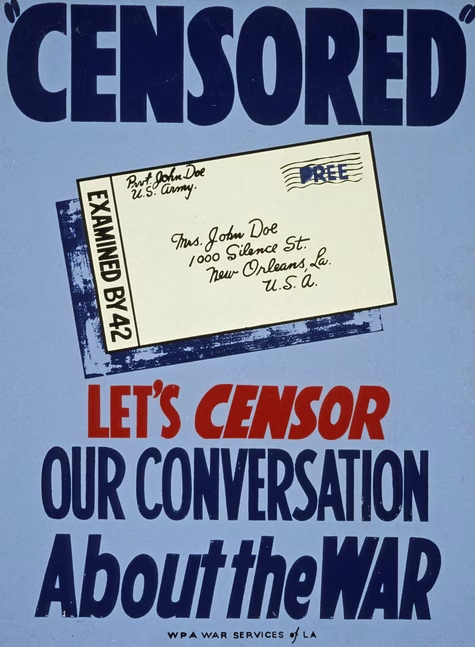
A panicked President Nixon, wanting to protect his reputation, formed the White House Special Investigations Unit - known as the Plumbers. It was created as an attempt to prevent further security leaks and to ruin Ellsberg's reputation.
Henry Kissinger, the U.S. National Security Adviser at the time, publicly described Ellsberg as “the most dangerous man in America.”
Nixon vs Ellsberg
Ellsberg was indicted on 12 felony counts, the most serious of which were theft and violation of the Espionage Act. He faced up to 115 years in prison.
Before the trial, Nixon gave the Plumbers orders to dig up dirt on Ellsberg. They broke into the office of Ellsberg’s psychiatrist to steal medical files. As part of a separate operation, they broke into the Democratic National Committee headquarters in the Watergate complex. They wired the office phones and copied campaign documents in an effort to help Nixon get re-elected.
During Ellsberg's trial, investigations into the Watergate break-in exposed the burglary of his psychiatrist's office. The judge was forced to dismiss all charges against Ellsberg due to government misconduct and illegal evidence gathering.
In his attempt to destroy Ellsberg, Nixon became the cause of his own downfall. Facing certain conviction in an impeachment trial, Nixon resigned in August 1974. With this, his pledge to renew the bombing in South Vietnam was never fulfilled, and the war officially ended on April 30, 1975.
Ellsberg never spent any time in jail and today is an internationally celebrated guardian of the truth.
Daniel Ellsberg - Activism
“War should always be a last resort, and the decision should never be made lightly” - Daniel Ellsberg.
Since the release of the Pentagon Papers, Ellsberg became a lifelong champion of press freedom, whistleblowers, peace, nuclear disarmament, and government transparency.
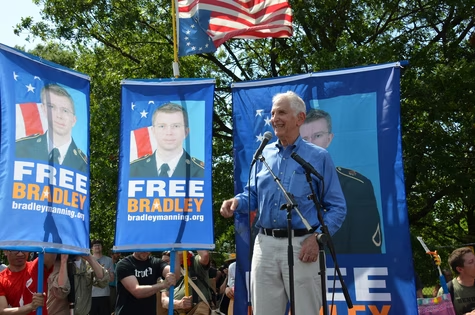
He has supported fellow whistleblowers Chelsea Manning, Julian Assange, Edward Snowden and others who have been charged under the Espionage Act for their commitment to the truth. In his long career, he notes that the climate for journalism has become more restrictive and criminalised than ever before.
Over the decades, Ellsberg worked closely with the executive editor of the Washington Post, Ben Bradlee; the celebrated intellectual Noam Chomsky; the prominent peace activists Dan Berrigan & Philip Berrigan; and the co-founder of the anti-war organisation CODE PINK, Medea Benjamin.
He was also closely associated with Veteran Intelligence Professionals for Sanity (VIPS), serving as a member emeritus and prominent supporter of the group.
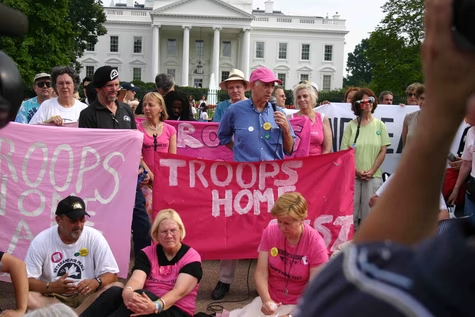
His activism at protests has led to his arrest dozens of times.
He also became an acclaimed and successful author. He wrote several memoirs and books, including his best-selling ‘Secrets: A Memoir of Vietnam and the Pentagon Papers’ and ‘The Doomsday Machine: Confessions of a Nuclear War Planner.’
Of note, many comparisons have been drawn between Ellsberg's stance on nuclear weapons and the Bulletin Of The Atomic Scientists' Doomsday Clock. The annual adjustment of the Doomsday Clock is a symbolic representation used to convey the urgency of existential threats to humanity, particularly nuclear warfare and climate change.
On January 27, 2026, citing a failure of leadership, the Doomsday Clock was set to 85 seconds to midnight - the closest it has ever been to midnight since its creation in 1947.
Ellsberg vocally condemned Russia’s 2022 invasion of Ukraine as a "tragic and criminal attack". Before his death in June 2023, he repeatedly warned that the conflict dramatically escalated the risk of a global nuclear war.
Inspiring A New Generation Of Whistleblowers
“Every citizen has a responsibility to question the actions of their government” - Daniel Ellsberg.
Fifty years later, in an interview in 2021 referring to the release of the Pentagon Papers, Ellsberg said, “I’ve never regretted doing it.” He urged fellow whistleblowers, “Don’t wait years till the bombs are falling and people have been dying”.
Ellsberg will be remembered for his profound impact on U.S. policy, public opinion, and press freedom. His case before the Supreme Court set a precedent regarding the public's right to know the truth, even in the face of state concealment.
His lifelong dedication has inspired others to challenge government secrecy and deception and to stand up for what they believe in, even against the greatest of odds.
Author: Rachael Mellor, 08.08.26, licensed under CC BY-SA 4.0
More Resources
Curated Directory & Deep-Dive Resources on Daniel Ellsberg (USA)
- Daniel Ellsberg (USA) - RLA 2006 186813
- Daniel Ellsberg - CommonDreams 422038
- Wikipedia 186815
- Pentagon Papers 1971 - Wikipedia 186816
- YouTube Search 186817
- Google News 186844
- Washington Post - Pentagon Papers 285969
- MUST WATCH VIDEO: An ORDINARY INSANITY Film (documentary) 05.06.26 520856
- Video: AN ORDINARY INSANITY - PREMIERE Panel Discussion 04.06.26 (strongly recommended) 520857
- Documentary ‘An Ordinary Insanity’ Keeps Daniel Ellsberg’s Anti-Nuclear Warning Alive - CD 14.06.26 520893
- An Ordinary Insanity Trailer - By whistleblower and former nuclear war planner Daniel Ellsberg 29.04.26 517786
- Our TWEET on Daniel Ellsberg - please share 353794
- Our INSTAGRAM post - please share 353795
- Our FACEBOOK post - please share 353796
- Honoring Daniel Ellsberg’s Legacy One Year After His Death - CD 10.06.24 418370
- Video: A Celebration of the Life of Daniel Ellsberg - The Family's Memorial Online 10.12.23 388848
- Tweet: I was honored to speak on Nuclear Truth Telling in memory of our beloved @DanielEllsberg with gratitude to @IraHelfand @susisnyder & @ChristianGAppy @TheEIPAD… 393579
- Eulogy for My Father, Daniel Ellsberg - CD 27.10.23 380508
- Video: Celebration of the Life of Daniel Ellsberg - Daniel Ellsberg 22.10.23 379037
- Daniel Ellsberg warns that the risk of nuclear war is growing as tensions over Ukraine and Taiwan escalate - Pressenza 18.06.23 369236
- Video: RIP Daniel Ellsberg: “Most Dangerous Man in America” on Leaking Pentagon Papers, Exposing Gov’t Lies - DN! 03.07.23 357523
- Video: “The Doomsday Machine”: Confessions of Daniel Ellsberg, Former Nuclear War Planner - DN! 03.07.23 357389
- Video: Daniel Ellsberg’s Dying Wish: Free Julian Assange, Encourage Whistleblowers & Reveal the Truth - DN! 03.07.23 357390
- Against the Unthinkable: Life After Daniel Ellsberg - CD 22.06.23 356862
- Video: Months Before Death, Daniel Ellsberg Warned Crisis over Ukraine & Taiwan Could Lead to Nuclear War- DN! 20.06.23 356269
- Video: RIP Daniel Ellsberg: “Most Dangerous Man in America” on Leaking Pentagon Papers, Exposing Gov’t Lies - DN! 20.06.23 356245
- Video: “The Doomsday Machine”: Confessions of Daniel Ellsberg, Former Nuclear War Planner - DN! 20.06.23 356246
- Daniel Ellsberg’s Dying Wish: Free Julian Assange, Encourage Whistleblowers & Reveal the Truth - DN! 20.06.23 356244
- Tweet: Daniel's final unauthorized disclosure, to @charlie_savage of the @nytimes, in 2021 - @DanielEllsberg19.06.23 356034
- Daniel Ellsberg: A Friend and Peacemaker Who Did So Much More Than Leak the Pentagon Papers - CD 19.06.23 356318
- Daniel Ellsberg warns that the risk of nuclear war is growing as tensions over Ukraine and Taiwan escalate - Pressenza 18.06.23 363048
- Daniel Ellsberg wanted Americans to see the truth about war - Intercept 16.06.23 356407
- Daniel Ellsberg, American Hero - Jacobin 16.06.23 353423
- 'Peace Activist Until the Very End': Whistleblower Daniel Ellsberg Dead at 92 - CD 16.06.23 356701
- Daniel Ellsberg Has Passed Away. He Left Us a Message - CD 16.06.23 356733
- Daniel Ellsberg, Pentagon Papers whistleblower, dies at 92 - Al Jazeera 16.06.23 353321
- Daniel Ellsberg’s message to us, and to future generations - Bulletin 16.06.23 356036
- Daniel Ellsberg Is Dying. And He Has Some Final Things to Say - Politico 04.06.23 349894
- Pentagon Papers Whistleblower Daniel Ellsberg Dies at 92 - DN! 16.06.23 356270
- Daniel Ellberg Has Passed Away at 92 - NAPF 16.06.23 357410
- After Terminal Cancer Diagnosis, Daniel Ellsberg Reflects on Leaking Pentagon Papers & His Legacy - DN! 01.05.23 344715
- Celebrating Daniel Ellsberg and a Courage Unconfined to the Past - CD 11.04.23 341665
- My Fifty Years With Dan Ellsberg - Seymour Hersh 08.03.23 337197
- Daniel Ellsberg, who leaked the Pentagon Papers, announces he has terminal cancer - NPR 03.03.23 332988
- A Life That Matters: Daniel Ellsberg Has Terminal Cancer - CD 03.03.23 343178
- Lessons Not Learned From the Pentagon Papers - Counterpunch 01.03.23 423459
- Podcast: The Pentagon Papers at 50: Press Freedom and Whistleblowers Still at Risk - Democracy Now! 17.06.21 248400
- Pentagon Papers whistleblower reveals US weighed 1958 nuclear strike on China - Truthout 14.06.21 248985
- Daniel Ellsberg on Whistleblowers Julian Assange, Daniel Hale, Reality Winner, Ed Snowden & Others - DemocracyNow 14.06.21 248682
- 50 Years After Pentagon Papers, Ellsberg Reveals U.S. Weighed 1958 Nuclear Strike on China over Taiwan - DemocracyNow 14.06.21 248683
- Pentagon Papers at 50: Daniel Ellsberg on Risking Life in Jail to Expose U.S. Lies About Vietnam War - Democracy Now! 14.06.21 247828
- After 50 years, the Pentagon Papers give up their final secrets - Guardian 10.06.21 250325
- May Day 1971: Daniel Ellsberg on Joining Noam Chomsky, Howard Zinn at Historic Antiwar Direct Action - DN! 03.05.21 242760
- Truth, Dissent & the Legacy of Daniel Ellsberg - UMassAmherst 30.04.21 242619
- This is pathetic. Daniel Ellsberg risked his life to expose what the state wanted concealed: the lies behind a criminal war... - Aaron Good on Twitter 12.03.21 238684
- Because She Was Wrong About Iraq, Afghanistan, Syria, Yemen, and Libya, Daniel Ellsberg Joins Campaign Against Flournoy - CD 04.12.20 227671
- Daniel Ellsberg Among Anti-War Protesters Arrested At The White House - NPR 16.12.10 186818
- Daniel Ellsberg & Julian Assange at the Frontline Club - London 25.10.10 186819
- Daniel Ellsberg: Woodward Should Give Afghan Docs to WikiLeaks - CBS 10/10 186820
- “Our President Is Deceiving the American Public”: Pentagon Papers Whistleblower on President Obama and the Wars in Afghanistan and Iraq - Democracy Now! 3/10 186821
- The Most Dangerous Man in America: Daniel Ellsberg and the Pentagon Papers - Film (2009) 186822
- "The Most Dangerous Man in America": New Documentary Chronicles Story of Daniel Ellsberg, Whose Leak of the Pentagon Papers Helped End Vietnam War - DN 9/09 186823
- Most Dangerous Man in America: Daniel Ellsberg and the Pentagon Papers - LA 23/09 186824
- The Pentagon Papers: Secrets, Lies and Audiotapes - National Security Archives 186825
- Video: Daniel Ellsberg Draws Parallel: Vietnam to Afghanistan - YouTube 10/09 186826
- Video: Secrets - Vietnam and the Pentagon Papers - Daniel Ellsberg 12/08 390114
- Whistleblower Daniel Ellsberg: Bush Likely to Attack Iran, Impeachment a Must 2/08 186828
- Whistle-Blowers: A Conversation with Daniel Ellsberg and John Dean (Video) - Open Society Institute 186827
- Video: How the Pentagon Papers Came to be Published by the Beacon Press - Dem. Now! 7/07 186829
- Secrets: A Memoir of Vietnam and the Pentagon Papers - Barnes & Noble 9/03 186830
- Secrets: A Memoir of Vietnam and the Pentagon Papers (Book Review) - Foreign Affairs 12/02 186831
- Daniel Ellsberg, Edward Snowden, and the Modern Whistle-Blower - The New Yorker 2016/12 186832
- Wild Man: The Life and Times of Daniel Ellsberg (Book Review) - New Yorker 8/01 186833
- Lying about Vietnam - NY Times 29.06.01 283274
- Wild Man: The Life and Times of Daniel Ellsberg - Amazon 186834
- Conversations with History: Daniel Ellsberg (YouTube) - Institute of International Studies, UC Berkeley 7/98 186836
- Manhattan Project II - anti-nuclear initiative - Daniel Ellsberg 8/93 186837
- Physicians for Social Responsibility (PSR) 186838
- Randy Kehler - Wikipedia 186839
- Time & Date - San Francisco 186840
- Google Search 186841
- Google Images 186842
- Google Videos 186843
- Google Scholar 186845