
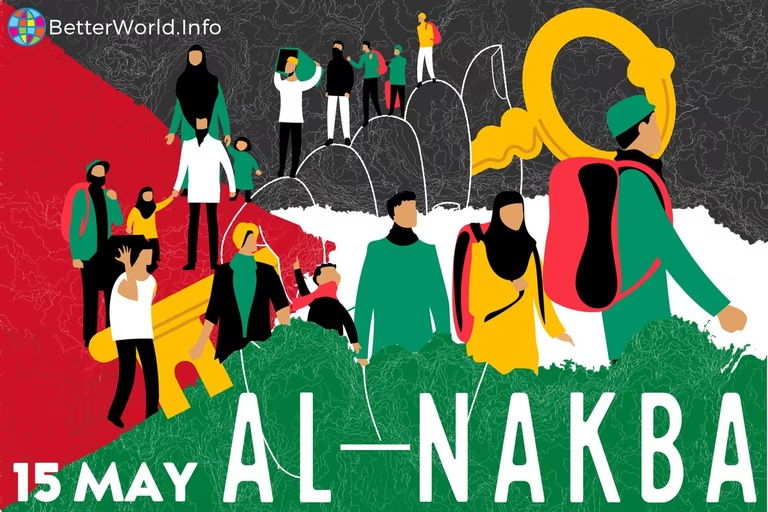
Al NAKBA 1948 - May 15
Explore the events of the 1948 Al Nakba and May 15 Remembrance Day. Discover resources on the displacement of 750,000 Palestinians and its ongoing impact.
AL NAKBA, May 15 1948 – A Day for Palestinian Remembrance
Discover the historical importance of Al Nakba and learn how Palestinians are still fighting for their rights today. Our guide offers you in-depth information on the events of 1948, Palestinian statelessness, and the war in Gaza.
Connect with valuable resources, initiatives, and organisations – for remembrance, promoting the right to return, and Palestinian solidarity.
Jump straight to our resources on ➡️ Al Nakba
*****
General Information
Al Nakba Day translates to "The Catastrophe" in Arabic. The day commemorates the events which took place in 1948, when 750,000 Palestinian refugees were created as they were violently displaced in the establishment of the State of Israel.
It resulted in 80% of the population being forcibly dispossessed of their land, property, and belongings. Such large-scale ethnic cleansing led to the destruction of Palestinian society, culture, identity, and civil rights, which were all stripped away.
Al Nakba is also used interchangeably to describe the ongoing persecution of the Palestinian people by Israel.
This annual remembrance day holds profound significance as it reflects on the loss and suffering endured by the Palestinian people and the ongoing issue of statelessness for millions. The day serves as a time of mourning and remembrance for Palestinians, and also aims to raise international awareness about their historical and ongoing struggle for rights and recognition.
This year marks 78 years since the beginning of Israel's settler-colonial project, and given the current situation in Gaza, observances are set to be particularly emotive.
The commemoration of Nakba Day was criminalised in Israel under the Nakba Law in 2011, acting as a deterrent for those mourning the dispossession of their ancestors' land. Regardless, every year, protests, marches, rallies, and public speeches take place to keep the memory of the events alive and promote the right of return for Palestinian refugees.
They serve as a form of remembrance, a call for political change, and a reaffirmation of Palestinian identity. This year, widespread international protests have been planned to demand a ceasefire in the Gaza war and an end to the suffering of the Palestinian people.
Explore our comprehensive guides on Israeli occupation, land grabs, settler violence, Palestinian refugees, and the BDS Movement.
Please share this unique resource via Twitter, Bluesky, Facebook, Instagram and LinkedIn.
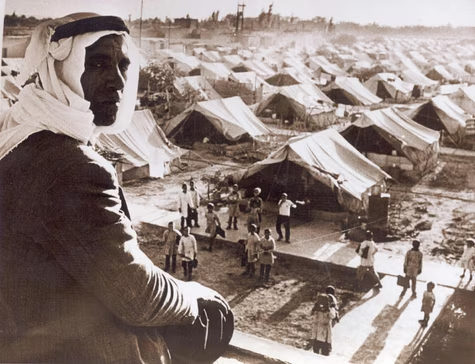
What Were The Events That Led To Al Nakba?
The historical backdrop of Al Nakba is intertwined with the broader Arab-Israeli conflict. During the late 19th and early 20th centuries, tensions grew as the immigration of Jewish people to Palestine increased, driven by the desire for a Jewish homeland and the escape from persecution in Europe.
The United Nations' partition plan of 1947, which proposed dividing Palestine into Arab and Jewish states, was met with opposition and led to escalating conflicts. Following the declaration of the State of Israel in 1948, and the end of the British Mandate and departure of British forces, 80% of the Palestinian population were forcibly displaced by Zionist militias.
The 1967 Palestinian exodus or Naksa refers to the flight of around 300,000 Palestinians out of the territories captured by Israel during and in the aftermath of the Six-Day War.
Today, an estimated 5-9 million Palestinians still live as refugees in 58 recognised camps in Jordan, Lebanon, Syria, the Gaza Strip, and the West Bank. Conditions in these camps are poor. They are dangerously overcrowded, lack basic infrastructure, and provide limited access to resources or opportunities for socioeconomic advancement.
For many years, the Nakba did not receive global attention or recognition, but in 2023, the United Nations officially commemorated the day for the first time. The decision to mark the 75th anniversary was made to "serve as a reminder of the historic injustice suffered by the Palestinian people".
The increase in global Palestinian solidarity movements and recognition of Nakba Day has helped bring broader attention to the struggle of the Palestinian people to the international stage.
As the Hamas-Israel war continues into its second year, Israel must be forced to stop their blockade of Gaza and relentless attacks, as the ethnic cleansing of Gaza and a second Nakba is unfolding before our eyes.
Better World Info supports de-escalation, disarmament, diplomacy, and a peace-first approach.
Author: Rachael Mellor 13.05.24, latest update 31.08.26, licensed under CC BY-SA 4.0
More Resources
Curated Directory & Deep-Dive Resources on Al NAKBA 1948 - May 15
- Google News 28496
- PALESTINE REMEMBERED 28497
- Nakba DAY - May 15, 1948 (Wikipedia) 28498
- Our TWEET on #Nakba75 - please retweet to share 345788
- Nakba – The Ongoing Ethnic Cleansing of Palestine 28499
- NAKBA - 1948 Palestinian Exodus (Wikipedia) 28500
- Nakba-Archive 516018
- The Nakba and the Palestinian Right of Return - Palestine Solidarity Campaign 515138
- Timeline: Al Nakba - Palestine Remix 282922
- The NAKBA FILES 28502
- Nakba Case Book 28503
- #KeyToJustPeace 479358
- @NakbaFiles - Twitter 28504
- NakbaFiles - Facebook 28505
- The ETHNIC CLEANSING of Palestine - Wikipedia 28506
- Al-Nakba - Al-Jazeera Documentary, 2008, subtitled 28507
- Ilan Pappe on "The Nakba of Palestine" - YouTube 8/10 28508
- Al-Nakba - Episode 1 - Al Jazeera 28509
- AL JAZEERA on Al-Nakba 28510
- Palestinian Exodus - Wikipedia 28511
- Palestinian Exodus - YouTube 28512
- Plan Dalet - Wikipedia 28513
- Electronic Intifada 28514
- CommonDreams 28515
- DemocracyNow! 28516
- MondoWeiss 28517
- +972 on Nakba 28518
- Haaretz 28519
- Google Images ! 28520
- YouTube ! 28521
- Please retweet! 28522
- Twitter - #Nakba 28523
- Twitter - #Nakba75 28524
- Twitter - #NakbaDay 28525
- Facebook - #Nakba 28526
- Palestinian right of return !? - Wikipedia 28527
- Zochrot - Remembering Booklet series (Hebrew) 28528
- Ethnic Cleansing - Wikipedia 28529
- Nakba DENIAL (by Israel) - Wikipedia 28530
- Nakba Week of Action (PSC) - 5/16 28531
- The Great Book Robbery (1948) 28533
- Voices Across The Divide - Documentary 28535
- Voices Across The Divide - Twitter 28536
- Voices Across The Divide - Facebook 28537
- Book: Catastrophe Remembered: Palestine, Israel and the Internal Refugees: Essays in Memory of Edward W. Said 272929
- Event: 11-15 May, Speaking Tour: Lubnah Shomali – The Ongoing Nakba: Ending 78 years of Israeli Apartheid & Genocide - Ireland-Palestine Solidarity Campaign 515354
- Event: May 16, 2026 - Nakba 78: March for Palestine & against the far right - Stop the War, London 12pm 514878
- Stride for Palestinians - 15 May - 15 June 2024 - MAP 411931
- Panel Discussion “1948 – 2024: The Ongoing Palestinian Nakba” - 17.05.24 10:00 am - 1:00 pm EDT 411929
- ActionAid Statement on the 78th Commemoration of the Nakba - Action Aid Palestine 17.05.26 516224
- Tens of thousands attend London pro-Palestine rally to mark Nakba Day - Guardian 16.05.26 516222
- From the Nakba to Gaza’s ruins: One man’s lifetime of displacement - Al Jazeera 16.05.26 516221
- Nakba is not a memory; it is a system still in motion - Middle East Monitor 16.05.26 516223
- Millions of Palestinians mark 78 years since the Nakba - Al Jazeera 15.05.26 516178
- For Palestinians, the Nakba Isn’t Just History. It’s Also Our Present - Truthout 15.05.26 516394
- Video: Nakba Day: Muhammad Shehada on Israel’s Ethnic Cleansing in Gaza & Ongoing Palestinian Resilience - DN! 15.05.26 516246
- Three years of the West Bank’s ‘third Nakba’ - Al Jazeera 15.05.26 516173
- Podcast: Remembering the Nakba of urban Palestine - +972 Mag. 14.05.26 516015
- From the Nakba to Gaza, Palestinians continue to carry the keys to homes they were forced to leave behind - The New Arab 14.05.26 516013
- 1948 to 2026: The Nakba never ended, Israel simply normalised the death and destruction - TRT World 14.05.26 516014
- Arabs and Palestinians in Britain call on Starmer for equal protection during Nakba commemoration - MEMO 14.05.26 516017
- 78 Years On: The Nakba That Never Ended - Almodon 14.05.26 516016
- 78 years after Nakba: Palestinians endure at 15.5 million worldwide - Ahram Online 13.05.26 515925
- A Palestinian photographer’s ‘search for what remained’ from 1948 - +972mag 12.05.26 515924
- Palestinians gather to mark 78th anniversary of the Nakba and call for 'right of return' - Euronews 12.05.26 515923
- 6 Things to Know About the Palestinian Nakba - Institute for Middle East Understanding 12.05.26 515922
- New ‘Nakba’ in Jerusalem: Israel steps up Silwan demolitions near Al-Aqsa - Middle East Eye 11.05.26 515777
- Jewish supremacist Knesset member disrupt Nakba event in Jerusalem - WAFA 11.05.26 515778
- 78 years since the Nakba and the collapse of the Zionist project - Middle East Monitor 11.05.26 515775
- Israel used the Nakba not only to steal land, but Palestinians’ financial wealth too - Mondoweiss 10.05.26 515776
- A forensic account of the horrors my family experienced during the Nakba - Mondoweiss 06.05.26 515355
- Pro-Palestine groups mobilise for Nakba Day march in London - New Arab 06.05.26 515356
- 'Israeli Arabs Shouldn't Forget the Nakba. But We Have to Move On' - Haaretz 01.05.26 515139
- Nakba 78: Exposing the 'invincibility' of the 'Zionist State' - Al Jazeera 30.04.26 515140
- Israel blocked the March of Return. Palestinians marked the Nakba anyway - +972 28.04.26 514877
- For the Second Year in a Row, Nakba Day March Canceled Due to Israel Police Limits - Haaretz 23.04.26 514880
- Palestinians not welcome as Israel marks Memorial Day - Al Jazeera 20.04.26 514881
- Holocaust survivors, MPs, artists demand Met reverse decision favouring fascist march over Nakba - Canary 15.04.26 514882
- ‘Another Nakba’: UN expert says Gaza recovery will take generations - Al Jazeera 11.10.25 494037
- In Berlin, Nakba Day Took Place Under the Threat of Violence - Jacobin 17.05.25 470864
- Rep. Rashida Tlaib Reintroduces Nakba Resolution Amid Israel’s Genocide on Gaza - DN! 16.05.25 469482
- Seventy-seven years after the Nakba, we are naming our new ruin - Al Jazeera 16.05.25 469477
- Urge Congress to Support Rep. Tlaib’s Resolution Recognizing 77th Anniversary of Nakba, Affirming Palestinian Rights - CAIR 16.05.25 469481
- The Nakba anniversary: Shared lessons between Palestine and Latin America - Middle East Monitor 16.05.25 469484
- Tensions between pro-Palestine, pro-Israel groups rise in US as hundreds mark 77th anniversary of Nakba - AA 16.05.25 469478
- Palestine Museum opens first Europe branch on Nakba Day - Middle East Monitor 16.05.25 469483
- Al Nakba 77 today: Israel's New Gaza Operation Should Be Called 'Chariots of Genocide' - TFF 15.05.25 470096
- Nakba Day 2025: We Existed Then, We Exist Now, We Will Continue to Exist - Novara Media 15.05.25 470868
- On Nakba Anniversary, Israeli strikes kill Dozens of women and children in Gaza - Days of Palestine 15.05.25 469479
- In Gaza, the Nakba is being relived in 2025 - Al Jazeera 15.05.25 469489
- ‘One long Nakba’: Palestinians mark 77 years since mass expulsion by Israel - Al Jazeera 15.05.25 469362
- They Never Stopped: Gaza and the Legacy of Israeli Colonial Violence - Palestine Chronicle 15.05.25 469487
- From 1948 to now, a Nakba that never ended - Al Jazeera 15.05.25 469361
- At UN 'Nakba' commemoration, Abbas urges action on Gaza - The Jordan Times 15.05.25 469480
- Nakba of the Children: How Israel is Targeting the Palestinian Future - The Intercept 15.05.25 469488
- Palestinians Commemorate 77th Anniversary of Nakba Amid Israeli Genocide - DN! 15.05.25 471237
- Nakba Day: Israel's genocidal war on Gaza 'even worse' than the expulsions of 1948 - The New Arab 15.05.25 469490
- As fighting continues in Gaza, more US Jews are recognizing the Nakba - Religion News 15.05.25 469485
- ‘Israel’s plan was always genocide’—workplace day of action marks Nakba anniversary - Socialist Worker 15.05.25 469486
- May 15, Nakba Day: a beautiful message and invitation to participate from the Combatants for Peace - Pressenza 12.05.25 468715