

Jean Ziegler (Switzerland)
Explore the life, books, and activism of Jean Ziegler. Learn about the Swiss sociologist and former UN Special Rapporteur on the Right to Food.
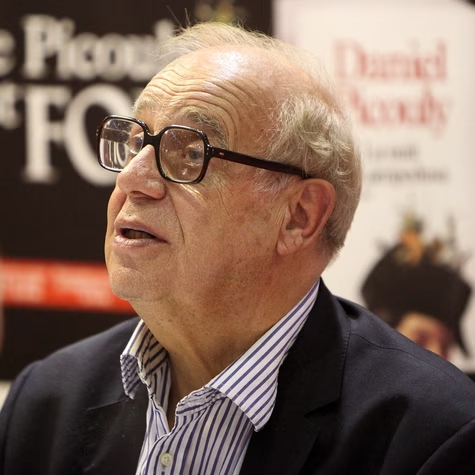
JEAN ZIEGLER (1934- 2026) - Swiss Left-Wing Intellectual
Discover the inspiring career of exemplary sociologist Jean Ziegler and learn about his advocacy for global justice. Our guide offers you in-depth information on his sharp critiques of neoliberal globalisation and predatory financial systems.
Connect with valuable insights into his work as an academic, politician, writer, and UN Special Rapporteur as he uncompromisingly fought to end hunger and prioritise human rights around the world.
Jean Ziegler is one of Europe’s most prominent critics of globalisation and is considered one of the most influential voices in the international fight for social justice.
Jump straight to our resources on ➡️ Jean Ziegler
Through his books, lectures, and work for the United Nations, he has drawn attention to the global issues of hunger, poverty, and economic inequality, becoming one of the most incisive critics of international financial capitalism.
*****
Jean Ziegler’s Career: From Swiss Politics To The United Nations
Jean Ziegler was born on April 19, 1934, in Thun, in the city of Bern. After studying law and sociology, he became politically active at an early age and joined the Social Democratic Party of Switzerland (SP).
He served in the Swiss National Council from 1967 to 1983 and again from 1987 to 1999. There, he championed social reforms, greater financial transparency, and stronger democratic control over economic power.
Ziegler gained international renown primarily through his work as the UN Special Rapporteur on the Right to Food. From 2000 to 2008, he travelled to numerous crisis regions in Africa, Asia, and Latin America.
His reports documented the dramatic effects of hunger, malnutrition, and poverty, and made it clear that enough food is produced worldwide to feed everyone. For Ziegler, hunger was therefore not a natural phenomenon, but the result of poor political and economic decisions.
Alongside his political work, he taught as a professor of sociology at the University of Geneva and published numerous academic and popular science works. His books have been translated into many languages and reached an international audience.
To delve deeper into his work, you can find his books and other publications on platforms such as Goodreads. For further insight into his more recent thinking and motivations, read this article on his legacy on Infosperber.
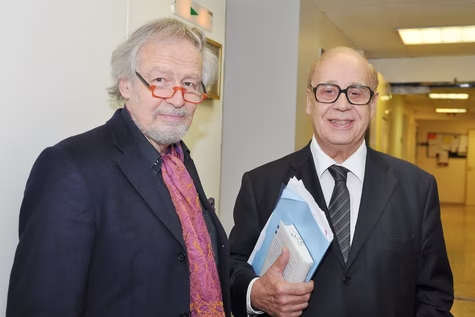
Jean Ziegler & His Critique Of The Global Economy
At the heart of Ziegler’s thinking lies a critique of a global economy that, in his view, serves the interests of a powerful few, while millions suffer from poverty and exploitation.
His description of today’s globalisation as a “cannibalistic world order” has become well-known.
He describes a system in which economic profits and capital interests are prioritised over human rights and social responsibility. His publications on the Swiss Financial Centre have also been the subject of controversy.
In books such as “Switzerland, the Gold, and the Dead,” he examined the role of banks and authorities in handling assets from the Nazi era as well as funds from authoritarian regimes.
His research has sparked public debate and contributed to a reassessment of historical and political responsibility. Ziegler also criticised the power of multinational corporations, speculation in agricultural commodities, and international trade structures that, in his view, hindered the economic development of many countries in the Global South.
His analyses have made him an important figure in global social movements and critics of globalisation.
Jean Ziegler’s Legacy: Hope For A More Just World
Despite his profound critique of existing conditions, Jean Ziegler’s work is characterised by a clear hope for change. He calls for a “revolt of conscience” and appeals to every individual's responsibility to stand up for human rights, solidarity, and social justice.
For him, a more just world can only emerge if economic interests no longer take precedence over human well-being.
In his later works, Ziegler shifts his focus to the younger generation. He sees young people who are committed to climate protection, democracy, and social justice as the greatest hope for a sustainable and equitable future.
His central concern remains unchanged: the conviction that hunger, extreme poverty, and social exclusion are not inevitable fates, but problems that can be overcome through political will and civic engagement.
Jean Ziegler has profoundly shaped the international discourse on hunger, human rights, and global inequality. His life’s work stands for a consistent commitment to combating social injustice and for the vision of a world in which human dignity and justice take precedence over economic interests.
Author: Maximilian Stark, 09.06.26, translated and edited by Rachael Mellor 09.07.26, latest update 29.08.26, licensed under CC BY-SA 4.0
More Resources
Curated Directory & Deep-Dive Resources on Jean Ziegler (Switzerland)
- Goodreads - Jean Ziegler 519646
- Right to Food - Jean Ziegler 240219
- Jean Ziegler - Wikipedia 84103
- Geneva cathedral packed for Jean Ziegler’s farewell ceremony - SWI 19.06.26 519648
- Jean Ziegler, Swiss Gadfly Who Provoked His Countrymen, Dies at 92 - NY Times 14.06.26 519643
- Jean Ziegler: The world’s conscience is dead - Sonnenseite 13.06.26 519647
- Leading left-wing intellectual Jean Ziegler dies in Switzerland at 92 - SWI 10.06.26 519642
- Professor Jean Ziegler: The awakened conscience of modern humanity - Maryam Rajavi 10.06.26 519644
- ‘Here lives the monster’s brain’: the man who exposed Switzerland’s dirty secrets - Guardian 13.02.25 519641
- Video: Jean Ziegler, the optimism of willpower - Autlook Filmsales 19.05.17 519645
- Book: Betting on Famine: Why the World Still Goes Hungry - Jean Ziegler, 2011 240223
- Book: The Swiss, The Gold and The Dead: How Swiss Bankers Helped Finance the Nazi War Machine - Jean Zeigler, 1998 240222