
Belfast Riots (2026)
Explore comprehensive news, expert analysis, and background coverage on the 2026 Belfast riots. A curated non-profit portal on right wing narratives in NI.
BELFAST RIOTS, June 2026 - Far-Right Extremists Sowing Further Division
Uncover the facts about the Belfast riots and how they were ignited by far-right groups and online agitators. Our guide offers in-depth information on the spread of disinformation, the rise of anti-immigrant sentiments, and the solidarity counter-protests.
Connect with valuable resources and organisations such as Hope Not Hate and United Against Racism.
Jump straight to our resources on the ➡️ Belfast Riots
*****
What Triggered The Belfast Riots?
On June 8th, 30-year-old asylum seeker Hadi Alodid from Sudan attacked and gravely injured Stephen Ogilvie, a local man in his 40s. The attack has resulted in him losing his left eye. Alodid was arrested and charged with attempted murder.
Immediately following the incident, a video of the brutal attack began circulating rapidly on social media platforms with a fierce anti-immigrant narrative.
Details soon emerged that Alodid had entered the UK in 2023 and was granted refugee status the same year. He was processed under a fast-track application scheme due to the dire humanitarian situation in Sudan.
Timeline of Events
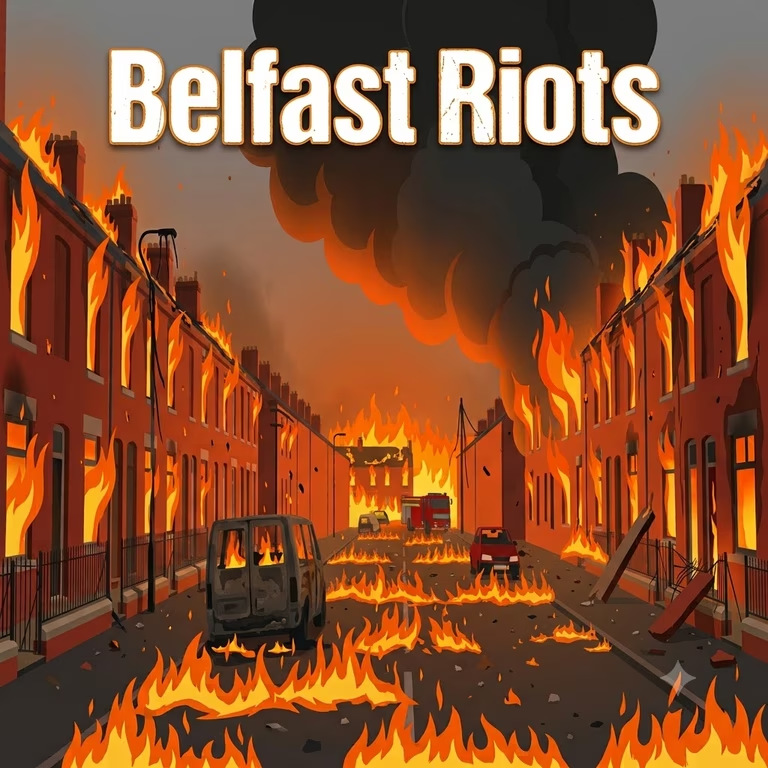
The riots began the following day on June 9th. Around 300 masked men descended into the streets and set fire to homes, businesses, buses, cars, and bins, and blocked off key roads. They went door-to-door seeking to identify the homes of immigrants. These events lasted 2 days.
As the protests erupted, Ogilvie's family spoke out to discourage the riots and said they were disgusted by the disorder. They stated that migrants make a valuable contribution to society and pleaded that the tragedy not be used to divide communities.
The Police responded with water cannons and police dogs in an attempt to disperse crowds. Rioters threw objects at the police, resulting in 12 officers being injured. 19 people were arrested.
The arson attacks left at least 27 people homeless.
Connected protests were also reported across other areas of Northern Ireland and also in Glasgow, Edinburgh, and Southampton.
“That is racist thuggery, there’s no question about it at all.” - Hilary Benn, Northern Ireland Secretary of State.
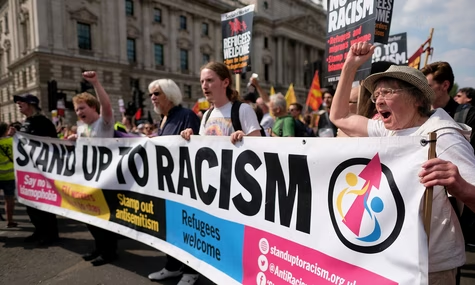
A few days later, on June 13th, in a demonstration of solidarity, thousands attended the "Together Against Hate" rally organised by the group United Against Racism.
The Far-Right Narrative
This is not the first time that the violent acts of an individual have been used to justify racial pogroms.
“It fits into the current trend of trigger events where something horrifying happens and is then attached to an existing narrative being pushed by the far right, with mass migration being promoted as the reason” - Joe Mulhall, the director of research at Hope Not Hate.
Similar events took place in Dublin in 2023 and in Southport, England in 2024. Both times, a shocking but isolated crime involving a foreign-born suspect was quickly shifted into a broader incrimination of all migrants.
The Role Of Social Media & Foreign Interference
Clips of the initial knife attack were shared online almost immediately after ithappened. The scenes were horrific and were freely accessible without any warnings, including to millions of children.
Several accounts inaccurately claimed the victim to be a teenage boy. Others falsely announced the attacker to be of Somali descent, leading to a wave of anti-Somali hate to spread online.
This disinformation was spread widely, even by Restore Britain leader Rupert Lowe MP, who went on to say that his party would deport all Somalis.
The speed at which disinformation spreads on social media is a complete platform failure. X eventually added age-related restrictions and a warning to the video. But by Tuesday afternoon it had reached 52,000 views.
There is no reason for violent content to be so publicly available, particularly to children. The role of social media platforms in allowing this and in allowing the rapid spread of disinformation must not go unchecked.

Reactions to the video by far-right activists, organisations, and even loyalist paramilitary groups ignored the individual nature of the attack. Instead, they created a narrative that depicted all immigrants as a security threat. Influential figures such as Tommy Robinson repeatedly called for protests and incited violence by retweeting a post that said: “Torches and pitchforks time is past due”.
Among many others, Robinson also posted address lists of Houses in Multiple Occupation, the primary form of accommodation used to house asylum seekers, which were leaked online and shared widely, with users urging people to take action.
The addresses and personal information of immigration lawyers were also released online.
The Centre for Countering Digital Hate highlighted how misinformation and hate speech were heavily amplified online. X owner Elon Musk shared posts by Robinson and repeatedly called for protests to his 240 million followers.
The government has left any official reprimand of X and Elon Musk to Ofcom. A move that will most likely result in nothing more than a slap on the wrist.
Political Response & Solidarity
There is no denying that immigration has emerged as one of voters' top concerns, but despite this, the vast majority say recent riots ‘brought shame on Northern Ireland’.
Keir Starmer, the now ex-Prime Minister of the UK, described the stabbing as "abhorrent" and condemned the subsequent riots.
In a rare joint statement, the five main political parties in Northern Ireland called for calm. They reiterated that there is "no place in our society for this kind of brutality".
The United Against Racism protest drew thousands of people out for a peaceful anti-racism rally which began outside the Belfast City Hall on Saturday, 13 June 2026. Speeches described the riots as planned, racist, violent, and meant to exploit fear.
Under the banner ‘Together Against Hate’, it was clear that there is far more support in Belfast for immigrants than there is for racism and senseless violence.
*****
“What we witnessed was not legitimate protest. It was organised, planned racist violence.” - Patrick Corrigan, NI Director, Amnesty International UK.
It is well known that the immigrant-threat narrative is a common tool used by the far right to create a villain and a simple solution to the issue of violent crime.
The Belfast riots were organised and fuelled through established far-right networks that are experienced in circulating viral footage, creating enemies, and mobilising people into the streets.
Not only are they well organised, but they have the backing of tech billionaires who not only allow hateful narratives and misinformation to circulate, but actually spread it themselves.
Social media platforms benefit from civil unrest and polarisation as it generates higher engagement; it gives them the ability to shape public discourse to meet their own agendas, and it gives them political leverage to avoid stricter regulation.
This incident, like others before it, quickly became a story about all immigrants, and future crimes will likely be manipulated in the same way.
The horrific stabbing and the subsequent riots have had profound effects on Belfast and internationally. It has left people from minority backgrounds in Northern Ireland living in “terror and fear”.
Responding with violence and disorder to a genuine public concern is never the answer.
What it did instead was result in the largest anti-racism rally in the city's history, proving that violent factions do not represent the city's majority.
Author: Rachael Mellor, 23.07.26, licensed under CC BY-SA 4.0
More Resources
Curated Directory & Deep-Dive Resources on Belfast Riots (2026)
- JRCT - Antiracist Toolkit NI 520225
- Embrace NI - Ways you can help 520229
- Migrant Centre NI 520230
- Right to Remain - Northern Ireland 520231
- Police Service of Northern Ireland - PSNI 518635
- United Against Racism Belfast - Facebook 520227
- 2026 Northern Ireland Riots - Wikipedia 518184
- Three arrested following west Belfast disorder - Police Service of Northern Ireland 19.07.26 520204
- 'This behaviour is going to result in someone dying' - BBC 19.07.26 520187
- Meta investigating Facebook posts linked to inciting racially motivated riots in NI - Belfast Telegraph 17.07.26 520206
- The myths and conspiracies that triggered the UK anti-immigrant riots - Bloomberg 09.07.26 520196
- Racist riots cost Translink £1.5m - BBC 03.07.26 520200
- Why the anti-immigrant riots in Belfast made me ashamed to be a Northern Protestant - Slugger O'Toole 30.06.26 520215
- From Belfast to Washington, a familiar script of the ‘dangerous migrant’ has emerged - Conversation 24.06.26 520188
- Seeking peace after anti-immigration riots in Northern Ireland - WNG 22.06.26 520234
- The Belfast riots: an anti-migrant ‘pogrom’ - The Week 20.06.26 520195
- Belfast volunteers rally to support residents as city settles in aftermath of racial and anti-migrant violence - Info Migrants 19.06.26 520232
- 'There really is something special about Belfast': Community response to race riots praised - Belfast Telegraph 19.06.26 520203
- Riots have 'made us want to leave Belfast' after home destroyed in blaze - BBC 17.06.26 520240
- Indifference to suffering amid Belfast riots - Guardian 16.06.26 520191
- Video: Major Antiracist Rally Held in Belfast to Condemn Anti-Immigrant Riots Egged On by Elon Musk - DN! 15.06.26 520221
- Northern Ireland has a racism problem, not an immigration problem - Belfast rally - Amnesty 15.06.26 520228
- Thousands gather for anti-racism rally in Belfast after disorder - BBC 14.06.26 518637
- Video: 'It's just dystopian': Belfast communities left 'terrified' after anti-immigrant riots - Sky News 14.06.26 520189
- This week's unrest in Belfast was a masterclass in how to incite a racist riot on social media - The Journal 14.06.26 520211
- Video: Communities in Belfast mobilise in response to racist riots - MEE 14.06.26 520233
- Anti-racism rally disrupted by masked group in Glasgow - BBC 13.06.26 518636
- Elon Musk's role was 'instrumental' in the Belfast riots, researchers say - Le Monde 13.06.26 520214
- Thousands gather for anti-racism rally in Belfast after disorder - BBC 13.06.26 518187
- Thousands attend anti-racism rallies following unrest in Belfast - Al Jazeera 13.06.26 518185
- Thousands rally in Belfast to condemn anti-immigrant rioting that followed stabbing - PBS 13.06.26 520190
- Elon Musk's role was 'instrumental' in the Belfast riots, researchers say - Le Monde 13.06.26 520192
- Belfast anti-immigrant riots show long legacy of sectarian violence - France24 13.06.26 520194
- The night people in Belfast fled their homes because of racist violence - BBC 13.06.26 520237
- A White Supremacist Youth Group Helped Orchestrate the Belfast Riots - Wired 12.06.26 520197
- Lists of Belfast addresses said to be immigrant homes circulated online amid riots in wake of stabbing - CBS 12.06.26 520198
- Riots, violence, hate: Anti-immigrant unrest spells danger in Belfast - Al Jazeera 12.06.26 520199
- What we know about how Northern Ireland's riots were organised - BBC 12.06.26 520207
- ‘Northern Ireland Does Not Have an Immigration Problem, It Has a Problem With Violence’ - Byline Times 12.06.26 520217
- Lendrick Street, a snapshot that explains violence against immigrants in Belfast - El Pais 12.06.26 520220
- VIDEO: Belfast: What You’re NOT Being Told - w/. Sarah Creighton - Owen Jones 11.06.26 518182
- Racist riots in Belfast recall the darkest days of the troubles - BIJ 11.06.26 520193
- They were driven from their homelands by violence – now Belfast riots have placed refugees under fresh attack - Independent 11.06.26 520202
- Elon Musk under fire for stoking anti-immigrant riots in Belfast - NBC 11.06.26 520212
- ‘Toxic’ social media overwhelms police response to Belfast violence - FT 11.06.26 520213
- What is the truth behind immigration figures in Northern Ireland? - Irish News 11.06.26 520218
- How migration surge changed Belfast - Telegraph 11.06.26 520219
- Video: Belfast riots: Who is to blame for anti-migrant violence? - MEE 11.06.26 520222
- Between fear and chaos: Migrants in Belfast wake up to destruction and questions about the future - Info Migrants 11.06.26 520216
- Racist violence and intimidation in Northern Ireland must be stopped - FIDH 11.06.26 520226
- Police were warned for months about addresses targeted in Belfast riots - Guardian 11.06.26 520235
- Video: The truth about the Belfast riots | Claire Hanna interview - PoliticsJOE 10.06.26 518183
- Why has Belfast erupted in anti-immigrant violence after a knife attack? - Al Jazeera 10.06.26 518186
- Social media platforms warned over role in fuelling Belfast riots - FT 10.06.26 520201
- Open letter to UK online service providers regarding civil unrest in Belfast - OFCOM 10.06.26 520208
- Belfast unrest shows the power of social media as far‑right views on immigration enter the mainstream - Conversation 10.06.26 520209
- Video: UK watchdog warns online platforms as Belfast riots go viral - France24 10.06.26 520210
- Video: Why There Is Zero Justification For Violence In Northern Ireland - Chris Philp MP 10.06.26 520223
- Disorder in Belfast ‘stoked by those who would struggle to find the city on a map’ - Guardian 10.06.26 520224
- I will never get over watching my home of 13 years burn down - BBC 10.06.26 520236
- ‘It was so terrifying’: care workers tell of being trapped at home by Belfast mob - Guardian 10.06.26 520238
- Belfast violence: an uncomfortable reminder of the innocent people ‘burnt out’ during the Troubles - Conversation 10.06.26 520239
- Masked rioters go door-to-door in Belfast burning migrants’ homes and targeting foreign-owned businesses after knife attack - LBC 10.06.26 520241
- As Belfast picks up the pieces from day of disorder, police vow rioters will face ‘full force of the law’ - Irish News 04.08.24 520205