LGBTQI+ Community
Explore comprehensive LGBTQI+ resources, human rights guides, and social justice topics. Raise awareness, support equal rights, and celebrate diversity worldwide.
THE LGBTQIA+ COMMUNITY - A New Era of Pride & Celebration of Diversity
Discover the vibrant LGBTQI+ community and learn how we can all actively support individuals and advocate for the community as a whole. Our informative guide offers you in-depth information on LGBTQI+ rights, diversity, and equal protections.
Connect with hundreds of valuable resources, initiatives, and organisations – for genuine social inclusion, improved legal equality, and a future free from discrimination, persecution, and violence.
Jump straight to our resources on the ➡️ LGBTQIA+ Community
*****
General Information
LGBTQIA+ is a community and acronym that encompasses a wide range of identities and sexual orientations. It is an inclusive umbrella for sexual and gender minorities.
Studies suggest that up to 9% of the global population may identify as part of this community. Generation Z, those born after 1997, are more than twice as likely to identify as bisexual, pansexual or asexual than millennials, and more than four times as likely as those in older generations.
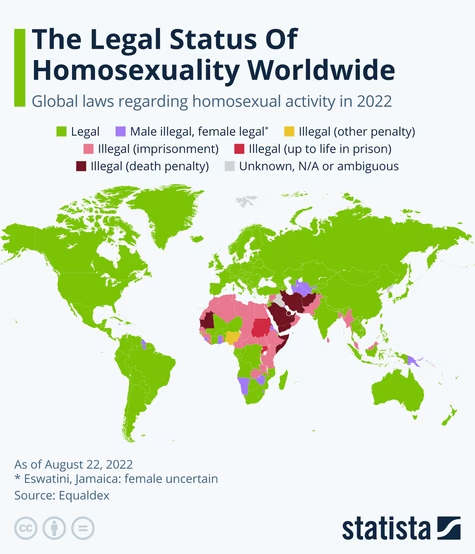
Devestatingly, major issues arise for many of those who identify with a minority sexuality, and the severity of the situation varies depending on geographical location. In 2026, there are still 65 countries that criminalise same-sex sexual relations. In 12 of these countries, it is punishable by death.
Although acceptance rates are increasing and legalisation efforts are taking shape, discrimination, violence, hate crimes, stigmas, and stereotypes are sadly still part of the daily reality for many in the LGBTQIA+ community.
"Equality means more than passing laws. The struggle is really won in the hearts and minds of the community, where it really counts" - American LGBTQ activist Barbara Gittings
Explore our comprehensive guide on International Day Against Homophobia, Biphobia & Transphobia - May 17.
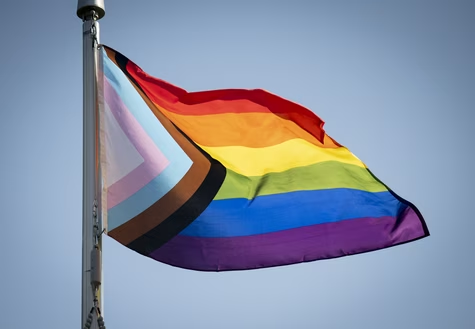
LGBTQIA+ Acronym Breakdown
- L = Lesbian: Women who are romantically or sexually attracted to other women.
- G = Gay: Men who are romantically or sexually attracted to other men.
- B = Bisexual: People who are romantically or sexually attracted to more than one gender.
- T = Transgender: People whose gender identity is different to the sex assigned to them at birth.
- Q = Queer: An umbrella term for people who do not fit into the traditional categories of gender and sexuality or who consciously adopt a non-heteronormative identity.
- I = Intersex: People who are born with physical sex characteristics that are not clearly male or female.
- A = Asexual or Agender: Asexual refers to people who experience little to no sexual attraction. Agender refers to people who do not identify with either gender.
- Plus symbol (+): Other identities and sexual orientations that are not explicitly covered by the letters of the acronym, but are also part of the community.
Eyeopening Facts
- Capital punishment for homosexuality exists in Brunei, Iran, Mauritania, Saudi Arabia, Yemen, Somalia, Uganda, and parts of Nigeria.
- Same-sex marriage is legally recognised in 35 countries as of early 2026. These countries are primarily in Europe and the Americas.
- Transgender people face intense violence and discrimination. Less than 1% of the global population is estimated to be trans, yet over 83% report verbal abuse and 56% report physical attacks.
- Only 12 countries give legal gender recognition based on self-determination to people identifying as trans.
- Intolerance to the community is highest in parts of the Middle East, Africa, and Asia.
- An estimated 14% of LGBTQIA+ individuals have avoided medical treatment due to fear of discrimination.
- At work, more than a third of staff who identify as LGBTQIA+ hide their identity to avoid discrimination.
- LGBTQIA+ people face significantly higher risks of anxiety and depression due to stigma. In a separate study, almost half of trans people had considered taking their own life.
- About 18% of LGBTQIA+ people have experienced homelessness at some point in their lives.
- Globally, the average level of acceptance for LGBTQ+ people has increased since 1980. Based on legal rights and public opinion, the most LGBTQIA+ friendly places are Iceland, Norway, the Netherlands, Sweden, Canada, and Malta.
- Despite historically low acceptance rates, some countries in Africa and Asia are experiencing significant increases, including South Africa and India.
- Inclusive LGBTQIA+ laws and policies are strongly connected to better health outcomes, including reduced HIV incidence among gay and bisexual men.
- Media representation of the LGBTQIA+ community reached record highs in 2022, promoting broader social understanding.
Challenges For The LGBTQIA+ Community
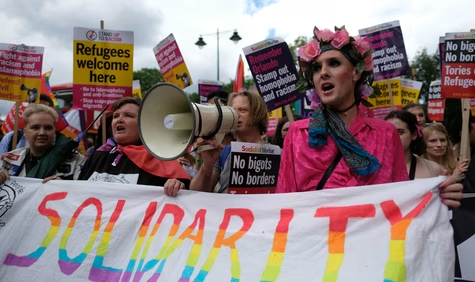
Those identifying as members of this community face a multitude of challenges and rights issues, both individually and structurally. The severity of these issues depends heavily on the region and cultural context. Common issues include:
DISCRIMINATION & STIGMATISATION -
In society, the workplace, and education, prejudices and negative stereotypes lead to exclusion and marginalisation. In the vast majority of countries, there are no legal safeguards in workplaces. In schools and universities, students can be ostracised. In both instances, it results in negative outcomes for LGBTQIA+ people.
LEGAL INEQUALITY -
In many countries, marriage and adoption are not legally permitted. Transgender and non-binary people are unable to get their gender identity legally recognised making it harder for them to access important documents and services. Where homosexuality is criminalised, arrests, violence, and forced conversion therapy are huge violations of human rights. So called 'anti-gay' laws bleed into society legitamising discrimination and violence.
VIOLENCE & HATE CRIMES -
LGBTQIA+ people are a common target of hate crimes, including physical assaults, sexual violence, and even murder. There were roughly between 281 and 350 trans/gender-diverse murders globally every year between 2023 and 2025. Brazil is a hotspot for transgender murders. In 2025, 30% of global cases took place in the Latin American country that has held the top spot for the 18th consecutive year. Transgender women of colour are the most disproportionately affected group of violence and hate crimes within the community.
HEALTH INEQUALITIES -
Discrimination and social rejection mean that LGBTQIA+ people have a higher risk of mental health problems, including suicidality. A report from 2021 indicates that 24% of LGBTQIA+ young people who had reported physical harm or threats had attempted suicide in the previous 12 months.
Barriers to accessing adequate medical care, especially for transgender people who require gender-affirming measures, are another huge challenge.
HIV/AIDS disproportionately affects gay and bisexual men worldwide. Devestatingly, access to prevention and treatment measures is still often inadequate as millions still lack access to life-saving drugs.
SOCIAL ISOLATION & EXCLUSION -
Many members of the LGBTQIA+ community experience rejection or exclusion by their families after they come out. This is especially prevalent in areas with high levels of discrimination. Lack of education, fear, customs, traditions, and religion all contribute to a climate of social isolation and even homelessness. In many regions, there is a complete lack of community, support, or organisations and so feelings of isolation are reinforced.
ECONOMIC INEQUALITY -
Workplace discrimination and a lack of legal protections mean that LGBTQIA+ people are more frequently affected by unemployment and poverty. Young people in the community are also disproportionately affected by homelessness, usually as a result of family rejection.
LACK OF POLITICAL REPRESENTATION -
As a minority, LGBTQIA+ people are massively underrepresented in politics. This means that their specific needs and issues are not adequately addressed in legislation and policymaking. As of 2020, only 0.5% of the world's parliamentarians were openly LGBTQIA+. Candidates often face "electoral penalties" and voter prejudice meaning that the incentive to become involved in the first place is low. The election of these individuals is crucial for addressing equal rights and combating discrimination in political processes.
The Influence Of Far-Right Politics & Media Outlets
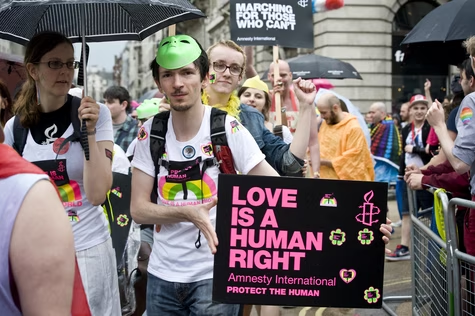
Far-right politics and media groups are playing an increasingly significant role in targeting the LGBTQIA+ community, weaponising rights issues, and serving their own agendas. Their ideological beliefs are often based on intolerance, hatred, and the rejection of diversity, leading to targeted attacks, discriminatory legislation, and negative outcomes for the LGBTQIA+ community.
Extremists go as far as promoting physical violence against this group ranging from assaults in the street to organised attacks on events and organisations. This behaviour is terrorising the community and marginalising them even further.
In Germany, the number of registered hate crimes against LGBTQIA+ people has risen steadily in recent years. In 2020, over 782 homophobic or transphobic offences were registered, many of them with right-wing extremist motivations.
In the U.S., far-right groups have specifically targeted or disrupted LGBTQIA+ events. The 2016 attack on Pulse nightclub in Orlando, in which 49 people were killed, is just one example.
In some Eastern European countries such as Poland and Hungary, right-wing governments have adopted a hostile stance towards the community declaring "LGBTQIA+ free zones". In these countries and in Russia, Pride parades have been the victim of attacks by far-right groups.
LGBTQIA+ Rights Are Human Rights
To combat violence, discrimination, and any other harm or inequalities against the LGBTQIA+ community, various measures are needed:
- Strengthened legislation: Introducing and enforcing laws that specifically punish hate crimes and provide legal protection for victims.
- Education and awareness programs: Promoting tolerance, acceptance, and inclusion through educational campaigns that combat homophobia, transphobia, and right-wing extremism.
- Support for the community and victims: Specialised centres provide psychological and legal support for those who need it. They can also help with questions about sexual orientation, gender identity, coming out, and other social issues. Many of these centres also offer community events, workshops, and recreational activities to meet others. Online platforms and hotlines also offer valuable support if there isn't a physical centre nearby.
- Monitoring and dissolution of extremist groups: Active monitoring of right-wing extremist groups is essential. If these groups are found to be inciting or perpetrating violence, they must be shut down.
Pride Parades - Annual Celebrations of Self-Acceptance, Rights & Visibility
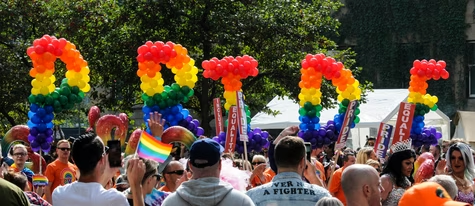
Pride events are crucial for promoting LGBTQIA+ visibility, fostering community, and fighting for equality. They serve as a vibrant celebration of identity and a powerful protest against discrimination.
Many pride events are organised in June to commemorate the Stonewall riots which began on June 28, 1969. These protests, which later evolved into riots, were against police raids which targeted LGBTQIA+ spaces. This uprising helped to catalysed the modern LGBTQIA+ rights movement.
Millions of people in cities around the world take to the streets each year to demonstrate for the rights and visibility of LGBTQIA+ people and show their support as allies. Beyond celebrating diversity and love, Pride demonstrations are also a protest against discrimination, violence, and inequality.
The first Pride march (Christopher Street Liberation Day) took place in 1970 to mark the first anniversary of the rebellion. Some of the biggest pride events take place in Sao Paulo, Sydney, Amsterdam, London, Berlin, and Madrid.

*****
The future of the LGBTQIA+ community lies on a path characterised by empowerment, acceptance, and education. Empowerment means that everyone in the community can live their true identities confidently and actively demand their rights.
Through social acceptance, diversity is not only tolerated but valued, leading to a more inclusive world. Children should be educated about diversity from an early age to dismantle prejudices and foster respect.
The hope is that the next generation will grow up in an environment where love, identity, and self-determination are valued. A future in which all people, regardless of their sexual orientation or gender identity, can live in dignity and freedom.
"We declare that human rights are for all of us, all the time: whoever we are and wherever we are from; no matter our class, our opinions, our sexual orientation." - Ban Ki-moon
Author: Jasmin, August 21, 2024. Translated and edited by Rachael Mellor 20.04.26, latest update 07.09.26, licensed under CC BY-SA 4.0
More Resources