
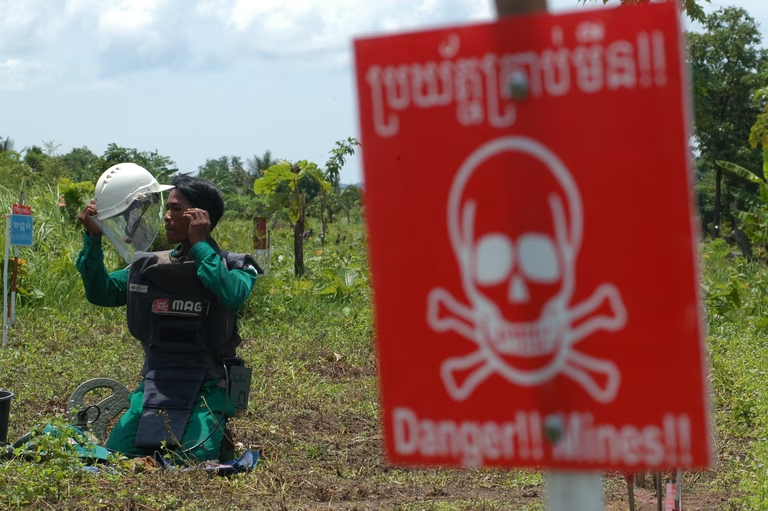
Mine Ban Treaty
The Ottawa Treaty was adopted in 1997 and signed by 160 countries – Prohibition of the use, stockpile, production| Victim assistance mine clearance
The Mine Ban Treaty, formally known as the Ottawa Treaty, represents a landmark in global disarmament efforts. Adopted in 1997, this treaty aims to eliminate the use, stockpiling, production, and transfer of anti-personnel landmines. It reflects a collective commitment to reducing the human suffering caused by these indiscriminate weapons, which continue to pose a threat long after conflicts have ended.
The treaty has been a significant step forward in international humanitarian law, emphasizing the protection of civilians and the promotion of peace. Since its inception, it has garnered widespread support, with over 160 countries committing to its principles. The treaty not only mandates the destruction of existing stockpiles but also requires signatories to clear mined areas and assist victims.
The Ottawa Treaty underscores a global consensus that the humanitarian costs of landmines far outweigh any perceived military advantages. Its success is evident in the significant reduction of landmine casualties and the increased funding for mine clearance operations. However, challenges remain, as some major military powers have yet to join. Nonetheless, the treaty stands as a testament to the power of international cooperation in addressing pressing global issues.
More Resources
Curated Directory & Deep-Dive Resources on Mine Ban Treaty
- Anti-Personnel Mine Ban Convention 382691
- International Campaign to Ban Landmines - The Treaty 382692
- International Campaign to Ban Landmines - Treaty Status 382693
- Ottawa Treaty - Wikipedia 382694
- @UNMAS 400021
- @MineBanTreaty 382699
- @minefreeworld 400014
- #MineBanTreaty25 400022
- #25YrMineBanPartnership 400023
- #25MBT 400016
- #MineFreeWorld 400017
- #MineAction 400020
- #MineBanConvention 400012
- #MineSurvivorsRights 400011
- Why landmines are back in force despite international bans - DW 26.08.26 522205
- Ukraine Withdraws from Landmine Ban Treaty, Following Poland, Finland and Baltic States - DN! 30.06.25 476720
- Why is Ukraine withdrawing from the Ottawa Treaty banning landmines? - Al Jazeera 30.06.25 479749
- Expressing Concern over Withdrawals from Mine Ban Convention, Secretary-General Announces Global Humanitarian Disarmament Campaign - UN 16.06.25 476719
- Leaving the Landmine Ban Treaty Puts Civilians at Risk - HRW 16.06.25 476721
- ICRC president: Civilians will pay the price if global commitment to ban landmines allowed to fracture - ICRC 16.06.25 476722
- Tweet: Today marks the 25th anniversary of the @MineBanTreaty entry into force! On this important occasion, the ICBL calls for redoubling efforts in view... - Mine Ban Treaty… 400015
- Tweet: #OnThisDay in 1999 the Mine Ban Treaty came into force, so children like Elsa, who lost her eye in a landmine accident, can grow up in a safer world. - @NobelPrize 01… 400013
- Tweet: Signed in December 1997, the @MineBanTreaty came into force exactly 25 years ago, on 1 March 1999, establishing a global prohibition on any #use, #production, #stockpi… 400018
- How clearing landmines can save an entire community - Vatican News 29.02.24 400019
- Cambodia ready to host the 5th Review Conference of Mine Ban Treaty - Khmer Times 18.10.23 382779
- Ukraine Promises Inquiry into Banned Landmine Use - HRW 30.06.23 382778
- The Mine Ban Treaty: How the world decided to bury the use of mines - Arab News 03.04.23 382776
- The Mine Ban Treaty: 25 years on - Relief Web 02.12.22 382697
- The origins and influence of victim assistance: Contributions of the Mine Ban Treaty, Convention on the Rights of Persons with Disabilities and Convention on Cluster Munition… 382777
- Growing calls for Finland to withdraw from Ottawa Mine Ban Treaty - Euractiv 03.03.22 382702
- Mine Ban convention - "20 years of protection. Celebrating 20 years since the Mine Ban Treaty entered into force" - OHCHR 01.03.19 382700
- Convention on the Prohibition of the Use, Stockpiling, Production and Transfer of Anti-Personnel Mines and on their Destruction - UN Treaty Collection 18.09.97 382695
- Convention on the prohibition of the use, stockpiling, production and transfer of anti-personnel mines and on their destruction - NTI, 1997 382775