
International Migrants Day - December 18
Learn about International Migrants Day on Dec 18. Discover the UN initiative, migrant rights, protection frameworks, and how migration enriches societies.
INTERNATIONAL MIGRANTS DAY, December 18 - Protecting Migrant Rights & Ending The Stigma
Discover the complex world of forced migration and learn how nations can actively protect vulnerable populations. Our guide offers you in-depth information on international protection, systemic equity, and migrant rights.
Connect with valuable resources, initiatives, and organisations – for genuine human dignity and improved migrant welfare.
Jump straight to our resources on ➡️ Migrants Day
*****
General Information
Established in 2000, the UN General Assembly began celebrating International Migrants Day to honour the contributions of millions of migrants worldwide and to promote their protection and the respect for their rights.
On December 18, 1990, the UN adopted the International Convention on the Protection of the Rights of All Migrant Workers and Members of Their Families (CMW). The treaty sets out guidelines and protections to promote migrant workers' rights and reiterates that migrants are not only workers but also human beings.
Unfortunately, the treaty has been ratified by only 60 countries, making it one of the least supported UN treaties. None of the countries hosting the highest numbers of migrants, including the U.S., the UK, Germany, France, the UAE, and Qatar, has signed.
As of 2024, the global number of international migrants was 304 million – double the number since 1990. Increasingly complex drivers of their relocation, including conflict, climate change, and economic crisis, mean a greater need to support migrant journeys, promote integration, ensure their rights are upheld, and also to understand and tackle the root causes.
Please share this useful resource on Twitter, Bluesky, Instagram, Facebook, and LinkedIn
Explore our comprehensive guides on undocumented migrants, migration and international development, refugees and migrants in the UK, U.S., and France, migrant caravans from Latin America, women and child migrants, migrant workers in Qatar, and the Committee of Experts on Intercultural Inclusion (ADI-INT).
German readers will find more information on Bessere Welt Info.
"Migrants and refugees are not pawns on the chessboard of humanity. They are children, women, and men who leave or who are forced to leave their homes for various reasons, who share a legitimate desire for knowing and having, but above all for being, more." - Pope Francis.
Key Drivers Of Migration
While most people migrate by choice, others do so out of necessity. The primary driver for the vast majority of migrants is the betterment of their lives and that of their families.
ECONOMIC DRIVERS - Rising inequalities and the ever-increasing gap between the rich and the poor push people to seek better employment opportunities and higher wages. Inflation, economic crises, and a lack of decent and safe work have made it impossible to cover even basic needs in some areas.
SOCIAL DRIVERS - A common reason for migration is family reunification, where a family member has already made a better life for themselves elsewhere, and other family members wish to join them. Well-established migrant communities make the prospect of moving to another country more appealing. Better educational opportunities for young people, especially at the university level, are also attractive.
POLITICAL DRIVERS - This type of migration is usually forced as migrants' home countries become unlivable due to various reasons, including conflict, violence, persecution, a breakdown of law and democracy, repression, and the removal of political/civil rights.
ENVIRONMENTAL DRIVERS - We are already witnessing the serious consequences of our changing climate. Natural disasters are on the rise, and some countries are more vulnerable than others. Floods, droughts, desertification, hurricanes, earthquakes, and other disasters make areas unlivable, land unfarmable, and strip civilians of all essential infrastructure. People under these circumstances do not want to leave their homes and land but must seek opportunities elsewhere just to feed their families.
International Organisation For Migration (IOM)
Established in 1951, the IOM works to ensure the orderly and humane management of migration. It was founded after the Second World War to assist with the large numbers of war refugees and displaced persons. In 1992, the organisation joined the United Nations to expand its capacity to help growing numbers of migrants.
Their main work is to promote international cooperation on key migration issues and provide humanitarian assistance to migrants, refugees, and internally displaced persons who need it.
Their three primary objectives are:
-
Saving lives and protecting people on the move.
-
Finding solutions to the root causes of displacement.
-
Supporting pathways for safe, regular and orderly migration.
In 2018, with the support of the IOM, the first-ever intergovernmental agreement on migration, the Global Compact for Migration, was adopted. It outlines 23 objectives regarding the management of migration, the protection of migrants' rights, and the promotion of greater cooperation between countries. It also works as a toolkit to help countries improve their migration policies. Former UN Secretary-General António Guterres established the UN Network on Migration shortly after to support its implementation.
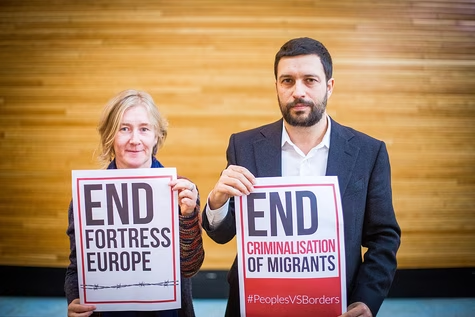
The Growth Of Anti-Immigration Sentiment
In recent years, an influx of migration has led to increasing hostility and negative stereotypes spread through misinformation, harmful political narratives, and dangerous social media campaigns.
Far-right political parties use immigration to push their agendas. They create fear by exaggerating issues, framing migrants as a threat to safety, our jobs, our homes, and our culture. Reform UK, a right-wing political party in Britain, have adopted this strategy to gain popularity and political support. The result was widespread anti-immigration protests, violent disorder, and rioting, which in 2024 and 2025 led to hundreds of arrests and injuries to police officers.
Statistics confirm that there is no relationship between migration and crime. Claims that migrants take jobs and commit crimes are baseless. In fact, migrants often fill undesirable jobs and boost the economy overall. When migration is managed safely and responsibly, it is a powerful force for good.
The vilification and criminalisation of migrants must end. Stigmas result in social exclusion, hinder their integration, create discrimination, increase the risk of depression and anxiety, and fuel violence and racial attacks against migrants.
The criminalisation of migrants leads to human rights violations, higher numbers of migrant deaths, harsh penalties, restrictions on humanitarian aid, the removal of legal representation, and increased separation of families. We must not turn humane and responsible migration control into a criminal justice issue.
Key Statistics On Migration
-
Since 2014, more than 72,000 migrants have died or gone missing in their attempt to seek out a better life. The true number is likely much higher. More than 50% of these incidents were at sea.
-
The deadliest migration route is the Central Mediterranean. In these waters, at least 24,000 people have lost their lives.
-
In 2024, more than 8,000 migrants in transit lost their lives, making it the deadliest year on record.
-
Record levels of conflict, economic instability, and the climate crisis are driving an unprecedented need for humanitarian aid.
-
The first-ever International Migration Review Forum took place in 2022 to review the implementation of the Global Compact for Migration.
-
A 2020 study in London estimated that every migrant worker boosts the economy by a net £46,000 in Gross Value Added (GVA) per annum.
-
Migrants often send money back to their families and communities. These remittances in 2024 were worth a staggering $905 billion. This money helps reduce poverty, boosts the economies of developing nations, and increases financial inclusion for recipients.
-
Migrant workers face significantly higher risks of labour exploitation. They are three times more vulnerable to forced labour. They are also much more likely to work under dangerous conditions, for excessive hours, be subjected to verbal and/or physical abuse, live in inadequate housing, and work for money far below the legal minimum wage.
-
Recruitment fees for migrants can exceed up to 20 times their salary, trapping them in a cycle of debt.
-
Sectors which are high risk for migrant worker exploitation include agriculture, the fishing industry, construction, manufacturing, domestic work, and the care sector.
-
Hotspots for modern slavery and migrant abuse are Saudi Arabia, the UAE, Kuwait, and Türkiye
-
With the highest proportion of migrant workers in the world, the UAE is home to 8.7 million migrant workers. They make up a massive 88% of its population. These people are predominantly unskilled and low-paid.
-
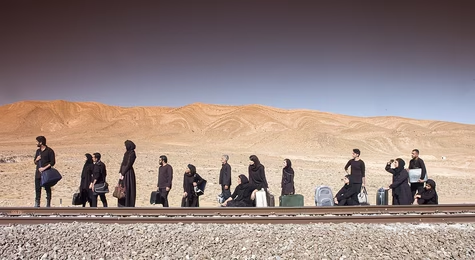
Labour migration in many Arab states is governed by the restrictive and abusive Kafala system. Sponsorship permits tying migrant workers to their employers, strips them of many of their rights, excludes them from society, and prevents them from reporting abuse and exploitation.
*****
Safe and well-managed migration holds extraordinary potential. They play crucial roles in labour markets, filling skills gaps, driving innovation and entrepreneurship, and reducing demographic imbalances in ageing societies. Migrants also boost economic growth, drive development, and provide an essential lifeline for their families back home.
Despite this, we are failing at our collective responsibility to protect these people during their most vulnerable time. Sustainable Development Goal 10.7 calls on countries to "facilitate orderly, safe, regular and responsible migration and mobility of people, including through the implementation of planned and well-managed migration policies". With less than 20% of all SDG targets on track, progress has been alarmingly slow.
We must support regular pathways for migration, promote opportunities for their success and integration, provide better protection of their rights, and recognise the benefits that they bring to the countries they leave and the ones that host them.
The issue of migration is a human rights issue. Let's use International Migrants Day to raise awareness, support those in need, work towards solving the root causes of migration, and spread the word that migrants are key to our bright, prosperous, and multicultural future.
"It is time to take a more comprehensive look at the various dimensions of the migration issue, which now involves hundreds of millions of people, and affects countries of origin, transit and destination. We need to understand better the causes of international flows of people and their complex interrelationship with development." - Kofi Annan
Author: Rachael Mellor, 08.12.25, latest update 31.08.26, licensed under CC BY-SA 4.0
More Resources
Curated Directory & Deep-Dive Resources on International Migrants Day - December 18
- International Migrants Day - United Nations 193519
- International Migrants Day, 18 December - UN 193521
- International Migrants Day - UNDP 193522
- International Migrants Day - UNESCO 193523
- International Migrants Day - Wikipedia 192982
- International Migrants Day 2024 - IOM 500748
- International Migrants Day 2023 - IOM 500747
- International Migrants Day 2022 - IOM 319834
- International Migrants Day 2021 - IOM 265440
- International Migrants Day 2025 - IISD 500751
- International Migrants Day 2024 - IISD 500750
- International Migrants Day 2023 - IISD 500749
- International Migrants Day 2022 - IISD 500746
- International Migrants Day 2021 - IISD 265442
- Global Issues: Migration - UN 193534
- International Migrants Day: Stories of Social Cohesion - IOM 228086
- Quick Facts - Time & Date 193524
- International Migrants Day - fb 193527
- Our TWEET on the topic - please share 320102
- Our Instagram post on the topic - please share 320104
- Our Facebook post on the topic - please share 320103
- @DTM_IOM - Displacement Tracking Matrix 265492
- Publication: World Migration Report 2020 (pdf) - IOM 193535
- @ICMC_news - International Catholic Migration Commission 265493
- Agenda des evenements 2020 (Europe) - EGM 228087
- Video: Int'l Migrants Day (18 December 2019) - UN Chief Message 193533
- Video: International Migrants Day 2019 - United Nations 193528
- Seminar in Bangkok Thailand - International Labour Organization 193520
- Strengthening union power with migrant workers - ITUC CSI 506820
- CReAM at RFBerlin – the Center for Research and Analysis on Migration at RFBerlin is dedicated to the production, promotion and dissemination of empirical research on migrat… 506821
- Video: IOM Senior Leadership Message on International Migrants Day 2025 - IOM/UN Migration 18.12.25 501511
- International Migrants Day 2025: WHO works to advance migrant health and strengthen health systems across migration journeys for universal health coverage - WHO 18.12.25 501510
- International Migrants Day 2025: Inside Lebanon’s Kafala System - antislavery 18.12.25 501512
- ILO calls for safe migration and decent work for Myanmar migrants on International Migrants Day - ILO 18.12.25 501513
- International Migrants Day 2025: Rights, social justice and democracy for all workers - ITUC 17.12.25 501514
- Tweet: Love global flavours or styles from afar? That’s migration at work – ideas, traditions, and creativity moving across borders to enrich our lives. - @UNmigration 15.12… 501347
- A Budding Cooperative in Mexico Helps Migrant Women Rebuild Their Lives Through Craft - IOM 12.12.25 501059
- UN Women Statement on International Migrants Day, 18 December 2025 - UN Women 11.12.25 501058
- Secretary-General's message on International Migrants Day - UN 18.12.24 445943
- International Migrants’ Day: 18 December 2024 - EPRS 18.12.24 445941
- Tweet: On International Migrants Day, we celebrate the contributions millions of migrants make to communities, economies and countries around the world. - @antonioguterres 18… 445937
- Tweet: International Migrant Day On #InternationalMigrantDay, we celebrate the contributions of migrant workers and stand up for their rights! The ITUC is strengthening union… 445938
- Tweet: Today, on #InternationalMigrantsDay, we celebrate the role of migrants in shaping inclusive, resilient cities. Let us harness migration as a force for positive change… 445939
- International Migrants Day 2024: building a healthier future for all - WHO 18.12.24 445940
- Tweet: Today is International Migrants Day. On this occasion, we reiterate our call for a more human and solidarity-based approach towards migrants. - @etuc_ces 18.12.24 445935
- Tweet: #InternationalMigrantsDay: Spotlight on Feminist Funding. Leni shares her journey from living undocumented in the U.S. to organising with deportees in Mexico, calling … 445936
- New report on international migration and sustainable development in time for International Migrants Day - UN 17.12.24 445942
- Tweet: Ahead of International Migrants Day (18 Dec), here are 5 things you may not know about migration - @FAOGeneva 14.12.24 445476
- Tweet: Whether on land or at sea, migrants deserve to be safe, to have their dignity respected. We are witnessing a steady increase in the numbers of migrants leaving their h… 445474
- Tweet: As International Migrants Day approaches, IOM Nepal happily shares Samira's inspiring story: “Studying abroad has deepened my commitment to giving back to Nepal”. Lear… 445475
- Tweet: People move for many reasons: to seek a better life, to reunite with family, to find safety. Migrants contribute to their communities in many ways, driving cultural ex… 445477
- ILO announces winners of the 10th edition of the Global Media Competition on Labour Migration - ILO 12.12.24 444863
- Message on International Migrants Day - unıs 12.12.24 445473
- Tweet: The results are in! Ahead of #InternationalMigrantsDay, the @ILO proudly announces the winners of the Global Media Competition on Labour Migration! Discover the power… 444860
- Virtual book launch of 'From uncertainty to policy: A guide to migration scenarios' on International Migrants Day - PRIO 10.12.24 444864
- Statement on International Migrants Day - UNIFOR 10.12.24 444862
- Global Compact for Safe, Orderly and Regular Migration - Report of the Secretary-General (A/79/590) - UN General Assembly 05.12.24 444793
- IOM Global Shelter and Settlements 2024-2030 Road Map - International Organization for Migration 05.12.24 444796
- IOM Innovation Facility Advances Transformative Solutions to Global Migration Challenges - International Organization for Migration 28.11.24 443006
- Global Route-Based Migration Programme 2023 Annual Update: One of the critical concerns for people on the move, at all stages of their journey, is the ability to access essen… 440779
- Türk calls for the proclamation of a Second International Decade for People of African Descent - UN Office of the High Commissioner for Human Rights 08.11.24 441786
- Unveiling the perils and hope of irregular migration on International Migrants Day - WHO 18.12.23 389622
- United Nations Network on Migration in the Arab Region Celebrates International Migrants Day - “Migration and Development go Hand in Hand” - IOM 18.12.23 389623
- Tweet: Today is International Migrants Day. All people on the move should be treated with dignity and respect for their basic human rights — regardless of the reason for thei… 389614
- Joint statement by the European Commission and the High Representative on International Migrants Day - European Commission 18.12.23 389621
- Tweet: This #InternationalMigrantsDay we need more than ever to hear the voices of those most affected, and what they want to speak out about it. Here is our Birmingham Netw… 389619
- International Migrants Day Spotlights Need For More Humane Immigration System - SPLC 18.12.23 389613
- Int'l Migrants Day: Salesian Missions highlights programs that support young migrants - Mission News Wire 18.12.23 389624
- Secretary-General, in International Migrants Day Message, Urges Humane, Orderly Management of Migration to Secure Safer, More Prosperous Future for All - UN 14.12.23 389222
- Winners of 2023 ILO Global Media Competition on Labour Migration announced - ILO 14.12.23 389221
- Experts convene to discuss migration governance ahead of International Migrants Day - OSCE 14.12.23 389223
- Can migration address the workforce needs in the care sector for aging populations? - World Bank 14.12.23 389220
- Fleeing Home, Chasing Hope: The Refugee And Migrant Experience - RFERL 11.12.23 388150
- Putting their Stamp on International Migrants Day - IOM 11.12.23 388151
- Immigration justice week of action set to begin on Human Rights Day - AFSC 08.12.23 388152
- International Migrants Day 2022: Stories from the deadly Darién Gap - Relief Web 20.12.22 321284
- Video: More than 16,000 workers celebrate International Migrants Day in Singapore - Channel News Asia 19.12.22 321287
- Message by United Nations High Commissioner for Human Rights on International Migrants Day 2022 - OHCHR 18.12.22 321280
- Time to act on health systems that include migrants - WHO 18.12.22 321278
- Fresh criticism for Qatar and FIFA as World Cup ends on International Migrants Day - CNN 18.12.22 321288
- International Migrants Day: 280 million people leave home for ‘a better life’ - Global Issues 17.12.22 321286
- Online event - International Migrants Day Conference 2022 - Asian Research Centre for Migration 16.12.22 319837
- International Migrants Day: Why UNODC combats migrant smugglers - UNODC 16.12.22 321283
- International Migrants Day: migrants, refugees and asylum seekers are welcome - ITUC CSI IGB 16.12.22 321279
- Who will be our migrants of the future? Celebrating International Migrants’ Day with a keen eye on the growing gender gap - World Bank Blogs 16.12.22 321285
- International Migrants’ Day Event: Exploring migration and human security - UNDP Human Development Reports 14.12.22 321282
- Video: International Migrants Day 2022 with Storytellers for Peace - Storytellers for Peace 08.12.22 319148
- World Day of Migrants and Refugees: Salesian Missions highlights life-changing programs - Salesian Missions 25.09.22 307598
- World Day of Migrants and Refugees 2022: Building the future together - Jesuit Refugee Service 14.09.22 305431
- Migration Health: 2021 Impact Overview - IOM 16.08.22 300879
- Skills and labour market transitions for refugees and host communities - Deutsche Gesellschaft für Internationale Zusammenarbeit (GIZ) GmbH, Finn Church Aid, International L… 297473
- Our Tweet on the topic 12/21 265724
- Our Facebook post on the topic 12/21 265725
- Our Instagram post on the topic 12/21 265726
- International Migrants Day – Migrant Lives Matter - Scoop 16.12.21 265458
- Migrant workers still at great risk despite key role in global economy - UN News 16.12.21 265453
- Mexico: Stories of friendship, resilience, and the search for safety - Doctors Without Borders 16.12.21 265459
- Has the pandemic shifted public opinion toward migrant workers in low-skilled, but essential, jobs? - Market Screener 16.12.21 265460
- New WHO Global Competency Standards aim to strengthen the health workforce and support provision of quality health services to refugees and migrants - WHO 16.12.21 265447
- Join the ICC to celebrate International Migrants Day 2021 - COE 26.07.21 265445